A Storm Knocked Down the Biggest Tree During the Worst Drought — What It Revealed Changed Everything
The Ghost in the Notebook
The storm came down from the north.
It began a little past midnight as heat lightning behind the ridge. Silent flashes that lit the trees in blue-white for a half-second and then left them darker than before. Florinda watched from the window while Nolan and Opal slept.
By one o’clock, the wind had turned. By two o’clock, the ancient oak on the hillside was bending in a way no oak that old had any business bending. Its massive branches were whipping against the sky like arms trying to hold on to something that was violently pulling away.
At a quarter past two, a sound came that was not a sound so much as a feeling beneath her feet. A long, low groan. Deep and terrible, like the earth itself remembering something it had tried for a thousand years to forget. The cabin floor shuddered. The tin on the shelf rattled.
Then, a crash that rolled down the hillside and under the cabin and through Florinda’s bones and stopped her breath.
“Mama?” Opal waking, reaching up from the straw mattress in the dark. “Mama.” “We are all right,” Florinda said.
She picked Opal up, and Nolan pressed himself against her side. His body was rigid. His muscles locked the way a boy’s muscles lock when he is trying very hard not to be afraid.
“Hush now. It is just weather.”
It was not just weather. She sat awake through the rest of the storm with Opal in her lap and Nolan against her ribs, and she did not let them see her shaking. She did not let them hear her praying. When the howling wind found a crack under the door and blew the candle out, she held them both in the dark and said nothing, because there was nothing to say that would have been true.
Dawn came gray and clean and wet. The air smelled miraculously new. It smelled of turned earth and broken wood and rain on hot stone. Florinda pulled her shawl over her nightdress, told the children to stay inside, opened the door, and walked out onto the hillside.
She had braced herself to find ruin. The shack collapsed. The root cellar caved in. The chicken coop blown to splinters, and the three hens she had left scattered across the county. She had braced herself, and she was ready, and she had already begun composing in her mind the humiliating walk to Mills Creek and the words she would say to Yarbrough when she signed his paper.
She did not find any of that.
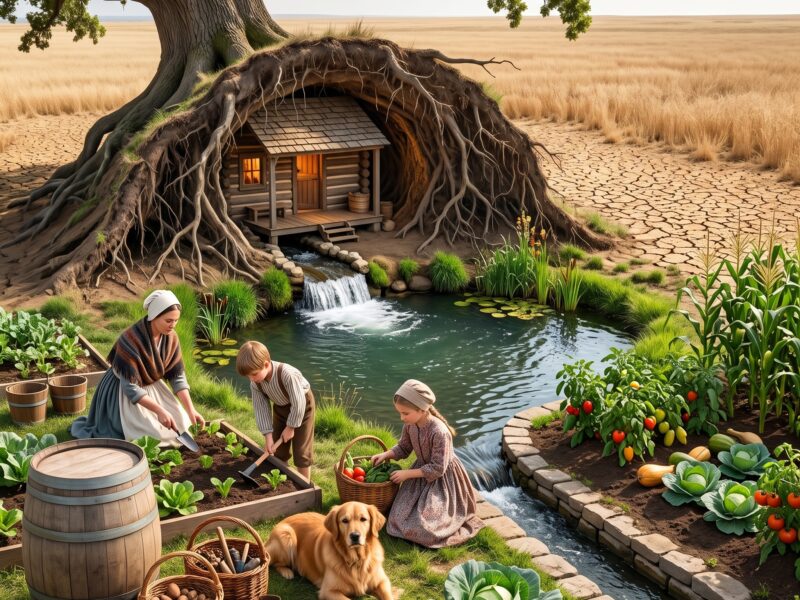
What she found was the oak. It lay on its side across the middle of her forty acres. A hundred and twenty feet of trunk and canopy stretched out on the wet grass like something ancient that had finally decided to lie down and rest. Its crown was still green, impossibly green, the leaves glistening with rain.
But where the roots had been—where that four-foot trunk had anchored itself into the Missouri earth for two centuries or more—there was something Florinda had never seen before.
A vertical wall of earth, fifteen feet tall and twelve feet wide and four feet thick. A curved shelf of tangled, dark roots holding packed Ozark clay and stone, ripped up out of the ground and turned to face the sky like the palm of a hand opened in offering. The root ball was massive, still holding together, still dense, still dark with the deep earth it had lived in.
And at its base, where the trunk had once met the ground, there was a crater. Four feet across, three feet deep.
And water was coming up out of it.
Clear water. Cold water. Water that rose through the broken earth in steady pulses like a heartbeat. Water that tasted, when Florinda knelt and cupped it in her palm and brought it to her lips, of limestone and pine needles and something older than her grandmother’s grandmother. Something that had been waiting down there in the dark for a very long time, held in place by the suffocating roots of a tree that had been drinking it for two hundred years.
And now the tree was down, and the water was free, and it was coming up to find the sun.
Florinda sat down in the wet grass beside the crater. She sat there a long time. The sun came over the ridge and hit the water, and the water threw light back at the sky like a mirror. Florinda sat in that light and did not move.
“Mama.” Nolan, standing in the doorway of the cabin, hair standing up, squinting. “Mama, the tree.” “I see it, baby.”
He came down the hill in bare feet, careful of the storm-broken branches, picking his way through the debris until he stood beside her. He looked at the massive root wall. He looked at the crater. He looked at the root wall again. His mouth was open.
“Mama. It looks like a house with no front.”
Florinda put her hand on top of his head. She could feel his pulse through his skull, quick and warm.
“That is because the front has not been built yet.”
It was nine o’clock in the morning before anyone rode past on the ridge road. Mr. Treadwell, the Mills Creek storekeeper. A round man with a red face who sweated through his collars even in winter, and who made it his business to know everyone else’s business because knowing things was a form of currency in a small town. Treadwell liked to think of himself as wealthy in information if nothing else.
He reined up when he saw the fallen oak and made a clicking sound with his tongue that was meant to convey sympathy but actually conveyed profound satisfaction. The satisfaction of a man who is glad that something bad has happened to someone else because it confirms his belief that the world operates on a system of inevitable decline, and the best you can do is watch from a safe distance.
“Ruin, Widow Crenshaw. Pure ruin. You should have taken Yarbrough’s offer yesterday, ma’am. He will not give you thirty now with this mess to clear.”
Florinda stood in a way that put the crater behind her skirts. Her dress was wide enough. The water was quiet enough. Treadwell could not see it.
“I will tell him when I see him.” “That will be tomorrow,” Treadwell said. “He is out collecting signatures all week. You have a blessed day now, Mrs. Crenshaw.” He clucked at his horse. “My condolences on the tree.”
He rode on.
Florinda waited until the sound of his hooves disappeared beyond the ridge. Then she turned and looked at Nolan. And for the first time in two years, she heard herself laugh.
It was not a long laugh. It was not a pretty laugh. It was a laugh that came from somewhere deep in her chest, from the exact same place the grief lived, and it surprised her the way a sneeze surprises you. Involuntary and sudden and impossible to take back.
Nolan stared at her. He had been bracing himself to see her cry. He had been standing with his shoulders already set in the posture of a boy who is about to comfort his broken mother. And instead, his mother was laughing, and he did not know what to do with his shoulders now.
“Go wake your sister. We have got work to do today.”









