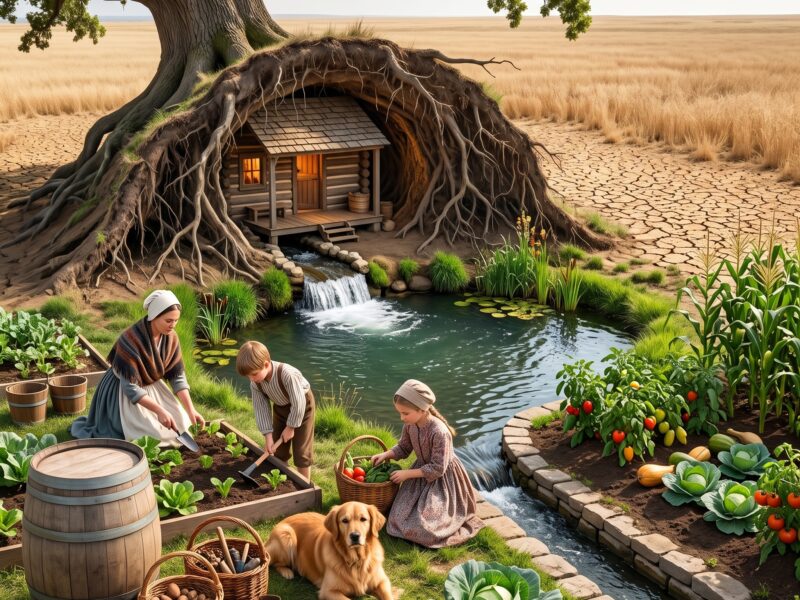
A Storm Knocked Down the Biggest Tree During the Worst Drought — What It Revealed Changed Everything
The Earth Opens
Yarbrough arrived the next morning a full hour earlier than the day before. The portfolio was the same. The silver pen was the same. His horse had been meticulously groomed. Florinda met him at the door with her hair combed and Opal on her hip.
“Thirty dollars stands, Mrs. Crenshaw. I can have this drawn up by supper.” “I need thirty days, Mr. Yarbrough.”
He took a breath. It was the breath a man takes before explaining something simple to a person he has decided is not capable of understanding complicated things. It was a breath that had patience in it the way a steel trap has patience. Quiet, mechanical, waiting for the foot to come down.
“Thirty days changes nothing, ma’am. This drought will not break before October. Your children will be thinner. Your cupboard will be empty. And my price drops to twenty-five on the first of September. I am offering thirty as a kindness today.”
“Thirty days.”
He looked past her, through the door, out to the hillside where the oak lay in its long green ruin. “You have not even cleared this mess. You think you can make a crop on a lot that has a hundred and twenty feet of timber lying across it?”
“Thirty days, Mr. Yarbrough.”
He studied her face. He looked at her the way a man looks at a hand of cards he cannot quite read, trying to decide whether the person across the table is bluffing or simply does not understand the game. He decided that thirty days of a widow alone on a ruined claim would do his dirty work for him. Thirty days of blistering heat and hunger and the slow, grinding arithmetic of poverty would bring her back to this door far more desperate than she was today. And desperation was Yarbrough’s inventory. It was the raw material of his business. The thing he bought cheap and sold dear.
He almost smiled. He nodded once.
“Thirty days. First of September, Mrs. Crenshaw. Not one hour more.”
His horse had not finished turning on the track before Florinda was on her knees on the cabin floor with Grandmother Ione’s notebook open across her lap, and Nolan and Opal crouched on either side of her like conspirators. Like the three of them were planning a bank robbery. Which, in a way, they were. Except what they were stealing was their own future from a man who had already counted it as his.
“Look here. Both of you, look.”
Florinda spread the notebook open on the floor beside a piece of charcoal and the back of an old flour sack. She drew as she spoke, sketching lines and measurements. The plan was coming out of her the way water comes out of a spring—from somewhere deep and pressurized and absolutely ready.
“The cabin will go inside the root cavity. The upturned root ball itself serving as the back wall. Oak planks from the fallen trunk for the sides. Fourteen by ten feet. A door facing south. A roof of cedar shakes. Then, following what Ione had written about Ozark springs, the stone basin. Then the channel, eighty feet down the natural slope. Then the garden. Thirty by forty. Corn, beans, squash, tomatoes.”
Her hands were not steady. She pressed her palm flat on the charcoal sketch and looked at both of them.
“This is going to take us thirty days. Maybe twenty-eight. We are not going to tell anyone what we are doing. Not the Pennywits, not Mr. Treadwell, not the reverend. Not a living soul until Mr. Yarbrough rides up that track on the first of September and finds us here.”
“Why not tell?” Opal asked.
“Because if people know, Mr. Yarbrough will know. And if Mr. Yarbrough knows, he will find a way to stop us. But if we look like nothing is happening… if we look like a widow and two children waiting to lose their home, he will leave us alone until the day we are ready. The secret is the only weapon we have, sugar.”
She laid out the plan. She explained it the way Grandmother Ione would have explained it. Clearly. Without decoration. The way you explain something to people whose lives depend on understanding it.
Nolan straightened his spine. “I can do it, Mama.” Opal nodded solemnly. “What is a foreman?” “A foreman is the person who keeps the grown-ups honest.”
Opal thought about this for a moment. Then she nodded again, harder this time, as if she had been waiting her whole five years for someone to give her this exact job.
Florinda closed the notebook. She pressed her palm on the leather cover the way Grandmother Ione used to press her palm on Florinda’s forehead to check for fever. A gesture that was both a measurement and a blessing. A way of saying: I am here, and I am paying attention, and I will not let you go through this alone.
“We start at first light.”
The first ten days reduced them to three things that could not be taken away: salt, sinew, and the particular kind of stubbornness that runs through women who have buried a husband and decided that the ground is not getting anyone else.
Day three. Florinda cleared the root cavity by hand, crouching inside the massive hollow. The upturned roots had left behind a space that smelled of deep earth and broken stone and centuries of darkness suddenly exposed to air. She shoveled clumps of clay and small rocks into a flour sack, dragged the sack out backward on her knees, emptied it downhill, and went back in. She filled the sack forty-one times. By sundown, her shoulders had gone past pain into a gray numbness that felt like her arms belonged to someone else, and that someone else was tired of lending them.
Her hands had opened in three places, the skin splitting along the lines where she gripped the rough shovel handle. The blood mixed with clay and dried into something that looked like rust on her palms.
Nolan brought her water. Opal brought her a piece of dry cornbread wrapped in a cloth. Neither of them asked her to stop. Neither of them said a word about the blood. They were learning something that children in hard country learn early, which is that there are times when the most loving thing you can do for a person is to pretend you do not see what it is costing them.
Day four, they framed the walls. Florinda cut fourteen oak posts from the fallen trunk’s smaller limbs using the long-handled handsaw that had been Ransom’s—the one with the walnut grip worn smooth by his right hand. Each post was eight feet tall and four inches across. Nolan held each one steady at the base while she sank it into the earth floor of the cavity and packed stones around the heel to keep it upright. The boy had to stand on an upturned flour sack to reach the top of the taller posts, stretching on his toes with his arms over his head, his whole body a single, quivering line of effort.
When they finished the last post, Florinda sat down on the ground and could not get up for ten minutes. Her legs would not answer. Her back had locked into a shape that did not include standing.
Nolan sat beside her. He did not speak. He did not offer help. He sat in the silence with her the way a man sits with another man after hard work. Not because there is nothing to say, but because the saying would diminish what they had just done together. He was eight years old, and he understood something about silence that most adults never learn: that some silences are not empty. Some silences are full. Some silences are the sound of two people trusting each other enough to be exhausted together without apology.
Day five was stone hauling. And stone hauling would go on for three blistering days.
The limestone of the Ozark hillside broke into flat slabs when you hit it right. Pieces the size of dinner plates and twice as heavy. And Florinda needed one hundred and twenty-seven of them. She counted them in her head as they carried them, because counting gave the brutal work a shape, and shape was the difference between labor and punishment.
The smallest was two pounds. The largest—the one she and Nolan carried together on a stretcher they made from a horse blanket and two oak poles—was fifteen. Nolan took the downhill end because he was shorter and the weight shifted brutally toward him on the slope. He carried it with his jaw set hard, and Florinda saw her dead husband in her son’s sweating face. She felt something move in her chest that was not grief and was not pride, but was some third thing that lived between them. Some alloy of the two that did not have a name.
On the morning of day six, Merritt Ogletree appeared at the cabin.
He was twenty-two, lean, with the corded forearms of a man who swung a heavy hammer for a living, which he did. He was the blacksmith at Mills Creek, or more accurately, he was the blacksmith’s successor, having bought the forge two years ago with money Ransom Crenshaw had lent him. Ransom had never asked for it back. Ransom had said the world needed more men who were good with their hands and fewer men who were good with paper. And he had meant it. When he died, the financial debt died with him as far as Merritt was concerned, but the moral obligation did not.
“Mrs. Crenshaw, I want to repay what I owe. I can pull timber, drive nails, haul anything that needs hauling. Whatever you need.”
Florinda looked at him. She looked at his strong arms and his earnest face and the sweat on his forehead from the walk up the hill, and she wanted to say yes the way a drowning person wants to say yes to a rope. Immediately and without reservation.
But she had spent the last five days building something in secret, and secrets only work when they are kept by the fewest possible number of people.
“If you come here often, Treadwell will ask why. And if Treadwell asks why, Yarbrough will know by supper.” “I could take the back way through the hollow. Nobody uses that trail.” “You are young, Merritt. You have not learned yet that in a small town, there is no trail that nobody uses.”
He stood there a moment, turning his hat in his massive hands. Then he reached into the canvas bag he had brought and set down a bundle wrapped in heavy burlap. A set of hand-forged nails. Each one straight as a pin, the iron still dark from the quench. He did not say anything about them. He just set them down, nodded, and walked back down the hill.
Florinda watched him go and thought about how the kindness of a stranger dresses simpler than you expect. No announcement. No ceremony. Just a bundle of nails on a doorstep and a young man walking away with his hat in his hands. And she thought about how refusing kindness hurts almost as much as never receiving it, because at least when kindness does not come, you are spared the agonizing act of pushing it away.
That afternoon, Nolan sat on a flat limestone slab too heavy for him to lift alone, wiping his filthy face with the back of his wrist. There was a nasty scrape on his cheek from a stone that had clipped him the day before. His hair was matted with dust. He looked at Florinda and asked the question he had been carrying for three days.
“Mama, why can’t we just ask the church?”
Florinda set down the stone she had been rolling and sat beside him on the slab. The limestone was baking warm from the sun. She could feel it through her skirt.
“The church already gave us a blanket, sugar. A blanket and some canned peaches after your papa’s funeral. And a hymn. And a promise they would be praying for us. And then the reverend went home and had his supper. So, they will not help. They already helped in the way they know how. And Reverend Gilstrap is a good man. But there is a kind of help that is a blanket, and there is a kind of help that is thirty days of back-breaking work. Churches are mostly built for the first kind.”
She touched the back of his hand. The skin was rough, already calloused at the base of each finger. The hands of a child who had been promoted to adulthood without anyone asking whether he wanted the job.
“Who are we asking then?” Nolan asked. “Your grandmother’s God. The one who told her to work her way through the Tennessee drought of ’42 and not look back. That is a harder God, baby.”
Nolan looked at her sideways. “A harder God?”
Florinda laughed. It was thin, but it was real, and it was different from the laugh on the hillside days ago. That one had come from surprise. This one came from recognition. The recognition that she was becoming her grandmother. That the exact same words were coming out of her mouth in the same order. That the line between inheritance and invention was thinner than she had ever understood.
“Yes. A harder God.”









