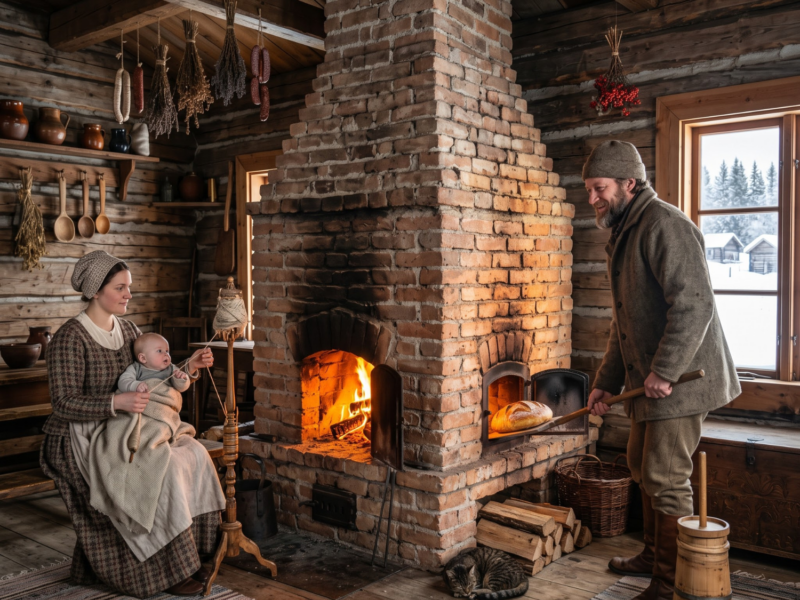
He Built a Central Stone Chimney — His Family Used Half the Firewood All Winter
He Built a Central Stone Chimney — His Family Used…
He Built a Central Stone Chimney — His Family Used Half the Firewood All Winter
Stearns County, Minnesota, in September of 1883, was a landscape holding its breath. The oak leaves were already beginning to curl at the edges, turning a bruised, rusty brown. The wind sweeping down from the Canadian border carried a metallic bite, a warning of what was coming.
While every carpenter, settler, and farmer in the territory built their chimneys against the exterior walls of their cabins—exactly where convention and common sense dictated they belonged—Alexi Kowalski was doing something that made his own wife question his sanity.
The forty-one-year-old Polish immigrant was constructing a massive, terrifyingly heavy brick chimney straight through the dead center of his cabin floor plan.
It sat like an unmovable monolith, blocking the natural flow of every room.
“You’re wasting two hundred dollars of brick on a monument to your own stubbornness,” his wife, Katarzyna, told him, her hands planted firmly on her hips, her accent thick with frustration.
Alexi paused, wiping mortar from his heavy, calloused hands. He looked at the base of his construction, then up at his wife. “I am building a heartbeat, Kasia. Without it, this house dies in January.”
The neighbors universally agreed with Katarzyna. The Polish community murmured at Sunday mass. The German farmers at the feed store shook their heads. But Alexi Kowalski had spent his first terrible winter in America watching families burn through their entire winter woodpile by January, only to freeze to death in their beds by February. He was not going to let that happen to his family.
Alexi had arrived in Minnesota in the autumn of 1879, part of the great wave of Polish immigrants fleeing crushing poverty and the looming threat of Russian conscription in the old country. He left behind a small village near Kraków, a place where winters ruthlessly culled the weak, and where fuel was so desperately precious that families burned dried cattle manure when the wood ran short.
In Poland, Alexi had worked as a master mason’s apprentice. He had learned to lay brick and stone in buildings designed not just to stand, but to fight the cold—structures built to trap and hoard every possible calorie of heat.
America had promised land, freedom, and boundless opportunity. What it actually delivered, at least in the brutal, flat expanse of central Minnesota, was a cold that made Polish winters feel like a mild spring by comparison.
During his first January in Stearns County, the temperature dropped to thirty-five degrees below zero. It stayed below zero for nineteen consecutive, agonizing days.
Alexi spent that winter huddled in a shared, drafty boarding house in St. Cloud. He watched American-born settlers burn through cord after cord of split hardwood at a rate that would have horrified his frugal father. They fed their roaring fireplaces constantly, yet they still shivered.
The problem, Alexi quickly realized, wasn’t the cold itself. The problem was the American architecture.
American frontier cabins were built for speed, not efficiency. Settlers threw up timber structures in a matter of weeks, anxious to establish their claims and break the ground for crops before the freeze. Chimneys went against exterior walls because that’s where they were easiest and cheapest to build. There was no need to cut a dangerous hole through the center roof beams, and no need to sacrifice precious interior floor space.
The fireplace or cast-iron stove sat in a corner, radiating heat forward into the room, while a staggering fifty percent of its thermal energy escaped directly backward, through the thin exterior wall, into the freezing wilderness.
Alexi had seen better in Poland.
The oldest, warmest farmhouses in his village had been built by German settlers centuries earlier, and they all shared one defining, immovable feature: The Piec.
A massive, central masonry stove that sat in the very center of the house. The piec wasn’t just a heat source; it was a colossal thermal battery.
Families would fire the piec intensely for two or three hours in the early morning, letting the hardwood burn down to glowing coals, and then they would let the flames completely die. The massive brick structure, sometimes weighing over three tons, would absorb that violent, explosive heat into its core. Then, it would release that captured energy slowly, gently radiating warmth into the house for the next twelve to sixteen hours.
One furious firing per day. That was all a well-built piec required to conquer a blizzard.
In Minnesota, Alexi watched families fire their iron stoves continuously from October to April. They woke in the freezing, pitch-black night to feed dying flames. They cut, hauled, split, and stacked wood until their hands bled and their backs gave out. And still, their cabins turned frigid within two hours of the fire dying down, the cold radiating relentlessly through thin timber walls and poorly placed chimneys that sent more precious heat outside to the snow than they kept indoors.
Alexi had sworn he would never build an American house.
Related Articles

They Mocked the Widow’s Dirt Cellar—Then the Freeze Left Every Cabin Cold but Hers Warm
They Mocked the Widow’s Dirt Cellar—Then the Freeze Left Every Cabin Cold but Hers Warm…

A Homeless Veteran and His German Shepherd Inherited a Ridge No One Wanted — 35 Feet In, They Found
Chapter 1 / 7 A Homeless Veteran and His German Shepherd Inherit… A Homeless Veteran…

Neighbors Laughed When He Built A Cabin Inside An Old Barn—Until It Kept His Home 35 Degrees Warmer
Chapter 1 / 8 Neighbors Laughed When He Built A Cabin Inside An… Neighbors Laughed…

His Sod House Had No Woodpile in January – Until the Trains Stopped and the Town Came Begging
Chapter 1 / 10 His Sod House Had No Woodpile in January – Until t……

She Built Her Cabin Over the Woodshed and Never Burned Wet Wood Again
Chapter 1 / 8 She Built Her Cabin Over the Woodshed and Never Bu… She…

The Duke Abandoned Her on Their Wedding Day—Years Later, He Discovered What He Had Lost
Chapter 1 / 7 The Duke Abandoned Her on Their Wedding Day—Years… The Duke Abandoned…

He Wedged a Tiny A Frame Into a Crevice Before Winter and His Family Slept at 75°F While Town Hit
Chapter 1 / 7 He Wedged a Tiny A Frame Into a Crevice Before Win……

He Was Too Old to Ride—So He Bought the Ruined Ranch and Found the Room Behind the Fireplac
Chapter 1 / 5 He Was Too Old to Ride—So He Bought the Ruined Ran……

Settlers Laughed at His Underground Heat Recovery Duct — Until It Kept His Cabin 71°F Warmer
Chapter 1 / 9 Settlers Laughed at His Underground Heat Recovery… Settlers Laughed at His…

A Navy SEAL Built a Home Inside a Mountain—Then His Dog Warned Him Before the Storm
Chapter 1 / 5 A Navy SEAL Built a Home Inside a Mountain—Then Hi… A…