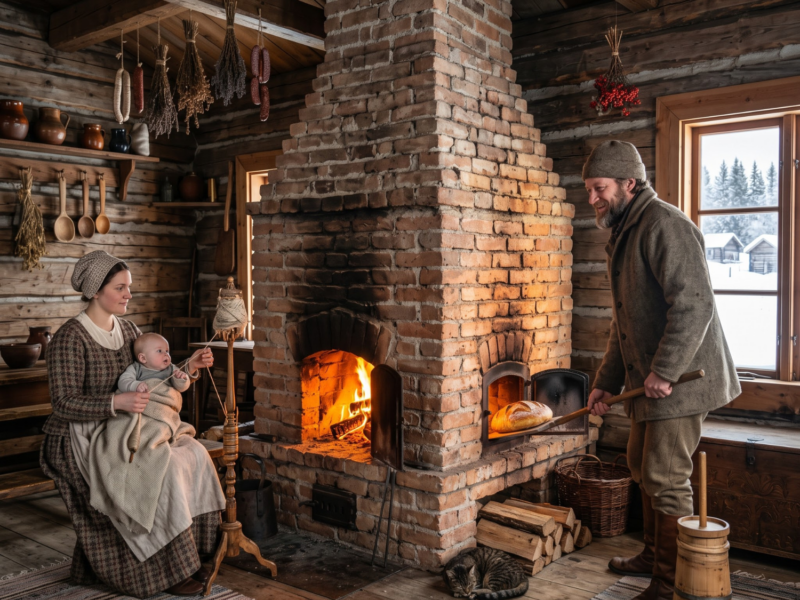
He Built a Central Stone Chimney — His Family Used Half the Firewood All Winter
The Deep Freeze
December 1883 arrived with a ferocity that veteran settlers said they hadn’t seen in a decade.
The temperature dropped below zero on December 3rd and did not rise above it for the next seventeen days. By Christmas Eve, the mercury had plunged to a staggering minus twenty-eight degrees, driven by shrieking winds that made exposed skin burn and blacken within minutes.
Across Stearns County, families entered a desperate survival mode.
The Hendricks family to the north burned through their first entire cord of wood in just nine days—a terrifying rate that would exhaust their supply well before March. Panic set in. They began severe rationing, letting interior temperatures drop into the low forties overnight. The parents took turns waking at 3:00 AM, stumbling through the freezing dark to rebuild fires that had died to embers.
Their cabin, with its standard exterior chimney pressed against the north timber wall, lost heat so rapidly that thick white frost formed on the interior walls and water buckets within two hours of the fire dying.
Wilhelm Brandt fared slightly better. His cabin was exceptionally well-built, and his chimney was properly maintained. But even he burned through his woodpile at an alarming pace—nearly half a cord per week. Despite roaring fires, interior temperatures still dipped into the upper thirties by dawn. His wife slept in thick wool stockings and a fur cap. His children shared beds for survival, huddled three to a mattress to share body heat.
The general store in Cold Spring became a clearinghouse for desperate, grim news. A family named Olsen, ten miles west, had abandoned their homestead entirely, fleeing to St. Cloud to crowd in with relatives to avoid freezing. Two bachelor farmers were found frozen solid in their cabin on December 19th. Their woodpile was completely exhausted, their firebox full of cold, gray ash.
The county sheriff organized emergency wood-sharing arrangements for the most desperate families, but supplies were limited, and the deep snowdrifts made delivery nearly impossible and highly dangerous.
No one thought to check on the Kowalskis.
Everyone assumed they knew exactly what they’d find if they rode out there. A freezing cabin. A depleted, empty woodpile. A stubborn Polish immigrant, finally ready to admit he’d been a fool. Some privately, grimly expected worse.
On December 27th, as the temperature hovered at minus twenty, Wilhelm Brandt decided he could not bear the guilt. He saddled his toughest horse to ride over.
Christian duty demands it, he told himself, wrapping his face in thick wool. If the family was suffering, he would bring them back to his own home, crowd them in somehow. If they had already frozen, at least he could arrange a proper burial before the ground hardened completely.
The ride took forty agonizing minutes through chest-deep snow and cutting wind. Brandt arrived at the Kowalski homestead expecting a tomb.
Instead, he saw a thin, lazy ribbon of white smoke rising from the chimney. Not the thick, frantic, billowing plume of a desperate fire, but a slow, steady exhaust.
More shockingly, the small woodpile behind the cabin appeared barely touched.
Brandt dismounted, his joints screaming from the cold, and approached the heavy oak door. He knocked, aggressively stamping his freezing feet against the porch boards.
Alexi Kowalski opened the door.
He was wearing a light cotton shirt with the sleeves rolled up.
Brandt stared at him. The wall of warmth that rolled out of the open cabin door hit the freezing German farmer like a physical force. It wasn’t the searing, localized blast of a roaring, open fire. It was a deep, pervasive, even heat that seemed to emanate from the very air itself.
He looked past Alexi into the living space. Katarzyna was kneeling on the floor, playing with their infant daughter, born in late October. Both mother and child were dressed in light cotton dresses.
“Wilhelm,” Alexi said pleasantly, a genuine smile on his face. “Come in. Warm yourself.”
Brandt stepped inside and stopped dead in his tracks.
The massive brick chimney dominated the center of the room, exactly as he remembered. But it wasn’t the visual presence that struck him; it was the intense, radiant heat pouring from its surface.
Brandt pulled off his heavy leather gloves and placed his bare hand directly onto the whitewashed brick. It was warm—almost hot—like sunbaked stone in the middle of a July afternoon.
“Your fire,” Brandt managed to say, his voice cracking. “How much are you burning?”
Alexi chuckled and gestured toward the firebox.
Brandt leaned over. Inside, a modest, low flame consumed two small oak logs. It was a fire that wouldn’t have heated Brandt’s own cabin above fifty degrees.
“I build it up in the morning,” Alexi explained, offering Brandt a chair. “Burn hard for maybe two hours, making it as hot as I can. Then, I close the damper and let the fire completely die. The bricks do the rest.”
Brandt looked at the massive chimney, at the comfortable, smiling family, and at Alexi’s bare forearms.
“Show me,” Brandt whispered quietly. “Show me everything.”









