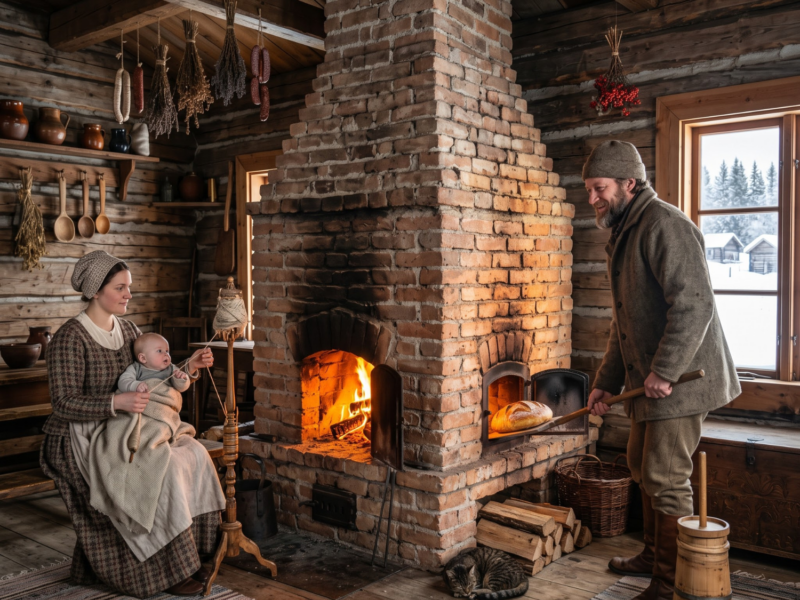
He Built a Central Stone Chimney — His Family Used Half the Firewood All Winter
The Stubborn Foundation
By the spring of 1883, Alexi had saved enough from backbreaking railroad labor to buy forty acres of heavily wooded land near the settlement of Cold Spring. He had also married Katarzyna Nowak, a fiery Polish woman ten years his junior who had grown up on a tough farm outside Poznań.
Together, they planned to build a proper homestead. Not the hasty, drafty American construction Alexi had come to despise, but something that would outlast them. Something that would keep them safe without consuming every waking hour in firewood preparation.
The land had thick oak timber for walls and, crucially, dense clay soil along the creek suitable for brickmaking. Their nearest neighbor, a stern German wheat farmer named Wilhelm Brandt, lived half a mile east. Brandt had already ridden over twice to offer unsolicited advice on local building practices.
“Put your chimney on the north wall, Kowalski,” Brandt had told him, pointing a thick, calloused finger at the timber foundation. “It blocks the prevailing wind. Everyone does it that way. Don’t try to reinvent the wheel.”
Alexi had nodded politely, smiled, and said absolutely nothing.
He had no intention of building his chimney against the north wall, or any wall. He was going to build it exactly where his grandfather would have built it: in the dead center of the house, where every single brick could earn its keep.
Katarzyna supported him in most things. She had followed him across a terrifying ocean, after all. But when he sketched his chimney plan in the dirt, she stared at him as if he had proposed building the cabin upside down.
“The center?” she repeated, her voice rising in pitch. “Alexi, that’s madness.”
The argument lasted three days. Katarzyna wasn’t a woman who surrendered easily, and she had highly practical, entirely reasonable concerns that Alexi couldn’t simply wave away.
“A chimney in the center means every room flows awkwardly around it,” she said, jabbing the stick into his dirt floor plan. “The kitchen, our bedroom, the main room—all of them will be cramped and crooked. And what about my furniture? Where do I put a proper dining table when there is a brick tower in the middle of everything?”
Alexi tried, patiently, to explain the thermal logic. A chimney against an exterior wall lost half its heat directly to the outside. The bricks warmed, yes, but they warmed the winter air and the snowdrifts just as much as the interior rooms. A central chimney radiated in all directions. Every face of the brick gave heat to living space. Not a single degree of warmth was wasted on walls that faced the deadly cold.
“Your grandmother’s house in Poznań,” he reminded her, holding her hands. “The piec sat in the center. You told me yourself how warm it stayed in January.”
“My grandmother’s house was built by her great-grandfather, piece by piece over decades!” Katarzyna shot back, pulling her hands away. “We don’t have a hundred years to get this right. We have one winter, Alexi. One chance. If this fails, we freeze.”
Word of the marital disagreement reached Wilhelm Brandt, who rode over on the third day under the thin pretense of returning a borrowed crosscut saw. He found Alexi laying the foundation for his chimney—a massive, six-foot square of mortared river stone positioned exactly in the center of the planned 24-by-18-foot structure.
Brandt watched in silence for several minutes before speaking.
“Kowalski. What in God’s name are you doing?”
Alexi explained. The central mass. The radiant heat. The efficiency of the Polish piec, adapted for brutal Minnesota conditions.
Brandt listened with the weary, strained patience of a man who had heard immigrant foolishness before and seen where it ended.
“I’ve been farming this county for eleven years,” Brandt said when Alexi finally finished. “I’ve seen men try clever, European ideas. Most of them end up burning their own furniture by February just to keep their children alive.”
Brandt gestured at the massive stone foundation. “You’re going to spend two hundred dollars on brick, block the center of your home, and make your wife miserable. For what? A theory from the old country that may not work with our timber?”
“It is not a theory, Wilhelm,” Alexi replied quietly, setting another heavy stone into the mortar. “It is physics.”
“Physics won’t keep your wife warm when she’s tripping over a chimney to cook your dinner,” Brandt said, gathering his horse’s reins. “I like you, Kowalski. You work hard. But you’re making a catastrophic mistake, and your wife knows it, even if your pride won’t let you see it.”
That evening, inside the canvas wall-tent they had been living in since arriving on the property, Katarzyna gave Alexi an ultimatum.
“Build the chimney my way, against the north wall like everyone else,” she said, her arms crossed tight over her chest. “Or build it your way, and you can sleep beside it alone.”
Alexi sat on his cot and considered her words carefully. He understood her terror. They had desperately limited resources, one chance to get the construction right, and a Minnesota winter looming that showed absolutely no mercy to mistakes. If his central chimney failed, they could lose everything.
But he had spent four years watching American settlers do things the fast, easy way and suffer horrific consequences for it. He’d seen families abandon their homesteads and flee back east because they physically couldn’t cut wood fast enough to survive the freeze. He’d seen children with blackened, frostbitten fingers. He’d heard of old men found dead in their beds, their breath frozen to their blankets. He’d seen women weeping over firewood piles that wouldn’t last until spring.
The American way was the fast way. It was not the right way. And Alexi Kowalski hadn’t crossed a lethal ocean just to repeat other men’s fatal mistakes.
“I will sleep beside the chimney alone if I must, Kasia,” Alexi told her, his voice quiet but carrying the immovable weight of a mountain. “But by January, you will be sleeping there, too. Because it will be the warmest place in Minnesota.”
Katarzyna threw a wooden cooking spoon at his head and stormed out of the tent into the dark.
Alexi rubbed his forehead, walked out into the moonlight, returned to his foundation, and kept laying stone.









