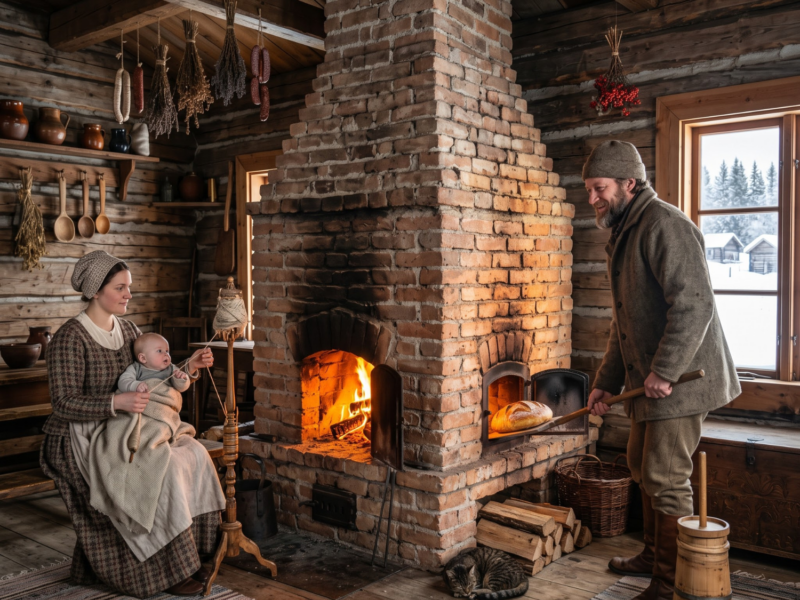
He Built a Central Stone Chimney — His Family Used Half the Firewood All Winter
The Physics of Clay and Fire
What Alexi Kowalski understood from years of hands-on masonry work, modern thermodynamic engineers would later quantify with exact, mathematical precision. But the principles he was applying had been proven through centuries of grueling Eastern European winters, long before anyone calculated the numbers.
The absolute key to survival was thermal mass—the ability of dense, heavy materials to absorb, store, and slowly release heat energy.
Every physical substance has a specific heat capacity: a measure of how much energy it takes to raise its temperature. Fired clay brick has a specific heat capacity of approximately 0.2 British Thermal Units (BTUs) per pound, per degree Fahrenheit. That sounds incredibly modest, until you calculate the sheer, staggering weight involved in Alexi’s plan.
Alexi’s central chimney would contain roughly 2,400 pounds of solid brick.
Heat that enormous mass from a resting 70 degrees up to 150 degrees—a highly reasonable temperature for bricks surrounding an active, roaring flue—and you have successfully stored approximately 38,400 BTUs of raw thermal energy. That is the heat equivalent of burning about five solid pounds of bone-dry oak.
But here is where the magic of the piec happens: unlike an open fire that releases all its blistering heat in an intense, localized burst and then immediately dies, brick releases its stored energy agonizingly slowly. It radiates a gentle, pervasive warmth into the room for hours after the flames have gone completely out.
The rate of heat release depends entirely on the temperature differential between the hot brick surface and the surrounding air. A chimney sitting at 150 degrees in a cabin room at 65 degrees will radiate approximately fifteen to twenty BTUs per square foot, per hour.
Alexi’s central chimney—with four faces completely exposed to the interior rooms, totaling roughly two hundred square feet of surface area—would emit between three and four thousand BTUs per hour. This was enough to meaningfully, comfortably warm a modest timber cabin, even with absolutely no active fire burning in the hearth.
But location mattered just as much as mass. This was the critical, fatal oversight that American frontier builders missed.
A chimney built against an exterior wall has only three faces radiating heat into the living space. The fourth face—often the largest, since it contains the back of the firebox opening—presses directly against the exterior timber wall, transferring massive amounts of heat into the logs that then conduct it outside.
In extreme, sub-zero cold, that exterior wall might be eighty or ninety degrees colder than the interior. This massive temperature gradient creates a powerful, relentless thermal draw, physically pulling the heat out through the brick and dumping it into the freezing wilderness beyond.
A central chimney eliminates this catastrophic waste entirely.
All four faces radiate inward. Not a single surface touches an exterior wall. Every single BTU stored in the 2,400-pound brick mass eventually reaches the living space. The efficiency improvement isn’t marginal; it is entirely transformative. A central chimney delivers thirty to forty percent more usable heat than an identical chimney built against an outside wall.
There was another subtle architectural advantage Alexi understood intuitively. The massive chimney would naturally divide his cabin into thermally zoned spaces. The kitchen, where Katarzyna’s cooking would generate additional, supplementary heat, would share one face. The bedroom would share another, keeping them warm while they slept. The main living area would benefit from the remaining two faces. Each room would receive radiant warmth without requiring multiple, dangerous separate heating sources.
The internal flue design mattered, too. American chimneys typically ran straight up—a vertical pipe offering the absolute shortest path from the firebox to the roofline.
Alexi planned a much more circuitous, cunning route.
His flue would rise from the firebox, then sharply turn horizontally, winding back and forth through the dense brick mass for several feet, before finally turning upward to exit the roof. This serpentine path forced the violently hot exhaust gases to travel further, transferring exponentially more of their heat into the surrounding brick before finally escaping to the sky.
The smoke that eventually left his chimney top would be noticeably cooler than smoke from a standard, straight American flue. Cooler, because all its thermal energy had been captured and kept inside the house.
His neighbors would see a giant brick column blocking the center of a small cabin. Alexi saw a massive thermal battery. A battery that would charge rapidly during short morning fires, and discharge life-saving heat for fourteen hours afterward.
He saw a system that would let his future children sleep through bitter blizzards without waking up freezing. He saw an efficiency that would cut their grueling firewood consumption by half or more.
Katarzyna saw an obstacle in her kitchen. But winter would teach her what the bricks already knew.









