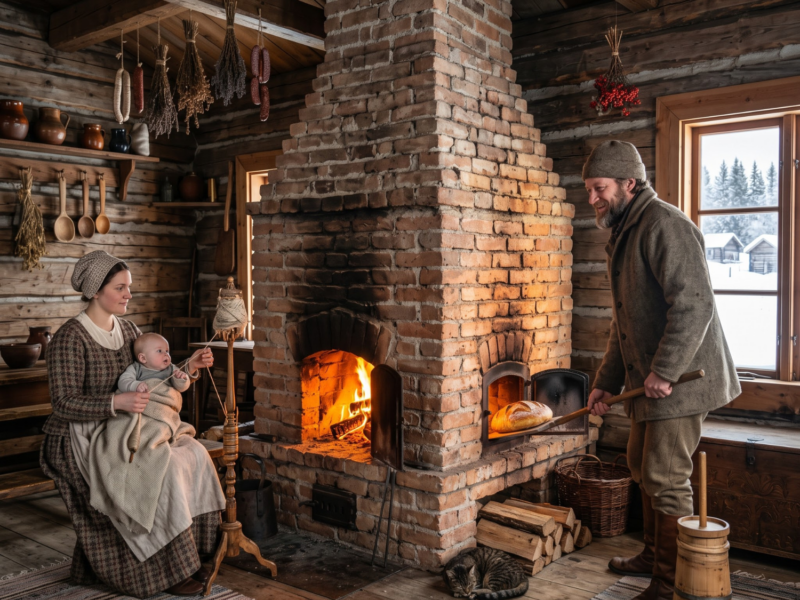
He Built a Central Stone Chimney — His Family Used Half the Firewood All Winter
Blood and Clay
The actual brickmaking began in June, beneath a punishing summer sun.
Alexi had located a rich deposit of suitable clay along the winding creek bank on his property. It was dense, red earth that held its shape perfectly when wet and promised to harden like iron when fired.
He dug and processed raw clay by hand for three grueling weeks. He hauled heavy buckets of water from the creek, mixing it with the clay and fine sand to achieve the exact right consistency, then pressed the heavy, wet mixture into wooden block molds he had built himself.
Each brick required individual, meticulous attention. If the mixture was too wet, the brick would warp and crack during the drying phase. Too dry, and it would crumble into dust during firing.
Alexi made over 1,800 bricks that summer. He laid them in long, precise rows to dry in the sun, turning them carefully by hand daily, ruthlessly discarding any that showed the slightest hairline weakness. His hands, his clothes, and his face stayed stained a deep, rusty red from June through August.
The firing happened in a temporary, beehive kiln he constructed from the first batch of sun-dried bricks.
He burned seasoned oak inside the kiln for three days and three nights straight, rarely sleeping, maintaining temperatures high enough to chemically transform the soft clay into hardened ceramic. The process consumed nearly a full cord of precious wood—an investment that severely bothered Katarzyna, until Alexi reminded her that properly fired brick would outlast their grandchildren.
By early September, he had enough high-quality brick to begin vertical construction.
The cabin walls went up first—heavy, hand-hewn oak logs from timber he’d felled and squared during the spring. The structure measured twenty-four feet by eighteen feet. It was modest, but sufficient for two people with hopes for children.
He deliberately left a massive, six-foot square opening in the center of the heavy timber floor plan.
Now, Alexi began the vertical construction, laying the bricks in careful, mortared courses. He built the firebox first. The opening faced the kitchen area, exactly where Katarzyna would cook. He specifically angled the interior firebrick walls to reflect heat outward into the room, rather than letting it absorb uselessly into the back of the firebox.
The serpentine flue design required the precision of a watchmaker. Alexi constructed the horizontal smoke channel that wound through the brick mass before turning upward—a twisting path roughly twelve feet long, contained within a structure that rose only eight feet to the ceiling. Sheet metal baffles, purchased at considerable expense from a hardware store in St. Cloud, directed the smoke flow and prevented deadly backdrafts.
Katarzyna watched the massive chimney rise, and said nothing.
The brick column dominated the interior space exactly as she had predicted. Walking from the kitchen to the bedroom required a deliberate circle around it. The main living area felt undeniably smaller with the massive structure occupying its center.
But as the weeks passed, she noticed something else.
As September nights grew crisp and cool, even without a single fire lit in the hearth, the massive chimney bricks held warmth from the afternoon sun that streamed through the south-facing windows. She placed her hand on the surface one chilly evening and felt a gentle, stored heat radiating into her palm.
“It’s warm,” she admitted quietly.
“It will be warmer,” Alexi promised.
The exterior log walls were chinked with clay and dried moss—standard practice for the region. The roof went on in late September, hand-split oak shingles over sturdy rafters. A single, heavy timber door faced south, with small glass windows on the east and west walls.
From the outside, the cabin looked perfectly ordinary, indistinguishable from any other poor immigrant’s homestead in Stearns County.
Inside, it was a revolution.
The brick chimney rose from floor to ceiling, a commanding, monolithic presence impossible to ignore. Alexi had plastered the exterior brick surfaces perfectly smooth and whitewashed them to increase heat reflection and brighten the room. The firebox opening gaped dark and ready, surrounded by a simple, elegant wooden mantle Katarzyna had reluctantly helped him sand and stain.
The total cost for the central chimney was two hundred and fourteen dollars in materials, plus four months of agonizing physical labor. Their American neighbors had built comparable cabins with standard exterior chimneys for half the price, in half the time.
Wilhelm Brandt rode his horse by in early October, saw the finished structure, and shook his head in grim disbelief.
“I hope you cut enough firewood, Kowalski,” Brandt warned, looking at the small stack behind the house. “You’re going to need it to heat that monstrosity.”
Alexi smiled, and said nothing.









