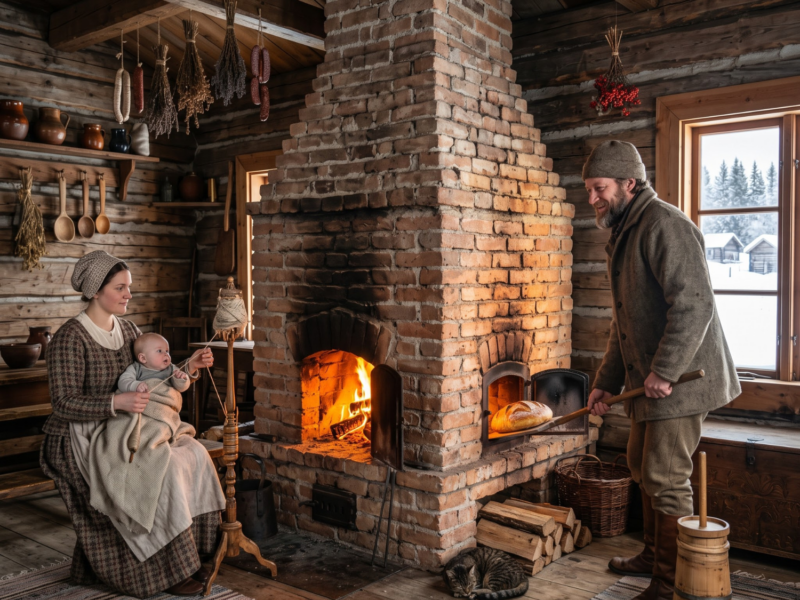
He Built a Central Stone Chimney — His Family Used Half the Firewood All Winter
The Woodpile of Folly
By late October, the Kowalski woodpile had become a source of genuine, panicked alarm among the neighbors.
Wilhelm Brandt mentioned it to the other German farmers at the feed store in Cold Spring. A family named Hendricks—Scandinavians who had homesteaded a mile north—rode their wagon past specifically just to count the cords stacked behind Alexi’s cabin.
“Three cords,” Mrs. Hendricks reported to her husband that evening over supper. “Maybe three and a half, for an entire Minnesota winter. They’ll be burning their bedframe by Christmas.”
The conventional frontier wisdom was clear, tested by death, and unanimous: a family needed six to eight cords of seasoned hardwood to survive a Stearns County winter. Many burned ten.
The Kowalskis had prepared less than half the absolute minimum, and the husband had wasted his summer and two hundred dollars on a chimney that blocked half his living space.
Katarzyna heard the harsh whispers at Sunday mass. The Polish community in Cold Spring was small but tight-knit, and news traveled with terrifying speed through kitchen conversations and after-church gatherings.
Women she barely knew offered her hushed, sympathetic advice about stretching firewood. Burn only at night. Wear three layers of wool indoors. Keep your children in bed during the coldest hours. Don’t waste heat boiling water.
“Your husband means well, Kasia,” one older woman told her in Polish, gripping her arm tightly. “Men get ideas. But you should prepare for the worst. Do you have family in Chicago who could take you in if things get desperate?”
The question stung fiercely, because Katarzyna had secretly wondered the exact same thing.
She had watched Alexi haul only small loads of wood from the timberline, while other men in the valley spent entire, grueling weeks doing nothing but cutting, hauling, and splitting. She had seen him politely refuse offers of help, insisting with a maddening smile that three and a half cords would be perfectly sufficient. His confidence felt like blind arrogance, and arrogance in a Minnesota winter was a death sentence.
Wilhelm Brandt, unable to bear the thought of a freezing family, confronted Alexi directly in early November, catching him at the general store loading supplies.
“Kowalski, I’m going to speak plainly because I don’t want your death on my conscience,” Brandt said, his voice loud enough for the other men in the store to hear. “You have half the wood you need. Your chimney is in the wrong place. And your wife is going to suffer for your stubbornness.”
“My wife will be warm,” Alexi replied calmly, tying off a sack of flour.
“Your wife will be a widow if you don’t cut more wood!” Brandt stepped closer, his face flushed. “I am offering you ten days of my labor. My sons and I will come to your property. We will help you fell and split enough oak to get through March. No charge. Consider it Christian charity.”
“I deeply appreciate the offer, Wilhelm. But it is not necessary.”
Brandt stared at him, aghast. “Pride is a terrible sin, Kowalski. So is waste.”
Alexi gathered his purchases and hoisted them into his wagon. “Come visit my home in January, Wilhelm. See for yourself how the chimney performs. If I am wrong, and my house is cold, I will humbly accept your help then.”
“In January, the wood in the forest will be buried under four feet of snow!” Brandt shouted.
“Then I will dig,” Alexi said calmly.
Brandt turned to the other men in the store, throwing his hands up in sheer exasperation. “You heard him! I tried. When his family freezes, I want you all to remember that I tried to save them.”
That Sunday, Father Novak mentioned the Kowalskis obliquely in his homily, speaking loudly from the pulpit about the virtue of humility, the sin of pride, and the profound dangers of refusing help from neighbors who wished only good.
Katarzyna sat rigid in the pew, her face burning with humiliation, while Alexi listened with apparent, immovable calm. After mass, not a single family approached them to shake hands.
The Kowalskis walked to their wagon in absolute silence, climbed aboard, and rode home through a bitter November wind that carried the first, stinging promise of snow.
That night, as the temperature plummeted outside, Alexi built the very first fire of the season in his central chimney.
Katarzyna sat on the edge of the bed and watched the flames catch. She watched the smoke rise and disappear cleanly into the serpentine flue. Slowly, inevitably, she felt the massive brick wall beside her begin to warm.
Neither of them spoke. The chimney would have to speak for itself.









