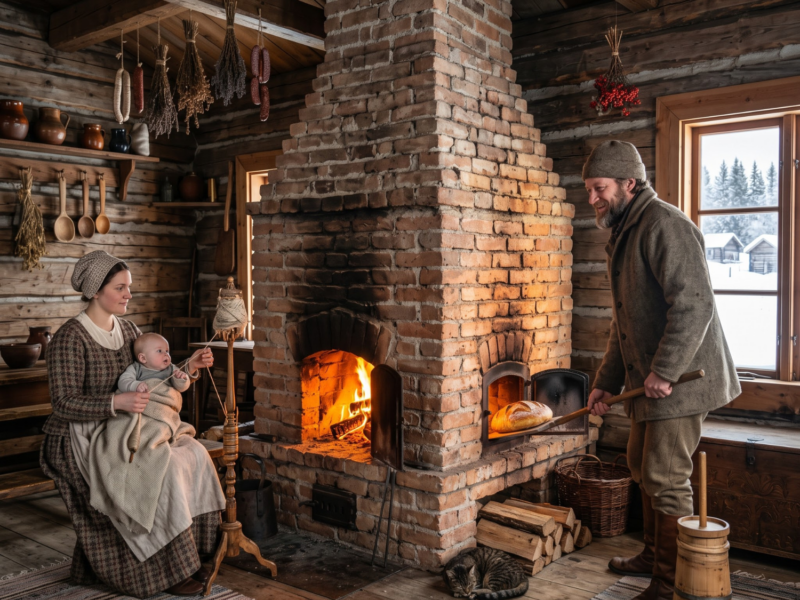
He Built a Central Stone Chimney — His Family Used Half the Firewood All Winter
The Legacy of Mass
Alexi Kowalski lived another forty-one years on that Minnesota homestead.
He died in 1924, a wealthy and deeply respected patriarch, surrounded by children and grandchildren who had all grown up in the profound, steady warmth of his central chimney.
The original timber cabin stood until 1956, when Alexi’s grandson finally decided to replace it with a modern, sprawling farmhouse. Before the demolition crew arrived, the grandson photographed the central chimney from every conceivable angle.
The 2,400 pounds of brick were still perfectly solid, still beautifully functional, and still warming the house seventy-three years after Alexi had laid the first course of mortar while the whole town called him a madman.
The brutal winter of 1883 to 1884 killed seventeen people in Stearns County alone. Dozens more suffered severe frostbite, lost fingers and toes to gangrene, or completely abandoned homesteads they simply couldn’t afford the physical labor to heat.
The Kowalskis burned less than two cords of wood, and never once let their interior temperature drop below fifty-five degrees.
The difference was 2,400 pounds of brick, placed in the exact right location.
By 1890, central masonry chimneys had become entirely common throughout the Polish, German, and Scandinavian communities of central Minnesota. Alexi helped build or supervise fourteen of them personally, refusing payment for every single one. His sons learned the technique and taught it to their neighbors.
The knowledge spread organically. It moved from family to family, community to community, until the “Kowalski Method” became simply the way things were done by smart men on the prairie.
The principle Alexi understood—thermal mass positioned centrally to maximize radiant efficiency—appears in indigenous and traditional heating systems worldwide. The Russian Pechka, the Austrian Kachelofen, the Finnish contraflow fireplace; they are all brilliant variations on the exact same thermodynamic theme.
Store explosive heat in incredibly dense material. Position that material to radiate inward. Let physics do the grueling, exhausting work that endless piles of firewood couldn’t.
Modern heating engineers now call it radiant mass heating. The mathematics have been refined by supercomputers. The materials have been optimized with refractory concrete. But the core insight remains utterly unchanged.
A pound of brick heated to 150 degrees will release its stored energy slowly over hours. Position enough brick in the center of a living space, and you have built a massive thermal battery that charges with morning fires and discharges life-saving heat through the coldest nights.
What Alexi knew, what his grandfather knew, and what generations of Eastern European builders knew, was that efficiency matters more than intensity.
His American neighbors built roaring, terrifyingly hot fires that consumed entire logs in an hour, blasting blistering heat into rooms that lost it almost as quickly through thin walls and poorly positioned exterior chimneys.
Alexi built modest, contained, highly efficient fires that transferred their energy deep into brick, and then let the brick do the slow, patient work of keeping his family alive.
The lesson extends far beyond chimneys and firewood.
Every system has losses. Every design choice either minimizes or maximizes those losses. The American settlers who built chimneys against exterior walls weren’t stupid; they were simply optimizing for speed and simplicity in a rush to claim land.
But optimization for one variable almost always means the sacrifice of another. They saved a week in construction time, and they paid for it every single winter in grueling labor, frozen limbs, and suffering.
Alexi optimized for efficiency. He spent four agonizing months making bricks by hand in the mud. He spent two hundred dollars on materials he could barely afford. He spent countless hours on complex construction that his neighbors bypassed in days.
But his investment paid dividends for seventy-three years.
His grandchildren slept warm. His great-grandchildren inherited a sprawling homestead that had never once run short of firewood.
Some knowledge survives in printed books and university engineering manuals. Other knowledge survives because someone stubborn enough to trust the old ways refuses to let it die, even when his own wife calls him mad, and his neighbors wait for him to freeze.
Katarzyna outlived Alexi by six years.
She spent her final, quiet winters in the cabin they had built together, kept warm by the massive chimney she had once called an ugly monument to stubbornness.
After she passed away peacefully in her sleep, her children went through her belongings. Tucked into the front cover of the heavy family Bible, they found a small note written in her careful, elegant Polish script.
He was right about the chimney. He was right about most things. I should have told him more often.
The bricks, of course, didn’t care about apologies, or mockery, or pride. They just held the heat. Steady, silent, and infinitely patient. Just the way they had done for seven decades, and the way they would keep doing, until someone finally tore them down.









