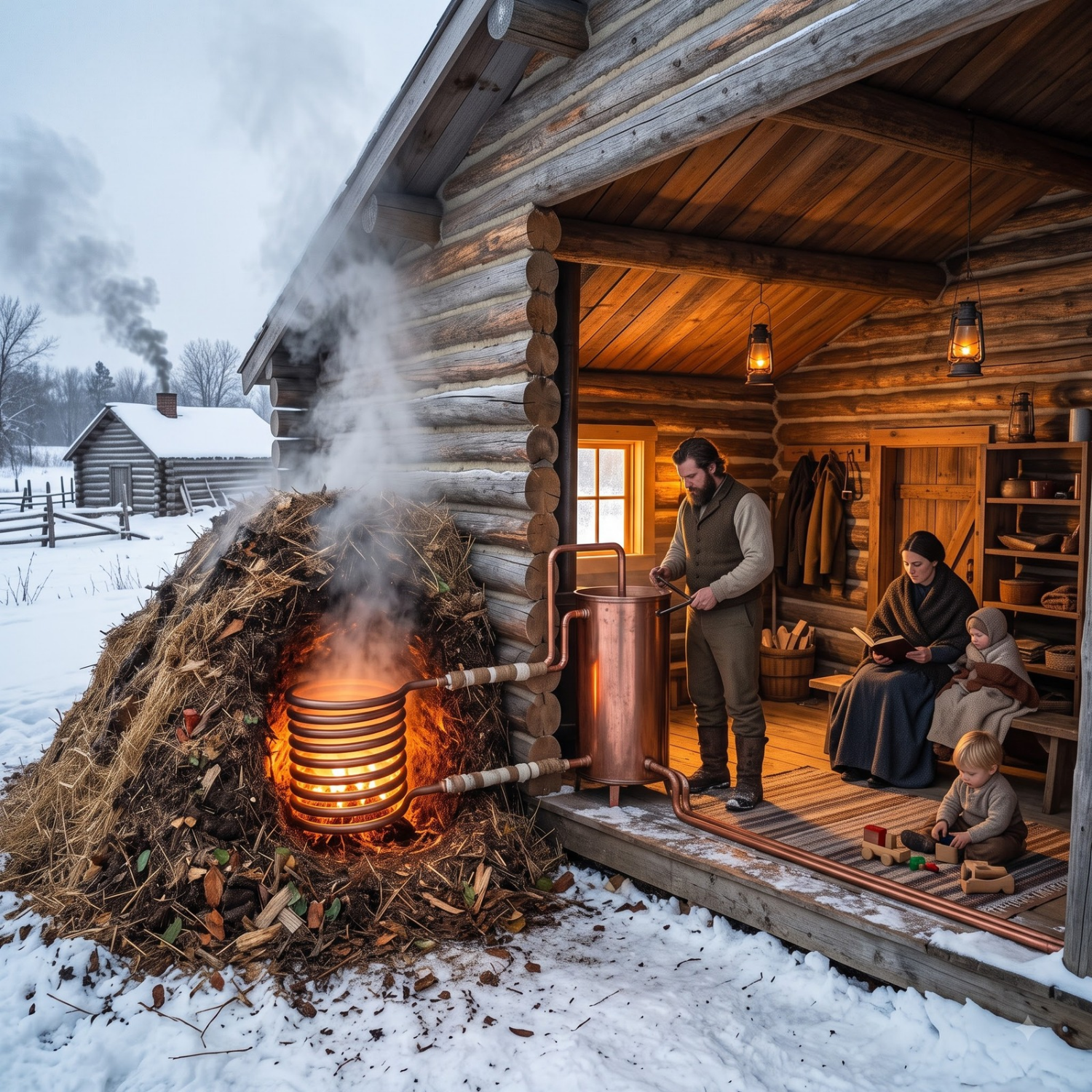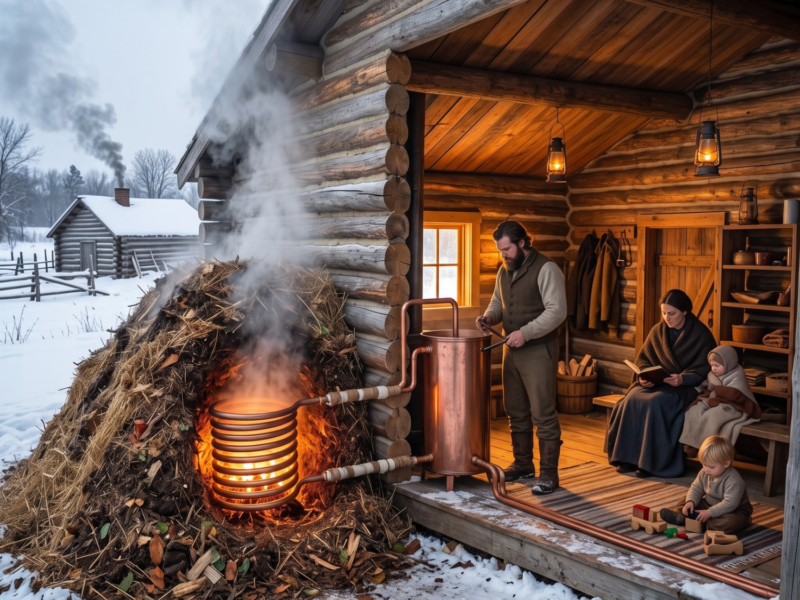
He Built a Steaming Manure Pile Beside His Cabin — It Heated His Home for Six Months
THE LESSONS OF THE DELEGER ESTATE
Anders Svenson had arrived in Wisconsin in the spring of 1882, part of the great wave of Swedish immigrants who crossed the Atlantic seeking cheap farmland and independence in the American Midwest. He had left behind the Dalarna region in central Sweden, where winters lasted half the year and peasant farmers had spent generations refining methods to survive the sub-zero frost with minimal resources.
In Sweden, Anders had spent five years working as a laborer on a sprawling estate outside Falun, where the head groundskeeper maintained enormous, meticulously engineered compost heaps designed to warm the manor’s botanical greenhouses through the punishing Scandinavian winter.
The underlying principle was ancient and well understood across the northern latitudes: organic matter breaking down in massive volumes generates tremendous internal heat. A properly constructed mound of manure, hay, and wood chips can sustain core temperatures exceeding one hundred and forty degrees Fahrenheit for months on end as billions of thermophilic microorganisms tear through the material.
The head groundskeeper at Falun had taken the concept a step further, running copper tubing through the center of the compost piles to circulate water that carried the heat directly into the greenhouse soil beds, keeping tropical flora alive through winters that would have frozen them solid in hours.
Anders had watched this biological heating system operate for five straight winters. He had helped build the mounds, plumb the copper lines, and monitor the thermometer readings.
The mathematical reality was undeniable: a twenty-ton compost pile generated thermal energy roughly equivalent to a small wood stove running continuously. And it did so for five to six months straight without requiring a single piece of fuel, a single swing of an axe, or any attention whatsoever beyond the initial construction.
America promised boundless opportunity. But what it delivered in the dense, unbroken forests of northern Wisconsin was winters that rivaled Sweden’s worst, paired with an approach to winter heating that baffled Anders completely.
His first winter near Phillips had nearly broken him. He had spent the season working in a grueling logging camp, watching the men burn staggering quantities of prime hardwood just to keep the bunkhouse livable. They would cut, split, and stack cords upon cords all through autumn, then feed roaring fires around the clock from November through April.
The grueling labor of heating consumed nearly as much human energy as the labor of felling the timber itself. And every single spring, the cycle restarted: cutting more trees, splitting more wood, stacking more fuel for the next winter’s endless consumption.
Anders watched this waste with quiet disbelief. The local lumber mills generated mountains of wood chips, sawdust, and bark that were simply left to rot in enormous, useless piles. The surrounding dairy farms produced tons of horse and cattle manure that sat steaming in neglected heaps behind every barn. The raw materials for a biological heating system lay everywhere—abundant, unvalued, and free for the taking.
By 1886, Anders had saved enough wages from lumber work to purchase forty acres of forested land five miles east of Phillips. The property possessed good timber, a reliable creek, and—most importantly—proximity to the lumber mill’s waste piles and three neighboring dairy farms whose manure heaps grew larger with every passing season.
His nearest neighbor, a stubborn German farmer named Friedrich Hoffman, watched Anders survey the north side of his cabin site with intense, suspicious curiosity.
“Planting a garden against the north wall?” Hoffman asked one afternoon, riding over on his heavy draft horse and pulling a handkerchief to his nose. “Nothing grows on the north side, Svenson. There’s no direct sun.”
“Not a garden, Friedrich,” Anders replied, his English still carrying the heavy, lyrical melody of Swedish vowels. “A compost mound. Twenty feet long, ten feet wide, eight feet tall. Horse manure, hay, and wood chips, with copper pipes running through the core. The heat from decomposition will warm water that circulates directly into my cabin.”
Hoffman stared at him for a long, silent moment, as if calculating whether the man was dangerous. “You want to pile manure against your house? Twenty tons of manure? Right against the wall where your family sleeps? The north wall, no less—where the winter winds hit the hardest.”
“The mound blocks the prevailing wind and heats the cabin at the same time,” Anders said simply.
“That is the single most disgusting thing I have ever heard a man propose with a straight face.”