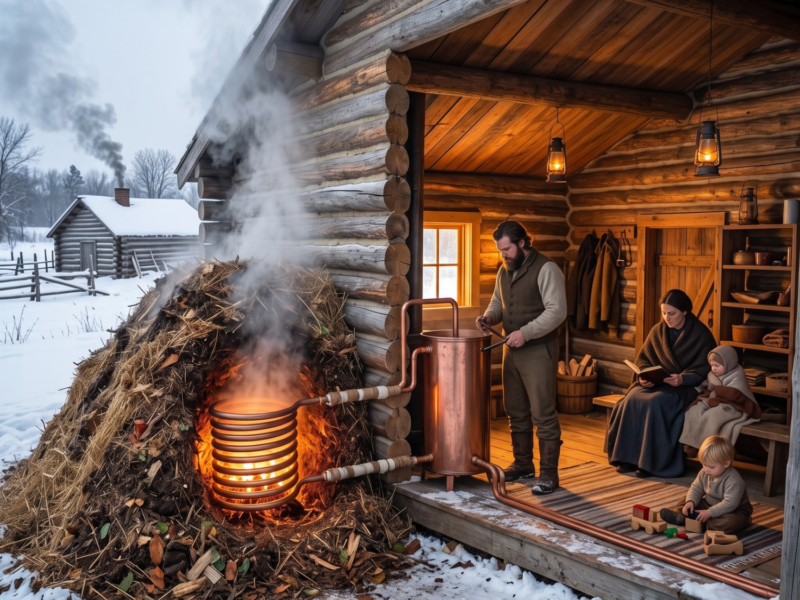
He Built a Steaming Manure Pile Beside His Cabin — It Heated His Home for Six Months
THE MICROBIOLOGY OF HEAT
What Anders Svenson understood from years of practical observation on a Swedish estate, modern thermodynamics would later quantify with precision.
When organic matter decomposes, billions of thermophilic bacteria consume the carbon and nitrogen in the material, releasing thermal energy as a direct metabolic byproduct. In a small garden compost bin, this heat dissipates rapidly into the surrounding atmosphere, leaving the compost lukewarm.
However, in a massive mound measuring twenty feet long, ten feet wide, and eight feet tall, the sheer volume of organic material insulates itself. The outer layers act as a thermal blanket, trapping the heat generated within the core.
The internal temperature climbs rapidly, stabilizing between one hundred and thirty and one hundred and sixty degrees Fahrenheit—hot enough to pasteurize soil, kill invasive weed seeds, and sustain itself for five to six continuous months before the material is fully exhausted.
The raw numbers told an astonishing story: a twenty-ton compost mound at peak thermophilic decomposition generates roughly ten to fifteen thousand BTUs per hour, matching the output of a small wood stove burning continuously.
Yet, unlike a wood stove, the compost mound required zero feeding, zero wood-splitting, zero hauling, and zero midnight interventions. Once constructed, the biological process sustained itself automatically, operating around the clock.
The copper pipe system served as the vital bridge between this biological heat and the interior living space. Coiled copper tubing buried deep within the mound’s scorching core was filled with water that rapidly absorbed heat from the surrounding decomposing organic matter.
As the water heated, it naturally expanded, rose through the copper tubing, and flowed into the fifty-gallon iron water tank positioned against the north wall inside the cabin. Simultaneously, cooler water from the bottom of the tank flowed back down through a return pipe into the mound to be reheated, creating a continuous, self-driving circulation loop governed entirely by the thermosiphon principle: hot water rises, cool water sinks, requiring no mechanical pump or electricity.
The material mixture ratios were critically important. Pure manure decomposed too rapidly, generating an intense spike of heat that burned out in weeks rather than months. Pure wood chips decomposed far too slowly, never reaching useful thermal thresholds.
The ideal blend—roughly one part horse manure to two parts a mixture of dry hay and wood chips—created optimal conditions for sustained thermophilic decomposition. The carbon-rich hay and wood chips provided long-burning fuel for the bacteria, while the nitrogen-rich manure acted as the biological catalyst driving the reaction.
Moisture management was equally vital. If the mound became too dry, the bacteria died off; if it grew too wet, the process turned anaerobic, producing foul-smelling gases and dramatically less heat.
The ideal moisture level felt like a freshly wrung-out sponge: damp throughout, but never dripping. Anders planned to monitor this balance by feel during construction and supplement with creek water during dry autumn spells.
Placing the mound against the north wall served three distinct functions simultaneously:
-
It physically blocked the prevailing north-westerly winter gales that drove the worst cold directly against the cabin logs.
-
The massive twenty-ton organic mass provided profound physical insulation, buffering the interior timber from the freezing air.
-
The north side received zero direct sunlight, keeping the mound’s exterior surface cool in autumn and preventing premature drying of the outer insulating layers.
His neighbors saw an unsightly pile of manure. Anders saw an automated, self-fueling biological furnace. The very material that sat neglected and wasted behind every dairy barn in Price County contained enough latent thermal energy to keep a human family comfortable through the harshest Wisconsin winter.









