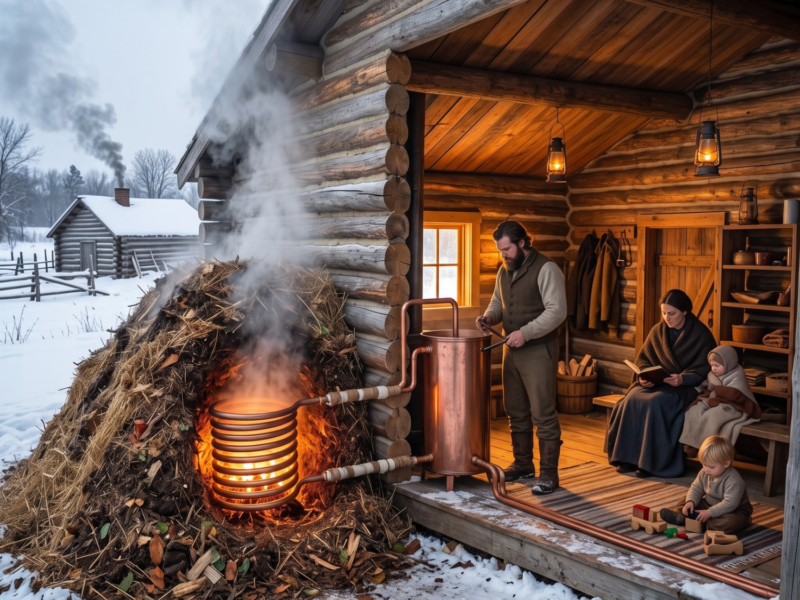
He Built a Steaming Manure Pile Beside His Cabin — It Heated His Home for Six Months
THE LEGACY OF THE STEVENSON METHOD
Anders Svenson lived for another thirty-seven years on his Price County homestead, passing away peacefully in 1923 surrounded by children and grandchildren who had grown up in a home heated entirely by biological decomposition, never knowing the bone-weary exhaustion of families who woke in the dead of night to feed roaring stoves.
The original cabin stood proudly until 1951, when his aging grandson finally dismantled it to construct a modern farmhouse with a forced-air furnace.
During the demolition, the cabin’s north log wall—sealed beneath its layers of pine tar and oil cloth—was thoroughly inspected by local builders. The heavy timbers were found to be as sound, dry, and unblemished as the day they were milled over six decades prior. Sixty-five years of wet compost pressed directly against raw wood, without a single trace of rot or structural compromise.
The severe winter of 1887 remained the permanent benchmark against which all subsequent Price County weather was measured. Yet the lingering terror of freezing isolation had been permanently broken.
By 1900, compost heating systems had spread outward from Price County into neighboring districts across northern Wisconsin, and agricultural journals published detailed technical accounts of “the Swedish method of biological heating.”
The Wisconsin Agricultural Extension formally invited Anders to speak at their annual statewide meeting in January 1904. The immigrant who had once been publicly mocked for piling manure against his cabin now stood before an audience of three hundred skeptical, frost-weary American farmers.
“Every farm in this state produces waste,” Anders told them, his voice carrying clearly across the auditorium through his still-thick Swedish accent. “Manure sits in neglected piles behind your barns doing absolutely nothing. Wood chips rot uselessly at every mill yard. Spoiled hay rots in every field. You throw away more thermal energy every single day than your iron stoves produce.”
He pointed to a large architectural diagram displayed on an easel behind him. “Twenty tons of organic material that costs you nothing generates warmth equivalent to four cords of high-grade firewood burning continuously for six months. The bacteria do the heavy labor. The copper tubing carries the heat. And you… you sleep peacefully through the night.”
Friedrich Hoffman never returned to conventional wood heating. His farm became a permanent regional showcase for the compost system, with every passing season bringing a fresh, towering mound against his cabin’s north wall. His grown sons built their own homesteads incorporating the Swedish method as standard architectural practice, and the Hoffman family remained rooted in Price County for four generations, every single one of them sleeping comfortably through Wisconsin winters while their neighbors chopped wood in the dark.
The core scientific principles Anders utilized—harnessing biological decomposition as a thermal source, captured and distributed via closed-loop liquid circulation—anticipates modern biomass heating systems and passive geothermal engineering by nearly a century.
Commercial composting facilities today generate electrical power using precisely the same microbial heat loops. Advanced agricultural facilities across Scandinavia and Canada utilize compost-heated water to extend growing seasons through sub-zero latitudes.
The mathematical equations have been refined, and modern synthetic polymers have replaced copper and oil cloth; but the underlying insight remains eternal: organic waste is not trash at all, but concentrated solar and biological energy waiting patiently to be released.
What Anders knew—what generations of Swedish estate workers understood instinctively—was that nature generates thermal energy continuously and silently through decomposition. Fighting the winter cold exclusively with brute-force fire was choosing the hardest, most punishing path when biology offered an infinitely more elegant solution.
His neighbors chopped, hauled, split, and exhausted themselves to the bone.
Anders piled, waited, and slept soundly through the night.
Britta outlived Anders by five summers. She spent her final elderly winters pressing her weathered palms against the warm iron water tank in the corner of the parlor, the exact way she had done on that first freezing November morning when paralyzing doubt finally gave way to enduring warmth.
After she passed away, their youngest daughter discovered a small, folded piece of paper tucked securely inside the pages of the family Bible, written in Britta’s neat, careful Swedish script:
He said the manure would heat our home. I told him he had lost his mind. The manure heated our home for thirty-seven consecutive winters. The neighbors burned down forests. We burned nothing. He understood something the Americans never learned: the earth is always working, always generating warmth. You only have to know where to find it.
The atmosphere in the room suddenly quieted down. Britta’s epigraph left behind was not just a belated vindication, but also the summary of a life that dared to go against prejudices, dared to face the stench and mockery in exchange for genuine survival.
Whenever winter arrived, the northern winds roared through the gaps in the houses around the Phillips area. But on the Svenson family’s land, the biological fire worked silently. There was no sound of axes splitting wood ringing out in the dark, no sweat drenched porches when snow piled up to the knees. Earth, horse manure, rotting wood, and straw—things discarded in the eyes of the world—had become the most enduring warmth-sustaining machine.
Years passed, and the outside world changed dizzyingly. Steam-powered engines gradually gave way to internal combustion engines, electricity began stretching into remote rural areas, and modern fireplaces gradually sprouted up in major cities. Yet, in this rural Price County, people still spoke of the “Svenson method” as a living legend. Not because it was flashy, but because it was so relentlessly pragmatic for those who preferred to work with nature rather than fight against it.
Anders’s descendants later built a more spacious, modern house. They even installed an electric steam heating system, but according to the family’s wishes, the northern wall of the new house was still designed to preserve that historical space. Sometimes, curious strangers passing by would catch a faint scent of damp earth and organic mulch from the corner of the garden and ask about it. And the younger generation of the Svensons would smile, leading them to the back of the house where a small compost heap was still gently steaming in the bone-chilling cold of a Wisconsin winter.
“Our forefather didn’t fight the winter,” they would say. “He just made winter work for him.”
And so, the story of the twenty-ton horse manure pile, the coils of copper piping, and the Swedish man considered crazy continued to be passed down from generation to generation. Amidst a world always rushing to burn everything to find temporary warmth, that story was like a gentle reminder from the earth: Life never yields to the bitter cold, as long as humans know how to listen to the silent heartbeat of nature.
In the winter of 1923, when Anders closed his eyes at the age of seventy-five, the snow outside was falling heavily. But inside the small house, the water in the iron kettle was still warm, and the children were fast asleep in the silent dreams of the howling storm. He had left his descendants a fortune not measured in money, but in peace through every invading blizzard.
And somewhere beneath that thick blanket of snow, microorganisms were still diligently working, transforming decay into warmth—proving that even in the harshest conditions of life, there is always a way to turn adversity into life itself.









