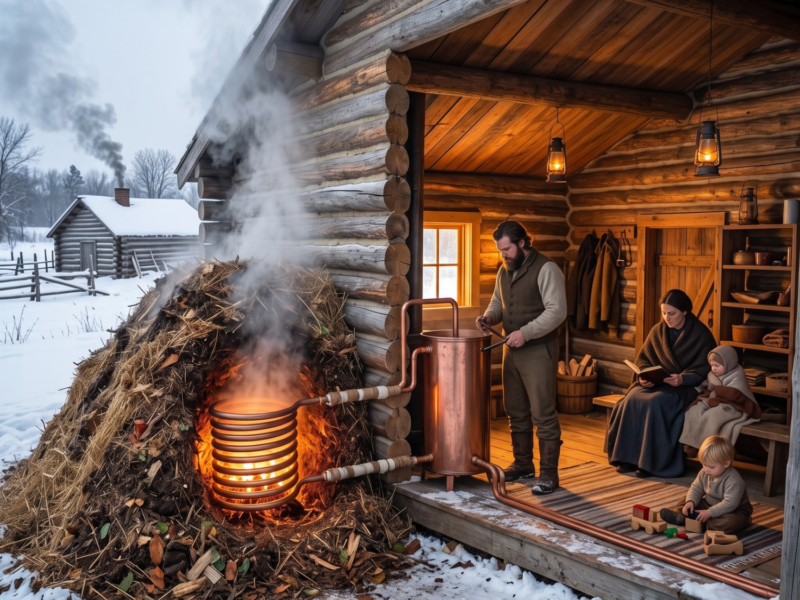
He Built a Steaming Manure Pile Beside His Cabin — It Heated His Home for Six Months
THE RAISING OF THE MOUND
Construction began in early September 1886, as soon as the autumn air cooled enough to make strenuous manual labor bearable.
Anders had spent the summer preparing: acquiring two hundred feet of copper tubing from a plumbing supplier in Milwaukee, forging custom iron fittings, and meticulously sealing the cabin’s entire north log wall with thick pine tar and three overlapping layers of oil cloth to create an impenetrable moisture barrier between the mound and the timber structure.
The wall preparation came first. Anders applied boiling pine tar to every single log on the north face, working it deep into every structural check, knot-hole, and joint until the surface glistened black.
Over the sticky tar, he stretched heavy oil cloth in overlapping sheets, tacking each layer down tight with copper nails that would not rust or bleed. A third layer went over the second, creating a watertight shield. The cabin’s structural timbers would remain as dry as the day they were milled, regardless of what pressed against them from the outside.
Next came the fabrication of the heat exchanger. Anders shaped the copper tubing into a massive spiral coil roughly six feet in diameter, designed to sit directly in the core of the mound where decomposition temperatures would reach their zenith.
The coil connected to two straight runs of pipe: one entering the cabin through a sealed port near the floor, and the other exiting through an upper port near the ceiling. Inside the cabin, these lines connected to the fifty-gallon iron water tank mounted firmly against the north wall.
The grueling physical labor of building the mound consumed three weeks of relentless hauling. Anders had arranged with three neighboring dairy farms to collect their accumulating manure piles, paying for the privilege with a binding promise of finished, nutrient-rich compost returned to them in the spring.
Borrowing a heavy farm wagon, he made two trips daily—each load hauling roughly a ton of fresh horse manure mixed with soiled livestock bedding straw.
The layering process was executed with geometric precision. Anders laid an initial drainage base of coarse wood chips eighteen inches deep across the entire twenty-by-ten-foot footprint, ensuring adequate airflow beneath the heap.
Upon this foundation, he spread a six-inch layer of manure, followed by an eight-inch layer of dry hay, followed by another layer of manure, layering outward like a giant biological layer cake.
When the mound reached a height of four feet, the massive copper coil was carefully hoisted into position at the exact geographic center, surrounded by the richest, most active material. Additional layers followed: manure, hay, wood chips, manure—each spread evenly and thoroughly saturated with water hauled in buckets from the nearby creek.
Anders tested the moisture content by squeezing handfuls of the mix, adjusting the watering until every cubic foot felt uniformly damp.
By late September, the mound stood a proud eight feet tall against the cabin’s north wall—an imposing, steaming mountain of organic material that could be clearly smelled from a quarter-mile away when the wind shifted.
The predicted stench proved entirely accurate for the first fortnight. The raw manure fermented with an intensity that forced Britta to keep every window on the north side firmly bolted shut and stuff damp rags beneath the bedroom door.
Yet Anders remained calm, knowing the biology would soon shift.
By mid-October, the smell changed. As the internal temperature crossed the threshold past one hundred and thirty degrees, the initial mesophilic microorganisms died off, replaced by ravenous thermophilic bacteria. The decomposition shifted from the foul-smelling anaerobic breakdown of fresh dung to the clean, aerobic process of high-temperature composting.
The odor transformed from a sharp, offensive barnyard reek to something closely resembling a rich, warm forest floor—earthy, deep, and entirely tolerable.
On October 15th, Anders walked to the north wall and pressed his palm against the exposed copper pipe where it entered the cabin.
The metal was distinctly warm to the touch. He stepped inside and laid his hand directly against the iron water tank.
It was hot. Not lukewarm—genuinely hot. The biological furnace had successfully ignited.









