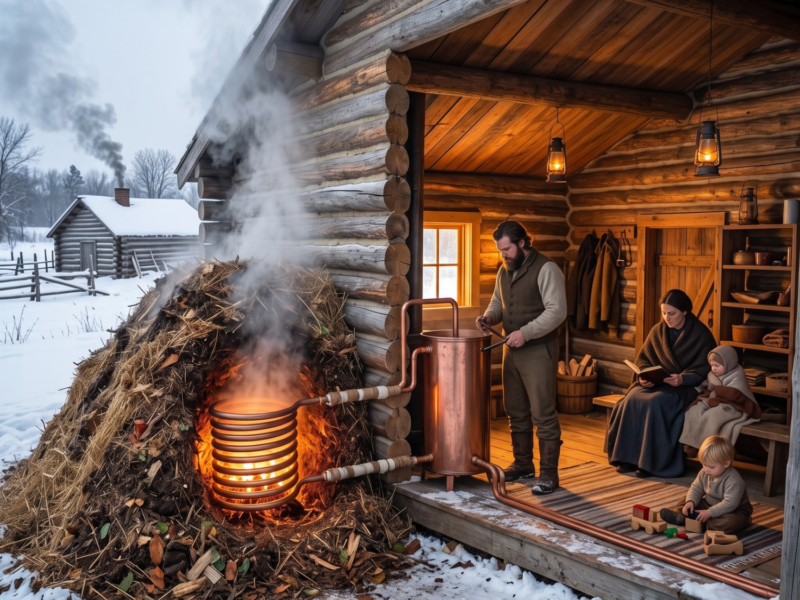
He Built a Steaming Manure Pile Beside His Cabin — It Heated His Home for Six Months
THE WINTER OF EIGHTY-SEVEN
By late October, Anders Svenson’s steaming mound had become the most controversial landmark in Price County.
Passing farmers made deliberate detours on their way to the mill just to ride past and stare at the enormous heap pressed against the cabin, its surface releasing steady wisps of white steam into the crisp autumn air like a sleeping giant exhaling.
Public opinion shifted rapidly from amused disbelief to genuine alarm.
“It’s not right,” one local farmer declared at the general store, shaking his head grimly. “A man doesn’t pile filth against his own home and call it heating. There’s something fundamentally wrong with his head. That wall is going to rot clean through by spring.”
Another farmer nodded in solemn agreement. “All that moisture, all that heat pressing against raw timber—those logs won’t last the winter. He’ll wake up one freezing morning with a mountain of manure collapsing directly into his bedroom. And the vermin! Every rat and mouse in the county will be tunneling into that heap for warmth. His children will be sleeping three feet from a nest of rodents.”
Friedrich Hoffman had inspected the completed mound in early October, walking its perimeter while Anders detailed the layering system and pipe connections. The German had pressed his palm against the steaming surface, feeling the surprising heat radiating outward, and studied the copper pipes entering the cabin with grudging curiosity.
“It’s warm,” Hoffman admitted grudgingly. “I’ll grant you that. But October warmth is easy. Any pile of manure steams in October. The real question is January. When it’s thirty below zero and the snow buries this heap and the bacteria freeze solid, we’ll see how warm your dung pile keeps you.”
“The bacteria won’t freeze,” Anders replied calmly. “The core stays above one hundred and thirty degrees regardless of outside temperature. The outer layers insulate the interior. Heavy snow will only add an extra layer of insulation. Bacteria don’t care what you think they’ll do.”
“Wisconsin cold kills everything, Svenson,” Hoffman warned, shaking his head. “I’ve seen clever ideas fail in this country before—root sellers that flooded, sod roofs that collapsed. This land humbles men who think they’ve outsmarted winter.”
Britta faced her own social pressures. The women of the local Lutheran church had moved past whispered expressions of concern into open, thinly veiled pity.
Margarita Olsen, the pastor’s wife, pulled Britta aside after services one Sunday in late October. “Is everything all right at home, dear?” Margarita asked, her tone heavy with suggestion. “The women are worried about you. A man who piles manure against his own house… some are wondering if the terrible isolation has affected his thinking.”
“His thinking is fine, Margarita,” Britta replied, her jaw tightening into a hard line. “The system works. The cabin is already warmer than any wood stove could make it.”
“But the smell, Britta! The appearance! Your children playing beside a mountain of dung—”
“My children will be warm all winter without their father risking his back splitting firewood in the dark,” Britta interrupted sharply. “If the women want to worry, they can worry about their own husbands standing in the freezing cold at four o’clock in the morning feeding wood stoves.”
The first hard frost arrived on November 4th.
Anders checked the water tank inside the cabin that evening. The iron surface radiated a steady, comforting warmth into the room, fueled entirely by the water circulating continuously in a closed loop from mound to tank and back.
The wall thermometer read sixty-eight degrees Fahrenheit. Outside, the temperature had dropped to twenty-two degrees.
He checked the tank again at dawn: sixty-five degrees. The kitchen cook stove had been completely unlit overnight, yet the cabin had lost a mere three degrees of heat. The biological furnace against the north wall had held its ground through the freezing night without a single log of wood burned.
Britta pressed her palm against the warm iron tank and said nothing, but she quietly stopped stuffing rags beneath the bedroom door.









