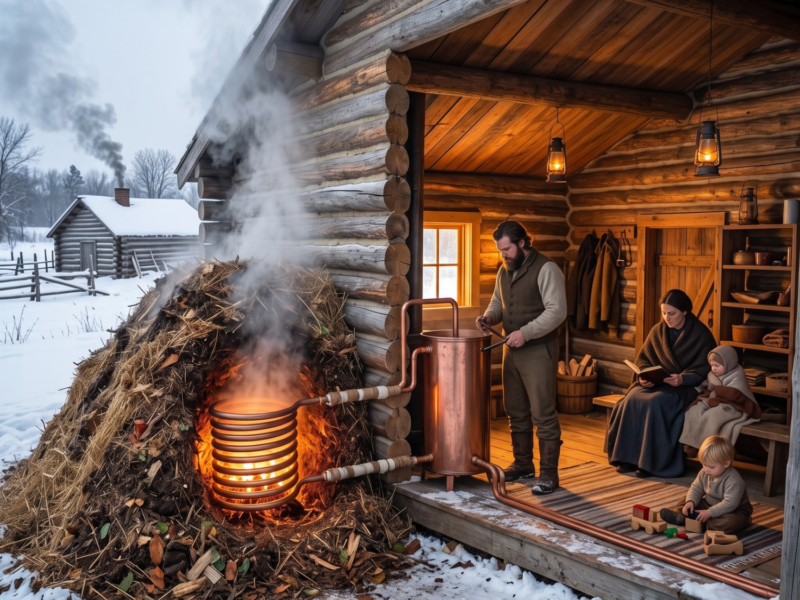
He Built a Steaming Manure Pile Beside His Cabin — It Heated His Home for Six Months
THE PRICE OF BRITTAS TRUST
The argument with his wife, Britta, began the exact moment Anders showed her where the steaming mountain would sit.
He had walked her around to the north side of the cabin frame, pointing proudly at the wooden stakes marking the base of what would soon become a massive heap of decomposing organic matter pressed directly against the exterior logs of their bedroom.
“Manure,” Britta said flatly, staring at the stakes with a dead, unblinking expression. “Against our bedroom wall.”
“Mixed with hay and wood chips, properly layered,” Anders explained, his enthusiasm undimmed. “The microbial decomposition generates steady heat for six straight months. The copper pipes carry hot water inside. We won’t burn a single log for heating.”
“And the smell, Anders? Twenty tons of rotting animal waste three feet from where our children sleep?”
“The smell fades after the first two weeks once the mound reaches operating temperature. At full heat, the decomposition is aerobic—clean. It smells like rich earth, not manure.”
“It smells like manure, Anders. It will always smell like manure. The children will go to school reeking of horses. The women at church will talk.”
“They already talk,” Anders said quietly.
Britta had followed her husband across the Atlantic from Dalarna without a single word of complaint. She had endured the violent ocean crossing, the grueling train journey, the crude lumber camp housing, and the profound isolation of a land where Swedish was spoken only in isolated pockets. But watching her family plan to bury their home in animal waste felt like something entirely beyond pioneering. It felt like madness.
Word reached Friedrich Hoffman within the week. The German farmer rode over and found Anders already hauling cartloads of manure from a neighboring dairy, piling it beside the cabin in a growing mound that hissed and steamed in the crisp September air.
“Svenson!” Hoffman called from his saddle, holding a handkerchief pressed tightly against his nose. “The men down at the mill are talking about your manure heap.”
Anders set down his pitchfork, wiping sweat from his forehead. “Let them talk.”
“They’re saying you’ve lost your mind. That you’re building a dung heap against your cabin wall, and that your wife must be either a saint or a fool to allow it.”
“My wife is neither. She’s practical. When we’re warm in January without chopping a single stick of firewood, she’ll understand.”
“You’ll rot the logs right off your wall!” Hoffman shouted, his horse stepping nervously away from the rising steam. “The ambient moisture alone will destroy the timber. And the rats! You’ll have every rat in Price County tunneling into that pile by November.”
“The wall will be sealed with hot pine tar and multiple layers of oil cloth,” Anders countered. “No moisture reaches the timber, and rats don’t nest in active hot compost. The internal temperature is far too high—they would cook alive.”
Hoffman shook his head slowly, wheeling his draft horse around. “I’ve been farming this land for nine years. I’ve seen clever men try clever things. This country breaks clever things, Svenson.”
The final social confrontation occurred at the general store in Phillips two weeks later.
Anders had driven in to pick up hardware supplies—copper tubing, pine tar, oil cloth, and iron pipe fittings—and found a knot of farmers and mill workers gathered near the counter, discussing his project with open amusement.
“The Swede is piling horse dung against his cabin,” one mill worker announced loudly to the room. “Claims it’s going to heat his home all winter. Twenty tons of it right against the wall! His wife and children sleeping on the other side of the logs. The man’s either lost his mind or never had one.”
“Who heats a home with manure?” another scoffed.
“Swedes, apparently. Must be how they do things over in the old country. Live in filth and call it progress.”
Anders collected his supplies without a single word of response. He loaded the copper tubing carefully into the bed of his wagon, paid the storekeeper in hard-earned cash, and drove home through the golden autumn afternoon.
The Americans could laugh. They could hold their noses and make crude jokes at his expense. Come January, they would be waking up at three o’clock in the morning in the freezing dark to feed their voracious iron stoves, while he slept undisturbed through the night in a home warmed by an invisible, silent biological engine.









