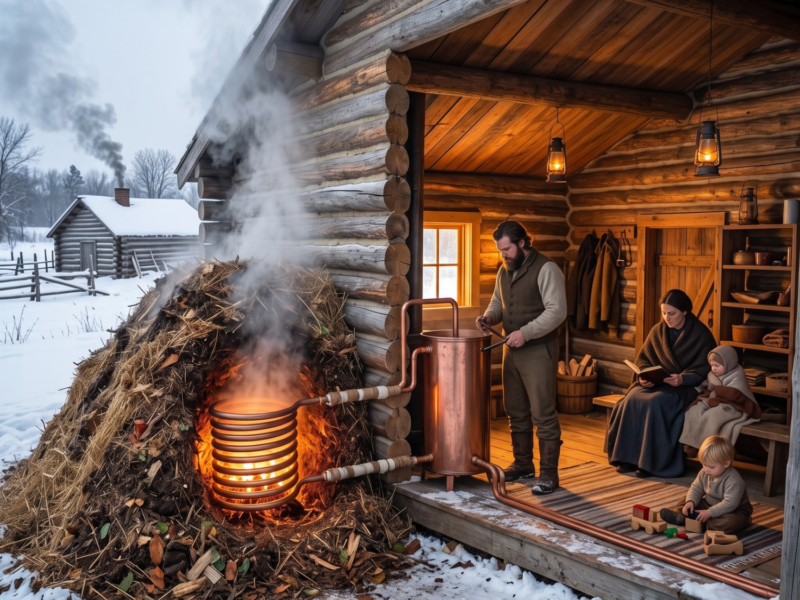
He Built a Steaming Manure Pile Beside His Cabin — It Heated His Home for Six Months
THE ARCTIC FRONT
January 1887 arrived with a meteorological savagery that old-timers would reference in hushed tones for decades.
An unyielding Arctic front descended directly from Canada on January 10th, driving temperatures from a mild twelve degrees down to twenty-six below zero by midnight. By dawn on January 11th, the mercury had plunged to thirty-four below.
And on the morning of January 13th, the outdoor thermometer hanging outside Friedrich Hoffman’s barn read minus thirty-eight degrees Fahrenheit—the coldest temperature officially recorded in Price County in living memory.
The surrounding forest offered zero shelter against the atmospheric assault. The biting wind found every microscopic gap between the trees, driving the cold through the woods with a persistence that made the open prairie seem almost honest by comparison. At least on the open prairie, you could see the storm approaching; in the Wisconsin North Woods, the cold crept in simultaneously from every direction, turning surrounding cabins into fragile paper boxes set on blocks of ice.
Across the county, the desperate battle for survival consumed every waking hour—and most of the sleeping ones.
Friedrich Hoffman burned through his carefully stacked winter woodpile at a terrifying rate. His cast-iron stove roared day and night, flames leaping furiously behind the iron grate. Yet thick frost formed heavily on the wooden floorboards a mere eight feet away from the firebox.
His exhausted wife fed the stove every two hours through the night while Hoffman split more cordwood by the feeble light of a handheld lantern in temperatures that instantly froze the sweat directly to his beard. In six days, he burned through what should have comfortably lasted three full weeks.
The Olsen family, living two miles north, fared catastrophically worse. Their stone chimney cracked right down the middle on the second night due to the extreme thermal shock between the roaring interior fire and the killing exterior cold. Thick, choking smoke filled their cabin before they could extinguish the flames, forcing them to flee into the night and crowd into a neighbor’s small home—eight people squeezing into a cabin built for four, all desperately feeding a single overworked stove.
A local bachelor logger named Thomas Garrett ran completely out of firewood on January 14th, having severely underestimated the duration of the cold snap. By the time a concerned neighbor finally reached him two days later, Garrett had burned his kitchen chair, his small dining table, and half his wooden floorboards just to keep the blood moving in his veins.
At the Svenson homestead, January 10th began like any ordinary winter day.
Anders woke up in a bedroom that registered sixty-seven degrees on the wall thermometer. He did not crawl out from under the heavy wool blankets to feed a wood stove. He did not pull on heavy Sorels to haul cordwood through the dark.
He simply lay comfortably, listening to the howling wind batter the north wall—where twenty tons of decomposing organic matter stood as an unbreakable shield between his family and the arctic wasteland.
The mound had been operating continuously for three months now. The buried copper pipes delivered a steady, uninterrupted flow of heated water into the iron tank, which radiated gentle, persistent warmth into the living space.
The biological process inside the heart of the mound was entirely indifferent to the meteorological catastrophe raging outside. The thermophilic bacteria thrived in their own micro-climate, insulated by outer layers of hay and wood chips that kept their internal environment stable.
When outdoor temperatures plunged to minus thirty-eight degrees, the mound’s core still registered a scorching one hundred and thirty-four degrees. The copper pipes delivered water to the cabin tank at ninety-one degrees.
The cabin interior maintained a steady, beautiful sixty-five to seventy degrees throughout the entire historic cold snap, without a single stick of wood consumed for heating.
Britta cooked family meals on the kitchen cook stove as usual, but the stove served strictly for culinary purposes. The home’s thermal baseline came entirely from the steaming mound outside. Their children slept peacefully through every single night of the storm without waking once to shivering or cold.
On January 16th, Friedrich Hoffman sent his eldest son over on horseback to check on the Swedish family, half-expecting to find them freezing or asphyxiated by fumes.
Instead, Hoffman arrived personally two days later, finding Anders walking the perimeter of the mound, pressing his palm against the steaming surface to check the outer thermal gradient the way an experienced stockman checks an animal’s hide.
“Show me,” Hoffman said without a preamble, pulling off his heavy leather mittens. “Show me how this devilry works.”
Anders led him around to the cabin’s north wall and pointed at the copper pipe entering through the sealed timber port. “Feel the pipe, Friedrich.”
The German removed his glove and wrapped his bare hand around the copper tubing. His eyes widened in absolute shock. The pipe was hot—not warm, but distinctly, uncomfortably hot, carrying water heated by microscopic decay directly into the heart of the home.
“Now come inside.”
Stepping through the heavy front door, Hoffman stopped three paces into the room. The air was warm—not the aggressive, scorching, localized blast of a roaring iron stove that bakes your face while your back freezes, but a gentle, uniform warmth that filled the entire volume of the room.
There were no cold drafts near the threshold, no frozen floorboards, no directional chill.
“The thermometer,” Anders said, gesturing toward the wall.
Hoffman walked over and leaned in close. 68°.
“It was sixty-seven this morning at dawn,” Anders noted quietly, “and seventy yesterday afternoon when the sun hit the south windows. The temperature inside has not dropped below sixty-three degrees since November.”
“Without burning a single log of wood?” Hoffman whispered.
“Britta uses the cook stove for boiling water and baking bread. That is all.”
Hoffman walked across the room to the iron water tank against the north wall and pressed both palms flat against its curved surface. Warmth flooded into his frozen hands. He held them there for a long moment, feeling energy generated not by burning forests, but by the ancient, quiet chemistry of decay.
“My family burned six cords of wood in eight days,” Hoffman said, his voice dropping into a hollow register. “I split logs at three o’clock in the morning by lantern light. My wife hasn’t slept more than two hours at a stretch since the cold hit, and my children are sleeping in their heavy coats.”
Anders retrieved a worn paper notebook from the shelf and flipped it open to pages covered in neat, daily columns of meteorological data. He had recorded temperatures faithfully since October:
January 10th: Outside -26°F. Mound Core 138°F. Water entering cabin 96°F. Cabin Temp 67°F. January 13th: Outside -38°F. Mound Core 134°F. Water entering cabin 91°F. Cabin Temp 65°F.
Hoffman took the notebook, his rough fingers flipping slowly through the pages. The mound core temperature barely fluctuated, hovering stubbornly between one hundred and thirty and one hundred and forty-five degrees, completely immune to the surface weather.
“The outside temperature dropped fifty-two degrees in a week,” Hoffman murmured, shaking his head in disbelief. “And your cabin lost two degrees.”
“The bacteria do not know what the temperature is outside,” Anders explained gently. “They live in their own climate. They consume, they generate heat, and the copper carries it inside. The biological process will not stop until the organic material is fully broken down—which will not happen until April.”
Hoffman closed the notebook and looked up, meeting Anders’s steady gaze. “Can you teach me to build one, Svenson?”
Anders smiled, stepping toward the door. “When the snow melts in spring, we will need a great deal of manure. Every farm in Price County has plenty.”









