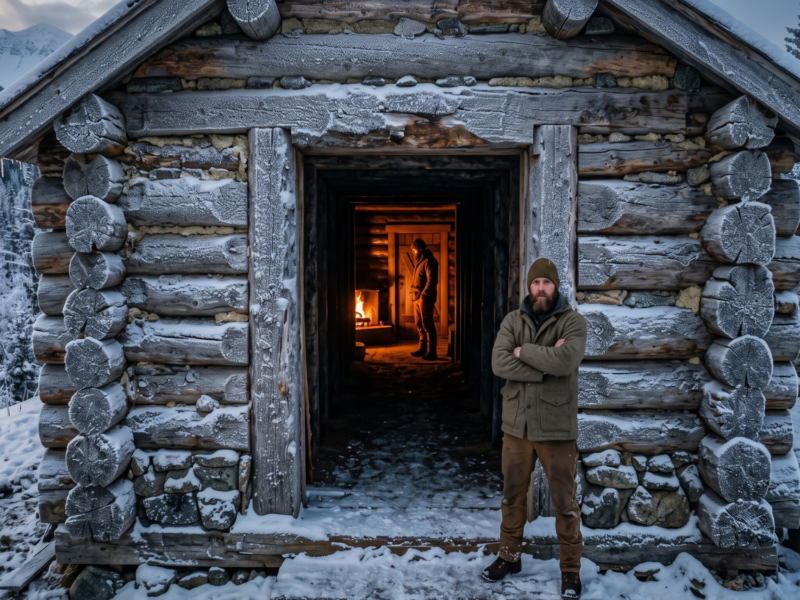
He Made His Walls So Thick the Door Was a Three-Foot Tunnel — the Coldest Night Never Reached Him
The Turf Cutter’s Secret
Niels Madsen was not a farmer by trade. He was not a carpenter, and he was certainly not a trained stonemason.
In his home country of Denmark, living on the harsh, windswept Jutland Peninsula, Niels had been a turf-cutter. His entire life from the time he was a boy had been spent out in the sprawling bogs and desolate heathlands, laboriously harvesting peat from the earth to be dried and burned for fuel.
He was a master of the spade. He understood the exact, critical angle of the iron blade that determined whether a block of turf would hold its dense, geometric shape, or crumble into useless, wet powder.
More importantly, because of his trade, he understood the earth itself. He did not view soil merely as something to be plowed and planted with wheat. He viewed it as an architectural material. He intimately knew its weight, its density, its moisture content, and its profound, hidden secrets about holding the damp and the cold at bay.
He had come to America with his wife, Annelise, and their two small children, Lars and Ingrid, chasing a specific promise: one hundred and sixty acres of free land. To a turf-cutter who had never owned more than the clothes on his back, those words had sounded like the keys to a kingdom.
But their first winter in the Dakota Territory had been a brutal, terrifying lesson in humility.
They had arrived late in the season and hastily built a conventional soddie, copying the exact design of their neighbors like Silas Croft. It had sixteen-inch walls, a single wooden door facing south, and a tin stovepipe jutting through the sod roof.
Niels quickly learned that the Dakota prairie was not the Danish coast. The cold here was a different, terrifying entity altogether. It was a predator with teeth made of ice.
That first winter was not a grand struggle; it was a grueling litany of small, daily miseries that compounded into a near-constant state of physical and mental suffering.
Niels vividly remembered the simple, agonizing act of trying to leave the cabin in the freezing mornings to tend the single cow. The iron latch on the plank door was always frozen solid on the inside, coated in a thick rime of white ice from their own condensed breath. His bare fingers would stick painfully to the frozen metal as he fought to wrench it open. Annelise had to keep a small, precious pot of hot water simmering on the stove overnight, just to pour boiling water over the latch and hinges so her husband could go outside.
Drafts, completely invisible but lethally potent, curled along the packed dirt floorboards like icy, striking snakes. The children, little Lars and Ingrid, were never without their heavy woolen coats, even while sitting at the dinner table. Their breath constantly plumed in the air of their own home. They learned very quickly to walk only around the extreme edges of the small room, desperately avoiding the deadly, rushing currents of cold air that flowed constantly from the single, drafty plank door and the ill-fitting, single-pane window frame.
At night, they piled every blanket, coat, and spare piece of clothing they owned onto their two beds, huddling together for shared body heat. But by dawn, the top layer of blankets would be stiff and heavy with a crust of frozen condensation from their own breathing during the night.
It was a cold that seemed to seep straight through the dirt walls, moving through the very air itself. A cold that made the roof timbers brittle, and made human hope incredibly fragile.
Niels burned through his meticulously gathered wood and buffalo chip pile at a terrifying, alarming rate. He kept the small sheet-iron stove glowing a dull, angry red, feeding it constantly. Yet, the heat seemed to simply vanish into the walls and out the door the absolute moment it was created.
Sitting up late one night, shivering while he watched the stove consume another log, Niels realized the fundamental truth of their suffering.
The problem wasn’t just the ambient temperature of the cold. The true enemy was the wind.
It was a constant, relentless, physical pressure against their thin walls. It was the wind that drove the freezing air through every microscopic crack in the mortar. It was the wind that actively stole the rising heat from the stovepipe, sucking it out of the house. It was the wind that made a simple, thirty-second trip to the woodpile a brutal, life-threatening ordeal.
Niels, a man who had spent his entire life working outdoors in the harsh coastal winds of Jutland, realized with a sinking heart that he had never truly understood the destructive power of wind until he was forced to live inside a fragile box that it was actively trying to dismantle.
That spring, as the snows finally melted, watching his children’s pale, drawn faces slowly regain a fraction of color in the weak sun, Niels swore a silent, unbreakable oath.
He would not subject his family to another winter like that. He would not build a house simply to keep the cold out. He would build a house specifically engineered to defeat the wind.
The cold, he reasoned, was just a passive passenger. The wind was the engine that delivered it. Kill the engine, and the passenger loses its power.









