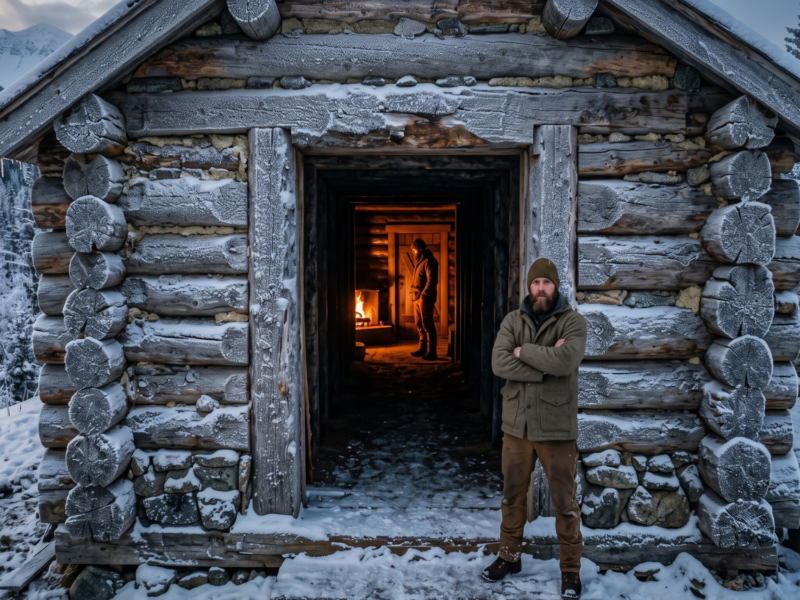
He Made His Walls So Thick the Door Was a Three-Foot Tunnel — the Coldest Night Never Reached Him
The Thermal Battery
To truly understand why Niels Madsen was willing to sacrifice precious interior space, natural light, and the social approval of his only neighbors, you have to understand the specific physics he was deploying against the elements.
His design was a sophisticated, multi-pronged attack on heat loss, with convection identified as the primary, high-value target.
First, consider the walls.
A standard eighteen-inch sod wall possessed a certain, limited amount of thermal mass. It could absorb heat from the stove, and it could hold that heat for a short while. But the constant, freezing wind blasting against the exterior surface of that wall continuously, aggressively pulled that absorbed heat away, chilling the dirt from the outside in.
Think of it like a bucket of water with a small hole in the bottom. You can keep pouring warm water (heat from the stove) into the top, but the bucket will always be leaking out the bottom (convective loss to the wind). You will never fill the bucket; you will only ever fight the leak. That was the reality of a standard soddie.
Niels’s massive, three-foot-thick, packed-earth wall wasn’t just a slightly bigger bucket. It was a bucket with a microscopic hole.
The sheer physical mass of the wall—literally tons of compacted earth and clay—created an immense, highly efficient thermal battery. It took a tremendous, sustained amount of energy (heat) to change the core temperature of that much dense material.
The outer surface of the sod would get freezing cold in a blizzard, yes. But that killing cold had to physically migrate, inch by slow inch, through three solid feet of incredibly dense earth to finally reach the interior living space.
This physical process, known in modern engineering as thermal lag, could take many hours, or even days, to occur.
Conversely, the meager warmth generated by the sun hitting the south wall during the day, combined with the heat of the cooking stove inside, would be deeply absorbed by the massive inner walls. This stored thermal energy would then slowly, gently radiate back into the house for hours, long after the sun had set and the fire had died down.
But the massive walls were only the defense. The true, offensive genius of the design was the entry tunnel.
Orrin Kesler saw the tunnel as a foolish waste of space. Niels saw it as a tactical weapon.
Convection—the rapid transfer of heat through air movement—is at its most aggressive and destructive when that air is moving quickly. The howling wind hitting the heavy outer door of the Madsen house was the exact same brutal, heat-stealing force that everyone else on the prairie faced.
But that is exactly where the wind’s attack stopped.
When Niels opened the heavy outer door to enter his home, he wasn’t letting the raging wind into his living space. He was only letting it into the three-foot-long, empty dirt tunnel.
When he stepped inside and firmly closed the outer door behind him, he physically trapped a small, finite pocket of freezing air inside that tunnel.
Crucially, that trapped air was now still.
Its physical ability to steal heat was instantly reduced by an order of magnitude. Without movement, it was stripped of its weapon. It was now just a small, harmless chamber of cold, dead air.
The inner door—the second door that actually opened into their warm living space—never once faced the howling prairie wind. It only ever faced this calm, transitional airlock.
When Annelise opened the inner door to let Niels inside the house, the exchange of air was minimal, slow, and gentle. A small, lazy puff of cold, still air from the tunnel might drift into the room, dropping the temperature by perhaps half a degree.
But it was absolutely nothing compared to the violent, wholesale replacement of warm air with freezing, wind-blasted air that occurred every single time the Crofts opened their single door across the prairie.
Niels had successfully created an airlock. It was a simple, primitive, but profoundly effective energy buffer.
He had defeated convection not by trying to build a hotter fire to fight it, but by neutralizing its primary delivery mechanism: movement. He had built a physical zone of absolute stillness. He had created a small piece of engineering that permanently broke the direct connection between his family’s warm interior and the raging, homicidal prairie wind.
Distance from the wind, he knew in his bones, was the first and most important barrier of survival.









