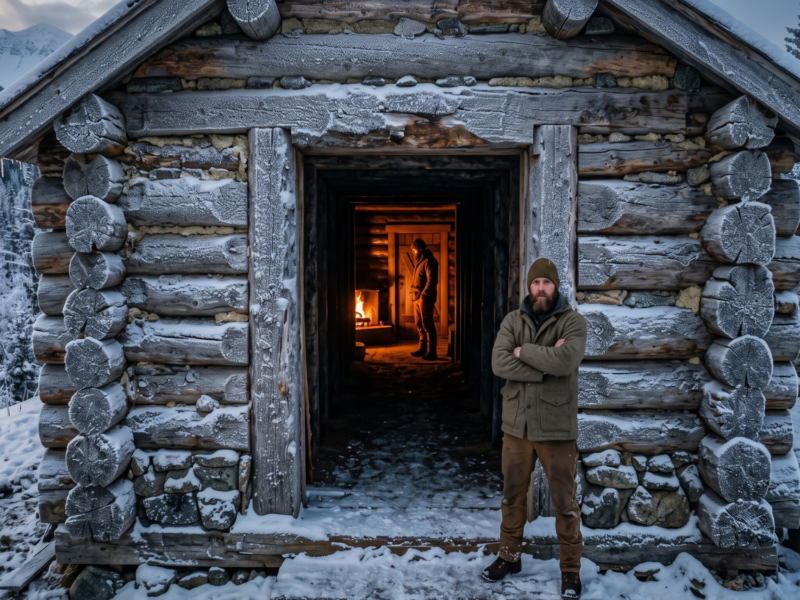
He Made His Walls So Thick the Door Was a Three-Foot Tunnel — the Coldest Night Never Reached Him
The Physics of the Prairie
His neighbors, men like Jedediah Stone and Silas Croft, were not inherently foolish men. They were simply blindly following the established, accepted wisdom of the plains.
A sod house, or “soddie,” was the absolute standard dwelling on the prairie where timber was scarce and ruinously expensive. The method was simple and universally agreed upon: you hitched a team of oxen, plowed long, continuous furrows of the thick, virgin prairie sod, sliced those ribbons of earth into manageable blocks with a spade, and stacked them up like bricks, grass-side down, to form walls.
The standard walls were typically sixteen to eighteen inches thick—a double layer of sod blocks. The roof was a crude lattice made of whatever brush could be found, topped with more sod and smeared with clay to shed water.
These houses were, in many ways, a miracle of desperate necessity. They were relatively cool in the blazing summer, and undeniably warmer than a canvas tent in the winter.
But they had a fundamental, fatal design flaw. And the relentless Dakota wind exploited that flaw without a shred of mercy.
The flaw was convection.
Heat moves and transfers in three specific ways:
-
Conduction (through direct physical contact, like touching a hot stove).
-
Radiation (through electromagnetic waves, like feeling the heat of the sun on your face).
-
Convection (through the movement of fluids, like water or, crucially, air).
On the open prairie, convection was the undisputed king of winter.
A 30-mile-per-hour wind blowing at zero degrees Fahrenheit doesn’t just “feel” colder to a human face. It actively, aggressively strips heat away from any surface it touches, exponentially faster than completely still air sitting at the exact same temperature.
Every single square inch of a conventional soddie’s exterior wall was a losing battlefield, where the home’s precious, generated warmth was being physically ripped away and carried off by the moving air.
Silas Croft’s family, living on the claim just east of Niels, lived in a textbook example of this architectural failure.
Their soddie was considered well-built by frontier standards. The walls were plumb; the roof didn’t leak too badly. Yet, in the depths of January, Silas was frantically burning nearly a quarter-cord of gathered wood a week—a terrifying pace of consumption he couldn’t possibly sustain through March.
The inside of his north-facing sod wall was coated in a permanent, shimmering layer of white frost that never melted. His wife, Mary, spent hours desperately stuffing ripped rags and mud into the shifting gaps around the wooden doorframe, but the wind always found its way through. It created a high-pitched, mocking whistle inside the cabin—a constant, auditory reminder of their losing battle against the elements.
The Croft family’s daily reality was a small, pathetic circle of survivable warmth, extending no more than five feet from the glowing iron stove. The rest of their one-room cabin was an uninhabitable landscape of deep, dangerous cold.
The problem, Niels realized as he analyzed his neighbor’s suffering, wasn’t the sod itself. Earth is actually a remarkably decent insulator.
The problem was the systemic design.
The single exterior door was a gaping, fatal wound in the house’s armor. Every single time Silas opened his front door to fetch wood or check the stock, a massive wave of frigid, dense, heavy outside air poured instantly into the cabin, spreading across the floor. This heavy cold air violently displaced the warm, lighter, heated air, which was immediately sucked out the door or rushed up the chimney.
A single entry or exit, lasting only seconds, could drop the entire room’s ambient temperature by twenty degrees in less than a minute. It took hours of burning precious fuel to recover that lost heat.
Furthermore, the standard walls, at only eighteen inches thick, simply didn’t possess enough thermal mass to resist the constant, relentless convective heat loss happening on the exterior surface. The wind was cooling the outside of the dirt faster than the stove could heat the inside.
They were all fighting a desperate war of attrition against an infinite enemy. And every howling gust of wind was a fresh wave of assault troops.
The settlers were building shelters, but they were fatally designing them as if the air on the prairie was still.
Niels Madsen, standing in the howling gales of Jutland since childhood, knew the air was never, ever still.









