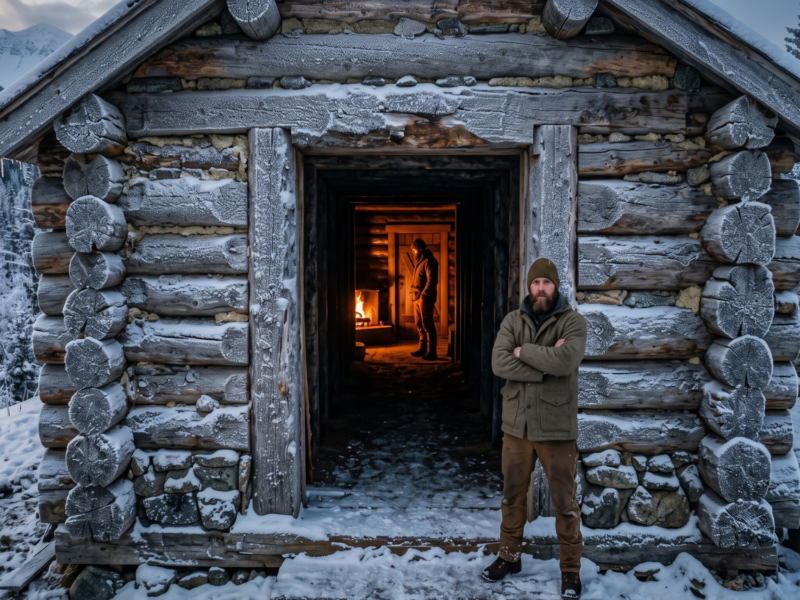
He Made His Walls So Thick the Door Was a Three-Foot Tunnel — the Coldest Night Never Reached Him
The Harbor
On the third brutal day of the polar cold snap, Orrin Kesler found himself in terrible trouble.
He had been riding a wide circuit across the county to check on the more isolated, vulnerable claims—a duty he took seriously, despite his bureaucratic arrogance. But the cold had proven far more severe and predatory than he had anticipated when he left town.
His bay horse was faltering badly, stumbling in the drifts. Its heavy breath was freezing instantly upon exhaling, forming a thick, suffocating coat of white rime ice over its muzzle and chest.
Kesler himself was dangerously, lethally cold. He couldn’t feel his feet in his stirrups. His hands, inside thick leather mittens, were completely numb, aching with a deep, bone-crushing pain. Worse, a creeping, warm lethargy was beginning to set into his mind—the final, deceptive stage of hypothermia, where the brain tells the body it’s okay to just lie down in the snow and go to sleep.
The sun above him was a pale, useless, heatless wafer in a white sky.
He calculated his position through the swirling snow. He was still two miles from the Croft place, and he knew, with a sudden spike of primal terror, that he and the horse might not make it that far.
Then, through a break in the wind-whipped snow, he saw it.
The low, dark, humped mound of the Mad Dane’s soddie, rising from the white plain.
He had no choice. It was his pride, or his life. It was shelter, or it was death.
He urged his exhausted horse the last few hundred yards, the animal fighting every step. Kesler practically fell from the saddle when they reached the lee of the mound, his legs giving out. He stumbled blindly toward the recessed, tunnel-like doorway he had mocked months ago.
His gloved fingers, feeling as clumsy and thick as blocks of wood, fumbled desperately with the iron latch of the heavy outer door. He expected the wind to catch the heavy wood and try to rip it from his weakened hand the moment he unlatched it.
He pulled the door open, lunged his body inside into the dark dirt tunnel, and slammed the heavy door shut behind him, leaning his full weight against it until the latch clicked.
And in that exact moment, the entire world changed.
The deafening, homicidal roaring of the wind instantly vanished, replaced by an absolute, ringing silence that made his ears pop. The brutal, physical pressure of the gale pushing against his body was suddenly, miraculously gone.
Kesler stood in the narrow, pitch-black space of the tunnel, his chest heaving violently, gasping for air. He felt a stillness around him so profound, so absolute, that it was physically shocking to his battered nervous system.
It was cold in the tunnel, yes. But it was a dead, calm, manageable cold. It was utterly, entirely different from the living, tearing, malicious cold outside.
He stood there in the dark for a full minute, just breathing. Just letting the sheer, magnificent feeling of being completely out of the wind wash over his shivering body. It was the most profound, overwhelming relief he had ever felt in his entire life.
Then, the inner door opened, spilling golden light into the tunnel.
Niels Madsen stood in the doorway, silhouetted by the warm, flickering lamplight from within the cabin. He simply looked at Kesler, his expression unreadable, showing no surprise or triumph.
Kesler braced himself defensively. He expected the wave of freezing air from the tunnel to rush past him, chilling the house. He expected the lamp on the table behind Niels to flicker wildly in the draft. He expected to see the Madsen family huddled in heavy coats, miserable and shivering.
Kesler stepped forward through the inner doorway into the living space.
Nothing happened.
The air that gently touched his half-frozen face was profoundly warm, smelling of baking bread, and completely still. The flame of the kerosene lamp on the table did not even tremble.
He saw Annelise looking up from her sewing, her expression showing polite concern for a stranger, but absolutely no surprise at the weather. He saw the boy playing on the floor in shirt-sleeves, looking up at the frozen man with simple, unbothered curiosity.
Kesler took another slow step forward, his heavy boots silent on the dry wooden floorboard.
He slowly turned his head and looked back at the doorway he had just passed through.
The heavy outer door, at the far end of the tunnel, the one he had just slammed shut against the blizzard, was already coated on its inside face with a thick, white layer of frost where his warm, exhausted breath had hit the freezing wood. The iron hinges of that outer door were rimed with sharp ice.
But the inner door. The door Niels had just opened, not three feet away from the ice.
It was bare, dry, warm wood. Its iron hinges were perfectly clean, dark, and dry.
That was the absolute proof. It was a stark, physical manifestation of the invisible boundary Niels had engineered. The brutal, lethal war with the Dakota winter ended right there, trapped and defeated in that three-foot space of empty dirt.
Kesler slowly pulled off his heavy, snow-caked gloves, wincing as the agonizing ache of returning circulation hit his fingers. He looked around the calm, impossibly warm, draft-free room. He looked at the simple, quiet, ingenious man standing before him holding the door.
Orrin Kesler finally understood.
His rigid mind—the mind of a bureaucratic land agent who had spent his career seeing the world strictly in square footage, efficiency, and dollar values—had to violently recategorize what he was seeing.
This wasn’t a wasteful, foolish design that stole living space.
It was the most brutally efficient, scientifically perfect piece of survival engineering he had ever witnessed in his life.
Kesler looked at Niels. A deep, slow, profound respect dawned in the land agent’s tired eyes, washing away months of arrogance. He shook his head slowly.
“You didn’t build a house, Madsen,” Orrin Kesler said, his voice raspy with cold and thick with genuine awe. “You built a harbor.”









