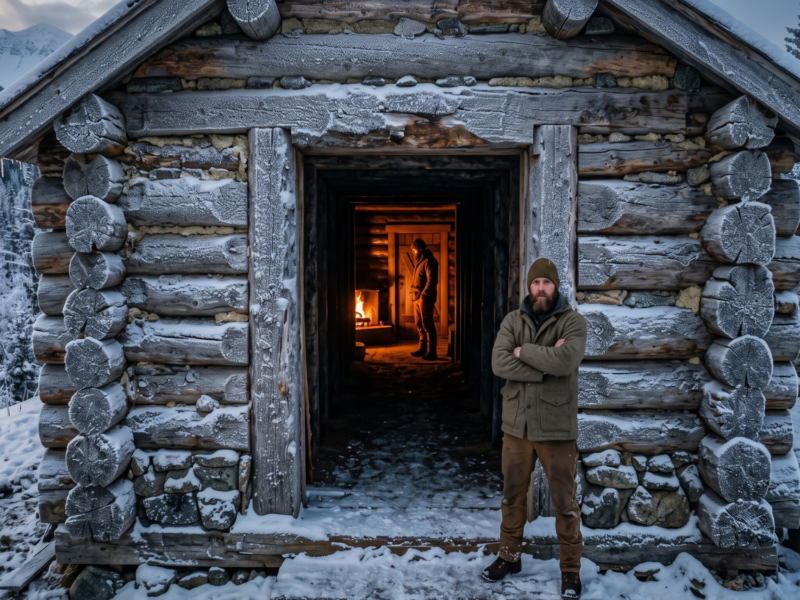
He Made His Walls So Thick the Door Was a Three-Foot Tunnel — the Coldest Night Never Reached Him
The Polar Vortex
The winter of 1880 arrived not gradually, with gentle frosts, but like a violent, invading army crossing the border.
November brought deep, heavy, wet snows that buried the dead grass. December brought a brittle, dangerous, snapping cold that made the frozen ground ring like iron under a boot.
By the first week of January 1881, the atmosphere fractured. A polar vortex—a devastating meteorological phenomenon the terrified settlers knew only as a “killing cold snap”—descended upon the Dakotas, trapping the region in a dome of high pressure.
For five consecutive, agonizing nights, the ambient air temperature dropped well below minus thirty degrees Fahrenheit.
And it was not a still, quiet cold. A steady, howling twenty-mile-per-hour wind blew relentlessly from the dead north. It was a continuous, freezing river of arctic air that scoured the flat landscape, finding every weakness.
The effective wind chill factor was close to minus seventy degrees.
It was a cold that killed exposed livestock exactly where they stood in the fields, freezing them solid upright. It was a cold that made a man’s exposed skin turn white and freeze dead in under a minute of exposure.
For the settlers huddled in their conventional soddies, it was no longer winter. It was a state of siege.
At the Croft cabin, survival was a minute-by-minute battle. Silas and his oldest teenage son took alternating shifts, staying awake all night, frantically feeding the stove. The thin, sheet-iron box glowed a dull, dangerous red in the dark, consuming their precious, shrinking pile of wood at a terrifying, unsustainable rate.
Despite the roaring fire, the side of the drinking water bucket, sitting just ten feet away from the stove, was frozen completely solid.
Mary Croft and the younger children huddled together under a massive, heavy mound of every quilt and coat they owned, lying on the bed, not daring to move an inch, shivering uncontrollably.
Every single hour, Silas had to take a red-hot iron poker from the fire and physically jab at the inside of the tin stovepipe, desperately breaking away the thick layers of ice and creosote that were freezing and choking the exhaust, trying to keep the pipe from closing completely and suffocating them all with smoke.
The Croft family’s entire world had shrunk to a tiny, precarious, five-foot island of survivable warmth in an ocean of lethal, encroaching cold.
At the Madsen house, buried under the snow, the scene was entirely, unimaginably different.
The wind howled brutally outside, a distant, mournful, high-pitched shriek across the prairie. But inside the subterranean room, it was profoundly, deeply still.
The massive, three-foot earth walls muted the screaming gale down to a low, easily ignored hum.
Annelise sat comfortably near the warm glow of the kerosene lamp, casually mending a tear in one of Lars’s cotton shirts. Her bare hands were nimble and relaxed, not stiff and painful with cold.
On the small wooden dining table beside her, a ceramic dish of butter sat out. It was soft enough to easily spread on bread.
Lars was sitting comfortably on the packed dirt floor, drawing happily on a slate with chalk. He was wearing only his standard woolen trousers and a light shirt, no coat required.
The air in the cabin was cool—perhaps a steady sixty-five degrees—but it was an even, comfortable, completely draft-free cool. There were no invisible rivers of ice sliding across the floorboards.
Niels sat in a wooden chair, calmly feeding their small iron stove just two modest, split logs every three hours.
The fire in the Madsen house was burning for comfort, and for cooking. It was not burning for desperate survival.
The house itself—the massive, undeniable thermal battery of the thick dirt walls and the insulated earth below their feet—was doing all the heavy lifting. The temperature inside the room barely fluctuated, day or night, a silent, powerful testament to the physics he had engineered.
Niels stood up and walked over to the single window, set deep inside its three-foot defensive casement. He placed his bare hand flat on the inner wooden sill.
It was very cool to the touch, but it was absolutely dry.
The small, freezing puddle of condensation and ice that had plagued them relentlessly the winter before, rotting the wood and freezing the glass, was entirely gone. The deep casement protected the glass from the wind, preventing the rapid temperature clash that caused condensation.
Niels looked at his wife, who smiled warmly back at him. He looked at his son drawing on the floor.
He had won.
He had not built a house to fight the winter in a grueling war of attrition. He had built a house that simply, elegantly ignored the winter altogether.









