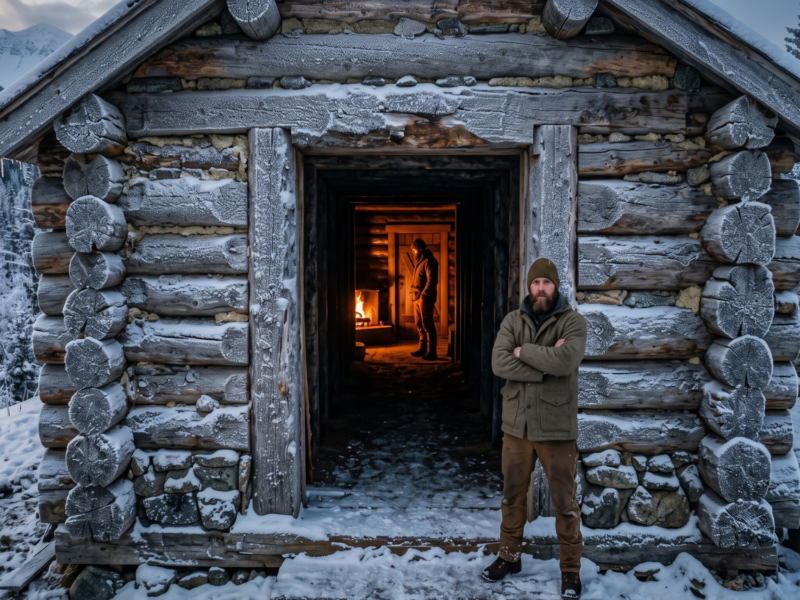
He Made His Walls So Thick the Door Was a Three-Foot Tunnel — the Coldest Night Never Reached Him
The Legacy of Stillness
Word of Orrin Kesler’s dramatic conversion spread across the territory faster than a prairie fire in dry August grass.
Kesler was known as a practical, serious, and deeply respected man, and his enthusiastic endorsement of the Dane’s design carried immense weight among the skeptical settlers.
When the long, brutal winter finally broke and the spring thaw came, turning the prairie to mud, Kesler rode out with the government survey crews. He was tasked with platting new claims for the massive influx of hopeful settlers arriving on the spring trains.
Around the campfires at night, he told the surveyors the story of that freezing January day. He told them about the miraculous dead air in the tunnel, and the warm, perfectly dry inner door.
Surveyors are, by their very nature and training, pragmatic men. They deal in angles, distances, mathematics, and practical, physical realities. They understood the elegant physics of the Madsen entryway immediately. They realized it wasn’t a matter of strange aesthetics or old-world quirks. It was a matter of pure, life-saving function.
That spring, as hundreds of new claim shacks and soddies were being hastily built across the county, a distinct new architectural feature began to appear on the landscape.
Small, tunnel-like vestibules—some made of thick sod, some framed out of rough-sawn lumber—were added to the entrances of homes. The locals called them “Madsen Entries,” or “Storm Porches.”
By the spring of 1882, a formal, official recommendation was issued from the territorial land office in Yankton. It strongly suggested that all new government-built structures in the Dakota Territory, from stagecoach relay stations to remote agency offices, must incorporate a double-door, airlock-style entryway to conserve fuel and protect personnel.
The idea spread rapidly across the plains. It spread not through a massive advertising campaign or a single, loud champion, but through the quiet, undeniable, compelling logic of its own success.
Families who adopted the double-door design and thickened their walls reported burning thirty to forty percent less fuel—whether wood, coal, or buffalo chips—than their neighbors with single doors.
That was a specific number every single settler on the frontier implicitly understood. Thirty percent less fuel meant drastically more money saved. It meant hundreds of hours of backbreaking labor spared. And, most importantly, it meant a significantly greater chance of surviving the next winter.
Niels Madsen never sought credit for the design. He never tried to patent it or sell the idea. He simply shared the knowledge freely with anyone who rode out to his claim and asked, explaining the core principle in his broken, quiet English.
Put a space between yourself and the wind.
The quiet Danish turf-cutter’s brilliant insight had anticipated core architectural principles that are now central to modern building science.
The recessed, double-door entry he built is the direct ancestor of the modern Arctic entryway or commercial vestibule—a standard, required feature in modern cold-climate architecture to prevent heat loss.
His super-insulated, high-mass, three-foot dirt walls are a rustic, brilliant precursor to the complex concepts behind modern “Passive House” construction. This modern standard uses thick, continuous insulation and extreme airtightness to maintain interior temperatures with almost zero energy input from mechanical heaters.
Niels Madsen, using only raw sod, packed earth, a sharp spade, and a deep, intuitive understanding of his natural materials, had engineered a high-performance, energy-efficient home a full century before the term was even invented by scientists. He proved that the most advanced technology is often just a profound, fundamental understanding of the elements.
In the end, the story of Niels Madsen’s strange sod house is about much more than just a family staying warm in a blizzard.
It is a lasting lesson in the true nature of problems, and the correct shape of solutions.
The other settlers on the Dakota prairie saw the freezing cold as the ultimate enemy, and they tried desperately to fight it head-on with fire and fuel, engaging in a war they could never win.
Niels Madsen looked deeper. He saw the wind as the enemy’s primary delivery system. And he brilliantly chose to fight that wind not with fire, but with absolute stillness.
He understood a core, eternal truth of the brutal prairie. The most violent, destructive force in nature is the one that moves. And therefore, the greatest, most enduring strength often lies not in fighting back, but in creating a protected place where that force is forced to be calm.
The theme is written on the land itself, for those willing to read it. Distance from the wind is the very first measure of warmth. It is the beginning of all shelter. It is the first principle of peace.
It was the simple, earthy wisdom of a turf-cutter that turned a foolish-looking mound of Dakota dirt into a safe, warm harbor on the endless, windswept sea of grass.









