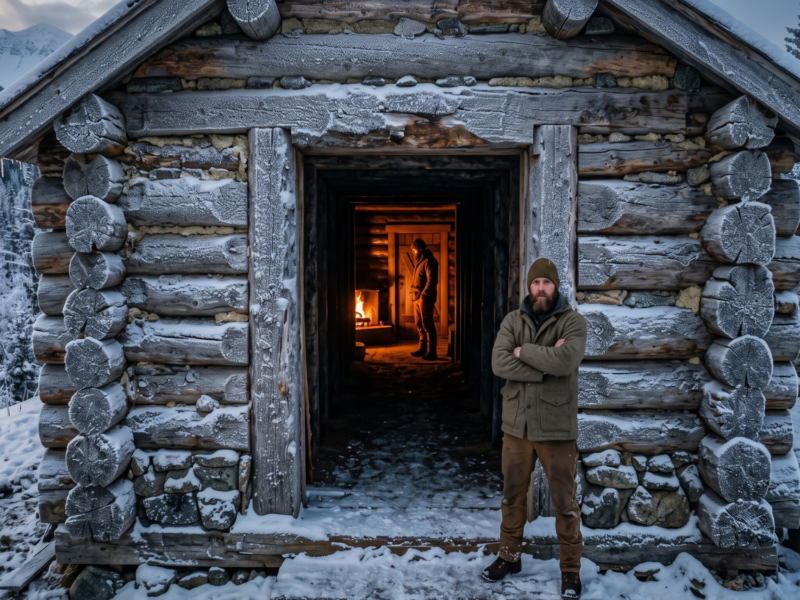
He Made His Walls So Thick the Door Was a Three-Foot Tunnel — the Coldest Night Never Reached Him
The Architecture of Stillness
That summer, Niels began his great work.
He carefully chose a slight, natural rise in the land to ensure drainage away from his foundation. But instead of just starting to stack sod on top of the grass, he brought out his heavy spade and dug down.
He excavated a large, perfectly level, shallow pit exactly two feet deep. He was creating a floor that was partially subterranean, intentionally borrowing the earth’s stable, ambient temperature to anchor the room.
Then, he began cutting his sod blocks from the prairie.
This was where his old-world, highly specialized craft became startlingly apparent. He wasn’t just hacking out rough, uneven chunks of dirt like his neighbors. He used a specialized, sharpened, long-bladed spade he had painstakingly forged himself at a blacksmith in town—a traditional Danish tørvespade.
His cuts were aggressive, clean, and perfectly square, ensuring that every single block would fit together with absolute precision, leaving minimal gaps for the wind to exploit. Each block he cut was massive: three feet long, a full foot wide, and four inches thick. They were incredibly dense, bound tightly with the tangled, ancient root systems that made the virgin prairie soil so structurally strong.
He laid the first course along the perimeter of the pit. Then the second, carefully staggering the vertical joints just like a master bricklayer, overlapping the seams for strength.
But after the third course was laid, Niels did something completely radical. Something that made Jedediah Stone and Orrin Kesler scoff.
He stopped laying solid blocks across the width of the wall. Instead, he built an outer face of sod blocks, and an inner face of sod blocks, leaving a massive, two-foot-wide empty cavity between them.
Then, he began shoveling loose, excavated earth and wet clay into that cavity, packing it down brutally hard with a heavy wooden tamp.
His wall was not just stacked dirt. It was a highly engineered composite. It featured an outer layer of tough, weather-resistant sod; a massive, dense, two-foot-thick core of solid, packed earth; and an inner layer of finishing sod.
The total thickness of the wall was a staggering, unheard-of thirty-six inches.
Jedediah Stone rode by one afternoon, watching Niels heave the heavy tamper up and down, his shirt soaked with sweat.
“Madsen, you’re a lunatic,” Stone called out, shaking his head. “You could build two complete houses with that much sod. You’re working yourself to death out here in the sun for absolutely no reason.”
“There is a reason,” Niels replied calmly, not breaking his rhythm, bringing the heavy log tamper down with a solid thud.
But the thick walls were only part of the equation. The most peculiar, controversial feature of the house was the entryway.
Instead of leaving a simple, flat opening in the wall for a wooden door, Niels extended the thick sod walls out forward from the house, creating a protruding tunnel exactly three feet long and three feet wide.
At the far, exterior end of this dirt tunnel, he framed a heavy oak opening for an outer door. At the near end, where the tunnel met the actual living space of the house, he framed a second opening for an inner door.
It was this specific feature that had drawn Orrin Kesler’s official, bureaucratic scorn.
“You’re wasting valuable land, you’re blocking your own light, and you’re wasting expensive lumber!” the land agent had insisted, gesturing angrily at the two door frames. “Lumber has to be hauled thirty miles, Madsen! One door is enough for any honest man.”
“One door is not enough for the wind,” Niels had said quietly. It was his longest sentence of the entire exchange.
Annelise watched her husband work day after day, her expression a complex mixture of absolute trust and weary, deeply ingrained concern. They were running out of time, and he was building so slowly, so meticulously.
One evening, as he was finally finishing the heavy timber roof structure, she brought him a tin dipper of cool water from the barrel.
“It looks like a badger’s den, Niels,” she said, her voice gentle, placing a hand on his dusty arm.
He drank deeply, wiping his mouth, then looked at the strange, hulking structure taking shape under the blood-red setting sun.
“Badgers are warm in the winter,” he said simply.
It was all the explanation he offered. And for Annelise, who remembered the blue tint of her children’s lips the previous January, it was all the explanation she needed.
He finished the house by late September, just as the first frost touched the morning grass.
The walls were so incredibly thick that the single, small glass window had to be set deep inside a splayed, angled dirt casement, much like the arrow-slits in an ancient medieval castle, just to allow any sunlight to angle into the room.
The entry tunnel felt exactly like a passage leading down into the earth itself. From the outside, walking across the prairie, the house looked less like a human building and more like a natural, geological feature of the landscape. It was a grassy, humped mound, hunkered down low against the sky, refusing to offer a flat profile to the horizon.
The open mockery from his neighbors eventually softened into a kind of embarrassed, pitying silence. They saw the Madsen family’s strange, dark, dirt fortress and simply shook their heads, assuming the Dane had lost his mind to the isolation.
The coming winter, they all agreed quietly in town, would be the final, harsh judgment on the Dane’s folly.









