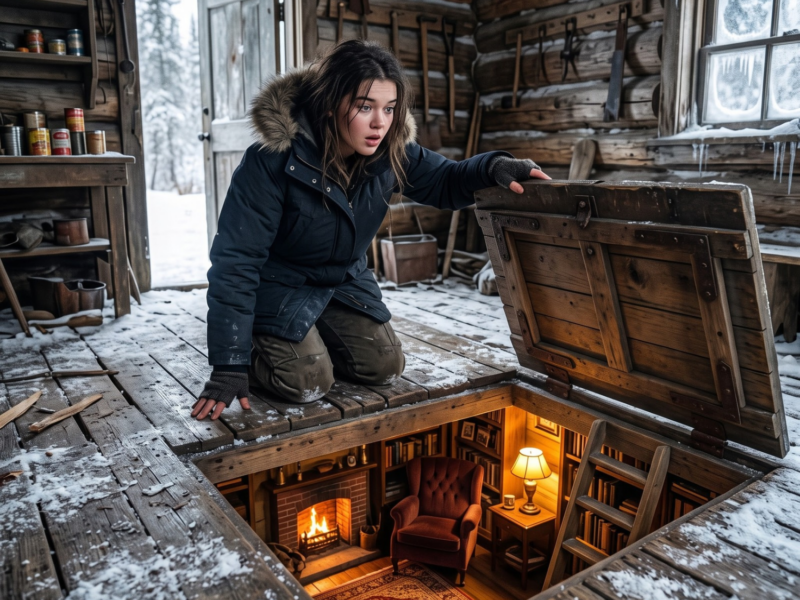
Her Parents Left Her in a Freezing Cabin and Took Everything—Then She Opened a Hatch Beneath floor
THE CONFRONTATION
Yet her parents didn’t know she knew.
That was the thought churning in her chest as Wendell drove her back up the mountain through the blue twilight, the truck heater roaring and Dutch sleeping soundly against her hip.
Her father and stepmother still believed she was up there in the dark with a dying fire and a sack of wormy flour, growing more terrified by the hour, ripening toward a signature. They had no idea about the hatch in the floor. They had no idea about the letters they had mailed back with their own hands. They had no inkling that she had eaten a hot meal at Fay’s counter, held a legal deed bearing her own name, and seen precisely what they were—and what they were desperately trying to steal.
Wendell dropped her off in the clearing, making her promise to keep the stove banked high, and handed down a sack of groceries from the truck bed she hadn’t asked for. Then he turned his plow around and headed back down into the timber.
The silence rushed back in. Ren carried the groceries inside, stoked the fire until the iron glowed, and lit the lamp. Before resting, she carried the first letter and the legal deed down into the stone cellar, placing them securely on the ledge beside Emtt’s tin.
Returning upstairs, she stood for a moment in the doorway of the workshop, looking at the half-finished rocking chair in the gray twilight, and made herself a silent promise: Whatever came up that road tonight, she was not going to be driven off this mountain.
Her mother had been driven off this land once already, and that was going to be more than enough for one family.
Sitting down at her grandfather’s table with Dutch resting at her feet, she didn’t have to wait long.
Dutch lifted his head sharply. His ears pricked forward, a low warning rumble began in his chest, and he rose to face the cabin door, stiff and resolute.
A moment later, Ren heard it too—the low, grinding whine of an engine laboring up the steep grade, its pale headlights swinging wildly across the cabin windows as a vehicle crested the ruts her grandfather had cut, pulling right up to the only door for eleven miles.
She knew that engine sound. She had ridden in the back of it her whole life. They were back.
The truck doors slammed shut, and for a moment, nothing moved except the swirling snow illuminated by the headlights. Two bright white cones pointed directly at her grandfather’s threshold.
Then the doors opened. Sandre stepped out first, followed by Garrett, moving slower, both picking their way through the deep snow toward the porch. Her father walked with his shoulders hunched against the biting cold, while Sandre picked her footing carefully in city boots never meant for a mountain pass.
Ren didn’t go out to meet them. She stood in the open doorway with the warm lamplight spilling from behind her and Dutch pressed firmly against her knee, waiting.
Earlier that evening, before the headlights had appeared, she had finally managed to open the strongbox. The small brass key from the metal box had fit a shallow, hidden drawer beneath the workbench in the shop; and inside that drawer, resting under pencil stubs and rolls of sandpaper, a flat steel key had been waiting for the padlock all along.
She already knew what was inside. She knew everything they had driven up the mountain to keep her from discovering.
“Oh, honey,” Sandre’s voice arrived ahead of her, pitched with the practiced warmth of a rescue worker. “Look at this place. Look at you. We have been worried sick about you up here.”
She stopped at the bottom of the steps, her breath pluming in the cold air. “I told your father we never should have left you alone so long. It isn’t safe. Get your things, sweetheart. We’re taking you home.”
“You said this was home yesterday,” Ren replied evenly. “You said it was a gift.”
“Well, I didn’t know it was this bad, did I?” Sandre forced a light, dismissive laugh. “There’s no power, barely a working stove. No daughter of ours is spending another night in a place like this.”
Dutch issued a low, steady growl from the floorboards. Sandre’s eyes dropped to the dog, and her polite smile instantly thinned. “Where did that beast come from?”
“He lives here,” Ren said. “Same as me.”
Garrett hadn’t said a single word. He stood off to the side at the edge of the lamplight, staring at the cabin—at the massive stone chimney and the squared logs—while an expression of profound internal reckoning worked across his face. He looked like a man standing in a place he had spent a long time pretending did not exist.
“Can we come in?” Sandre pressed, shivering visibly. “It’s freezing out here. Let’s talk inside like civilized people.”
Ren stepped back, opening the door wider. She wanted them inside. She wanted them standing in the exact center of every single lie they had ever told.
She had watched Sandre work a room her entire life; and now that she understood the machinery behind the performance, she could see every gear turning: the manufactured warmth arriving a fraction of a second too early; the worried hands that were never quite still; the word sweetheart deployed like a card in a rigged game. For a long time, that performance had made Ren feel small and ungrateful for not melting under it.
Tonight, she watched it with a cold, crystalline clarity—the trick fully exposed, the magic entirely gone.
Sandre walked in rubbing her hands, taking everything in with a quick, flat sweep of her eyes: the fire, the table, the braided rug pulled back from the corner where she deliberately avoided looking twice. She dropped her canvas bag onto the table and launched straight into her script before she even sat down.
“All right, here’s the thing, and I want you to hear me out because we’ve been going back and forth on how to handle this gently.”
She pulled a clean manila folder from her bag, complete with a pen clipped to the tab. “The cabin and the land are tangled up in your grandfather’s estate, and it’s a legal nightmare—back taxes and old paperwork going back years. Your dad and I have been trying to sort it out for you for months. The simplest thing, the thing the lawyer suggested, is for you to sign the property over to your father so we can manage all of it under one unified name. Then it’s entirely off your shoulders. You don’t have to deal with any of it.”
She slid the folder across the wood toward Ren. “Pen’s right here. Sign here and here, and you can sleep in your own bed tonight.”
Ren looked at the folder. She didn’t touch it. “Which lawyer?”
Sandre blinked, momentarily thrown. “What?”
“You said the lawyer suggested it. Which lawyer? What’s his name?”
“Our lawyer, Ren. Does it really matter?”
“It matters,” Ren said, her voice dropping an octave, “because I met with the lawyer today. The one who actually drew up my grandfather’s will—the fine man with the office over the hardware store. He told me you came to see him in March, and he had to inform you that the cabin doesn’t go to Dad. It goes to me, by name.”
She leaned forward slightly. “So I’m wondering which lawyer told you to put a quitclaim deed in front of me, because it certainly wasn’t him.”
The room plunged into absolute silence. The fire popped sharply in the hearth. Garrett closed his eyes.
Sandre recovered with her usual speed. “You walked down that mountain in this weather, Ren? That was incredibly dangerous, you could have—”
“Don’t.” Ren’s voice didn’t rise; it simply locked the room down. “Don’t do the worried-mother routine. Not anymore.”
“I am worried. I am your—”
“You are not my mother.”
The words landed flat, certain, and completely devoid of heat, which made them hit all the harder. “You never wanted to be, and that’s fine. I stopped needing you to be a long time ago. But I need you to stop talking for one minute and listen, because I know what this is now.”
Sandre’s mouth snapped shut.
“You’re broke,” Ren said plainly. “Dad’s contracting business went under. The trucks were repossessed last fall. You’ve been selling things off—I saw the empty garage. I’m not stupid. And then you found out my grandfather—the wicked old man who supposedly wanted nothing to do with us—left a piece of land worth more money than any of us has ever seen. To me. Not to you, to me. And you couldn’t sell it out from under me because it was never yours to touch.”
She nodded toward the manila folder. “So you brought me up here, took my phone so I couldn’t find anything out, took the car so I couldn’t leave, took my savings so I’d be desperate. You figured a few freezing nights would have me signing anything you put in front of me just to escape back to a warm house. That wasn’t a rescue. That was a botched eviction plan.”
“That is a disgusting thing to say to the people who raised you!” Sandre shrieked, her mask finally slipping. But her voice cracked at the edges, revealing something older, harder, and deeply afraid.
“Then tell me I’m wrong,” Ren challenged.
Sandre didn’t tell her she was wrong.
Garrett spoke then, for the first time, his voice broken and thin. “Sandra… stop.”
“Garrett, don’t you dare—”
He pulled a wooden chair out from the table and sat down heavily, as if his legs had completely given out, burying his face in his hands. When he finally lowered them, his eyes were wet. He looked directly at his daughter.
“He really left it to you? All of it?”
“You knew that in March,” Ren said. “Ren said you both did.”
“I knew,” Garrett’s jaw worked. “I let her tell me it was complicated. I let her tell me a lot of things because it was easier than facing the truth. And the truth was… I couldn’t stand to look at any of it. The cabin. Your grandfather. You.”
He shook his head slowly. “You have her face, Ren. You came out of the hospital with her exact face, and I spent the last eight years unable to look straight at my own kid because every time I did, I saw Sylvie, and I couldn’t carry the weight of it.”
His voice dropped to a ragged whisper. “She used to hum when she cooked—your mother. Songs she never knew all the words to. After the accident, the house went so quiet I thought it would kill me. And you were eleven years old, walking around with her exact eyes looking up at me, wanting me to make it all okay, and I couldn’t. I was just a hollow shell in the shape of a man.”
He pointed a shaky finger at Sandre. “Sandra came along and filled the quiet, made the decisions, and I let her make every single one of them because making decisions meant feeling things, and I was entirely done feeling. And one of the decisions she made was him—your grandfather calling, writing, wanting to see you.”
“You sent his letters back,” Ren said.
“She did.” Garrett’s voice cracked completely on the admission. “And I let her. God forgive me, I stood in that kitchen and watched her write Return to Sender on a dead woman’s father over and over again, and I told myself it was for the best—that he’d just confuse you, that we were a fresh start. I told myself whatever lies I had to.”
He looked up at her with naked agony. “There is no version of this where I’m not a coward, Ren. I know that. I’ve known it for a long time.”
Ren found that her own eyes were burning, but she didn’t move toward him. Not yet.
“Every letter you mailed back,” Ren said quietly, “they’re under this floorboards in a tin box tied with string. He kept the ones you returned, and he wrote new ones anyway. He saved everything for me, all that time.”
She turned her gaze back to Sandre. “You can keep the house in town. I don’t want it. You can keep the car—you already kept eight years of his letters, every single one. So I guess you’re exceptionally good at keeping things that don’t belong to you. But you do not get to stand inside his cabin and tell me I wasn’t loved. You don’t get to have that one. I’ve got the proof sitting in a tin box, and there is nothing you can write on it to send it back.”
Sandre had gone pale and utterly still. She lowered herself into the remaining chair, the fight completely draining out of her. For a terrifying moment, she didn’t look like the woman who ran their household with an iron fist; she just looked exhausted.
“You think I don’t know what I am?” Sandre said quietly, staring into the flickering fire. “I know exactly what I am. I grew up with nothing, Ren. And I don’t mean we were tight on cash—I mean nothing. No electricity, no heat, the car repossessed in the dead of winter, my mother crying over a shoebox full of past-due bills she couldn’t pay. I swore to myself I would never be cold, broke, and at anybody’s mercy ever again as long as I lived.”
Her hands were shaking. “And then I married a man with a child, a failing company, and a dead first wife whose photo he still kept hidden in his wallet. And I watched our life start sliding right back toward that shoebox. And up on this mountain, there was a fortune sitting here, going to a teenager who didn’t even know she had it.”
She looked up, defiant to the end. “I told myself you’d never miss what you never knew about. I told myself a lot of things.”
“That doesn’t make it right, Ren,” Garrett muttered.
“I’m not asking you to think it’s right.” Sandre’s eyes met Ren’s, devoid of tears, holding only the flat, hollow defeat of someone finally seen entirely. “I’m just telling you why. You wanted to know why. There it is.”









