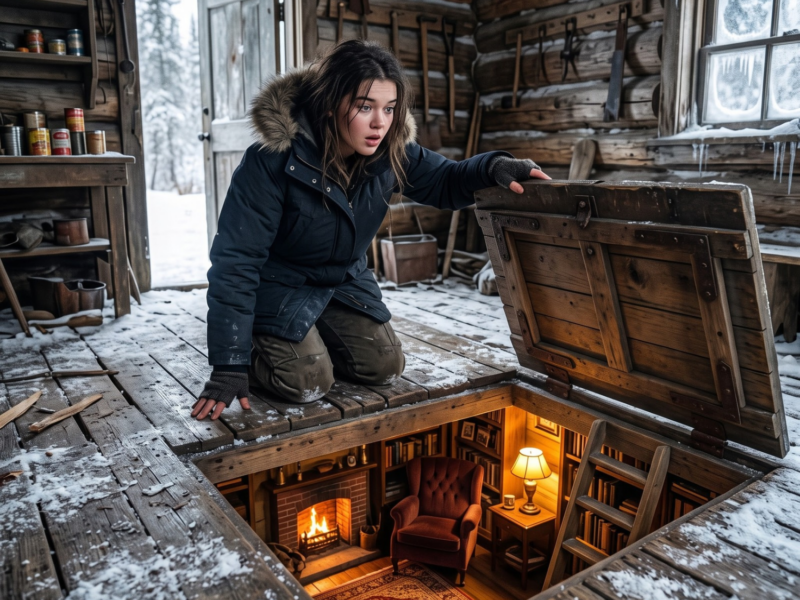
Her Parents Left Her in a Freezing Cabin and Took Everything—Then She Opened a Hatch Beneath floor
THE CHASM UNDER THE FLOOR
She spent the day fighting for survival. More wood was hauled in from the shed; snow was melted in the kettle for drinking water; and she found an old broom to sweep the worst of the accumulated dust out the door.
Going through the pantry cabinets properly, she managed to salvage enough dried beans, a string of withered onions, and a sealed jar of home-canned tomatoes to brew a thin, nourishing soup. She fed half of it to the dog, whom she decided to name Dutch by the afternoon—partly because he possessed a stubborn, squared-off face like a man she’d seen in an old photograph, and partly because he answered to it on the second try as if he’d been waiting his whole life for someone to bother.
Later, when the soup was gone and the kerosene lamp provided the only illumination in the room, she found herself talking to him in a low, easy murmur—telling him things she had never dared say aloud to another human being: about the diner and the envelope of tips she had hidden behind her bedroom baseboards; about the art classes she had always dreamed of taking, which Sandre dismissed as “hobbies for people with money to waste”; and how her mother’s voice was getting harder and harder to summon every spring.
Dutch listened with his chin planted squarely on his paws, his expressive eyebrows twitching. It was the longest anyone had allowed her to talk without interruption in years.
Night descended with terrifying speed, the temperature plunging alongside it. The wood stove struggled to keep pace against the mountain draft. Cold crept in along the floorboards and around the warped window frames.
Ren dragged the iron bed frame closer to the massive stone chimney, piled the fire high with seasoned pine, and crawled under both woolen blankets with her jacket still zipped to her chin. Dutch pressed his warm back against hers, yet still the cold found her.
It came up straight through the floor.
She noticed it first because her feet refused to warm up no matter how hard she rubbed them together. A thin, steady current of frigid air was gliding across the wide pine planks—colder than the cabin air, colder than it had any right to be, rising out of the joints as though the floor opened onto somewhere deep, black, and subterranean.
She lay awake for a long time with her feet aching, telling herself it was nothing—just an old mountain cabin breathing with the frost. But the draft persisted.
Around midnight, with the lamp guttering low and Dutch suddenly snapping awake beside her with his ears pinned forward and his nose working the air, she gave up on sleep. She slid off the edge of the bed and looked down at the braided rug in the center of the room.
The draft was screaming from directly beneath it.
She had walked across that rug a dozen times that day without a second thought. Now, she crouched down, ran her hand along its frayed edge, and felt the icy air pouring up through the wool as steady as a faucet left running.
Dutch came to stand beside her, stiff-legged, his entire focus riveted to the floorboards as a low, rumbling growl vibrated in his chest.
“Yeah,” Ren whispered quietly. “I feel it too.”
She grabbed the edge of the rug and hauled it back.
Beneath it lay the standard pine floorboards, dark with age and worn smooth by decades of foot traffic. But right here in the center of the room, a square section of the planks had been cut—sawn clean and fitted back so meticulously that the rug had hidden the seams entirely. The tiny gaps had been packed tightly with old dirt and petrified grease to kill the draft and disguise the line. And set flush into one edge, resting in a shallow hand-carved notch so it wouldn’t catch a boot heel, was a black iron ring.
Ren knelt there, her heart hammering against her ribs, staring at it for a long, breathless moment.
People didn’t cut a secret hatch into a cabin floor for nothing. They didn’t hide it under a rug and pack the seams with dirt just to forget it. Someone had built this either to be found by the right person, or to stay hidden forever. And either way, it had been sitting right here under her feet the whole time she was being told this was a worthless dumping ground—a disposal problem her parents were magnanimous enough to make her own.
She hooked two fingers through the cold iron ring. It was cold enough to burn the skin. Bracing her other hand flat against the floorboards, she pulled.
The dried dirt cracked along the seams with a sharp crunch, and the square of heavy planks lifted with a low, wooden groan. The rich, earthy smell of damp stone and cool soil billowed up into the room.
Below her lay absolute darkness—a square drop, maybe four feet deep, lined with fitted fieldstone masonry.
The yellow glow of her lamp slid down into the cavity, catching on dull metal shapes: the corner of a tin box, a row of glass jars with pale contents, and, resting along a stone ledge, a bundle of flat, rectangular objects tied neatly with kitchen twine. In the bad light, the bundle looked hauntingly like a stack of letters.
Dutch leaned over the edge beside her, perfectly still. Ren reached back blindly, grabbed the wire handle of the kerosene lamp, and brought it close. Lying flat on her stomach on the cold floor, she lowered the light slowly into the dark, down toward whatever it was that someone had gone to such extraordinary trouble to bury beneath the only place on earth that was finally, truly hers.









