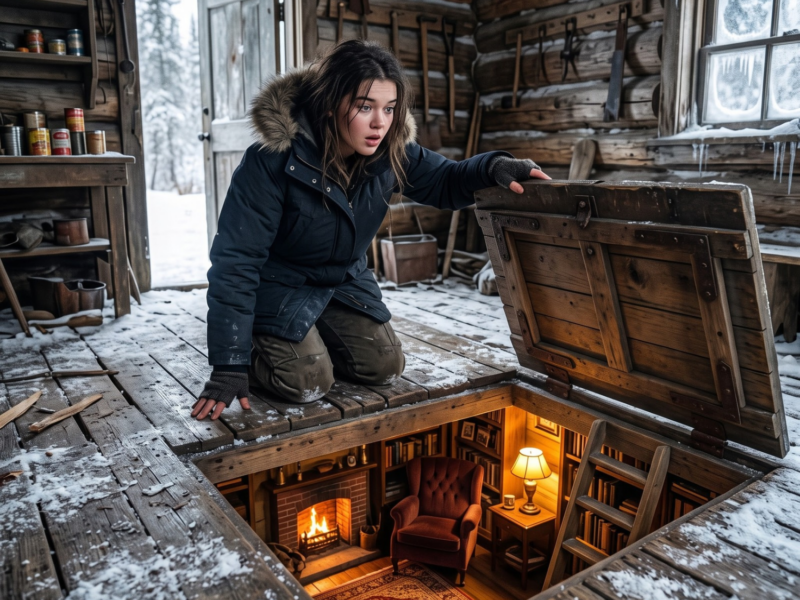
Her Parents Left Her in a Freezing Cabin and Took Everything—Then She Opened a Hatch Beneath floor
THE LETTER FROM EMTT VOSS
Back in the cabin, the stove fire had burned low. She fed it two fresh splits of pine until the flames roared back, casting a warm orange glow across the floor.
Dragging the wooden table close, she set the metal box in front of her, with Dutch settling heavily against her leg. The metal box wasn’t locked; a simple latch, stiff with cold, yielded to her thumb, lifting the lid.
Resting right on top, folded once, was a single sheet of lined notebook paper. Across the front, written in heavy pencil with a hand that pressed hard and slanted sharply to the right, were two words:
For Ren.
Her own name, written by someone who had been dead for a year and whom she had always been told had never wanted to know her at all.
Her hands were shaking. She unfolded the paper, held it close to the lamp, and read:
If you’re reading this, then they finally brought you here, and I am sorry it took so long.
My name is Emtt Voss. I am your mother’s father, which makes me your grandfather—though I expect by now you’ve been told differently. You’ve maybe been told I didn’t want you. You’ve maybe been told a lot of things. I am not going to spend this letter calling other people liars. Let me just tell you what is true, and you can sort the rest.
This cabin is mine. I built it the summer your mother turned four, log by log, with a borrowed mule and a chainsaw that quit on me twice a day. I cut the trees off this very ground. The cellar you climb down into? I dug it myself because I wanted to leave this letter where the cold would eventually lead an honest person to it. The table you’re sitting at, the bed, the chairs—these hands made all of it. Nobody gave me this mountain. I built what stands on it with these two hands.
And I am leaving it to you because you’ve got the same hands, even if nobody ever bothered to tell you so.
Ren stopped. She read that line again: The same hands.
She turned her own palms up in the lamplight and looked at them—the calluses already forming from two days of handling the hatchet and the broom. A strange, swelling pressure bloomed in her chest, and she kept reading:
It’s all yours now—not how they’ll tell it to you. Yours with papers signed, filed, and legal with a lawyer in town who has the rest and is waiting for you to come down and ask. They will try to make you believe this place is nothing, a ruin, a burden. They have their reasons, and the reasons are in that strong box you can’t open yet. We’ll get to that.
For now, I just need you to know one thing before you know anything else: You were wanted. You have always been wanted by me, and by your mother, who loved you more than her own life, and who would have brought you up here every summer of your childhood if the world had been a kinder place than it turned out to be.
Hold on to that. Light the stove. Read the rest when you’re ready.
It was signed simply: Your grandfather, Emtt Voss.
Ren sat very still. The fire ticked in the stove. The wind wrapped around the corner of the cabin and rushed past. Dutch let out a long breath against her knee and laid his chin upon her boot. She placed one hand deep into the warm fur at the back of his neck, holding on to him like a lifeline.
They had taken her phone. They had taken her car, her money, and the box of her mother’s things. And they had done it all while remaining blissfully unaware that the one thing in the world that was truly, legally hers had been waiting under the floorboards the entire time—hidden in the dark, cold patience of stone.
She looked around the room with entirely new eyes. He had made the table her elbows rested on. He had made the bed she shivered in, the two chairs, the shelf of dishes, and the heavy door that kept the winter out. A whole house built by the grandfather she had been raised to hate. Every joint of it had been cut by the same hands that had written the shaking letter currently clutched in her fingers.
Tucked inside the lid of the box, folded small, was a second slip of paper, and this one wasn’t tender at all. It was pure practicality:
The stove damper sticks. Hit it twice on the left and it drops. Sweet water comes from the spring behind the woodshed. Follow the blue paint on the trees. It beats the barrel. The beans in the blue jars are good. The green lids went off—throw them out. Split the standing dead first. It burns dry.
He had thought of every single detail. A man planning a welcome for a guest he could never be sure would actually arrive—leaving her the small mercies that would keep her alive long enough to work up the nerve to read the rest.
She thought of all the times she had been told the story of her grandfather. When she was thirteen, she had asked why she had no grandparents like the other kids. They had been sitting at the dinner table. Garrett had gone quiet and stared down at his plate. Sandre had answered for him, as she answered most things:
“Your mother’s father is not a kind man, sweetheart,” Sandre had said. “He cut your mom off when she married your dad, and said some terrible things. When she passed, we reached out. We tried. And he wanted nothing to do with us. Some people are just bitter. It’s better you don’t carry that around.”
“Did he ever try to see me?” Ren had asked.
“No,” Sandre had said smoothly. “He never did. I’m sorry, honey. I know it’s hard.”
Garrett had said nothing at all. He had simply reached over, refilled his water glass, and changed the subject to the weather. And Ren had carried that hard, flat rejection in her chest for the rest of her childhood—the crushing knowledge that her own blood had taken one look at the idea of her and turned away.
Looking down at the letter in her hand—at the hard, slanted pencil and the words You have always been wanted—the small, flat stone in her chest cracked clean down the middle.









