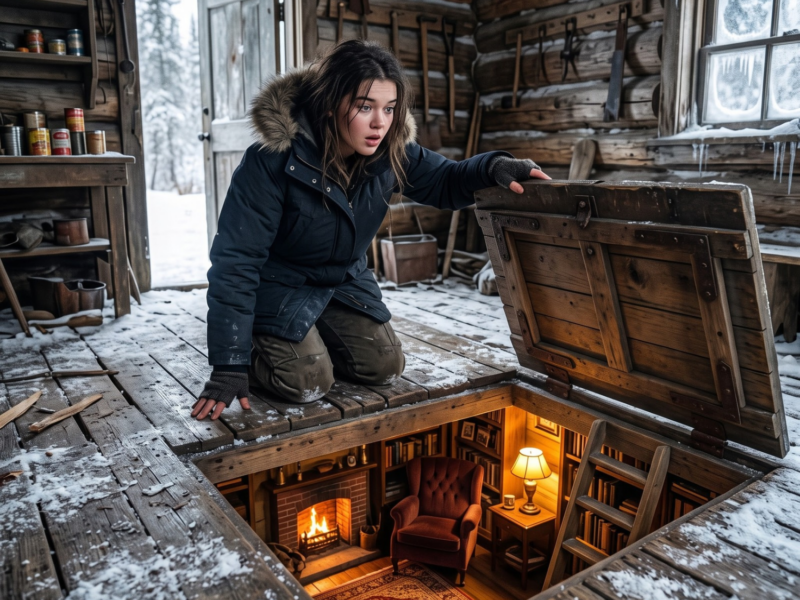
Her Parents Left Her in a Freezing Cabin and Took Everything—Then She Opened a Hatch Beneath floor
DUTCH
In the morning, the world was white, silent, and blindingly bright. The storm that had threatened all week had moved off to the east, leaving behind a fresh foot of snow and a sky scrubbed hard and blue.
Ren stood on the porch sipping black coffee boiled in the dented kettle, and for a few fleeting minutes, the country was so painfully beautiful it hurt to look at. The timber was heavy with snow; the clearing was an untouched, sparkling blank page; and the far blue ridges stacked one behind the other to the edge of the sky. It was a view people drove hours to see.
She owned it now. Apparently, she couldn’t eat it, she couldn’t call anyone with it, and it couldn’t drive her down to civilization—but it was hers.
That was when she heard the sound from the woodshed: a low, broken whine, followed by a frantic scuffle, and then absolute silence.
She moved carefully, the hatchet gripped tightly in one hand. At the back of the shed, wedged deep into the narrow gap between the wood stack and the log wall where the cold couldn’t bite quite as hard, there was a dog.
He was a massive animal—or had been once—a German shepherd mix, black and tan, heavily frosted with gray around the muzzle. His ribs showed in long, shadowed ridges beneath a coat matted with burrs and old ice. He lifted his head when she approached, watching her with dark, steady eyes. He didn’t growl, and he didn’t run. He looked at her the way an old soldier looks at a stranger—taking her measure, too bone-tired to care much what the verdict was.
“Hey,” Ren said softly. “Hey, easy.”
The dog thumped his tail once against the frozen dirt. She didn’t have much to offer—just a battered granola bar and the heel of a sandwich gone hard in her bag. She crouched down at a respectful distance, set the food on the snow, and waited.
The dog dragged himself up, limped forward, and ate the food in two gentle bites, taking nothing from her fingers. Then he sat down directly in front of her, leaned his heavy, bony weight against her knee, and let out a long, shuddering sigh.
And that was that. They had decided on each other.
“Where’d you come from?” she murmured.
He wore no collar. His paw pads were severely cracked from the cold, and one of his back legs dragged slightly, stiff with old injury. But beneath the starvation and neglect, he retained the heavy bone structure of a dog that had once been deeply loved and well-kept. Somebody had cherished this animal. Somebody had either let him go or been torn away from him. Ren knew that particular ache intimately.
“Come on then,” she said.
She stood up, and the dog followed her across the clearing, up the sagging porch steps, and into the cabin, immediately curling up in front of the warm stove as though he had done it a thousand times before. He fell into a deep, twitching sleep—the exhausted sleep of a creature that had finally let down its guard after a long, brutal war.
Ren sat beside him, resting her hand against his gaunt side, feeling the steady rise and fall of his ribs. For the first time since the car had driven away, she wasn’t entirely alone.









