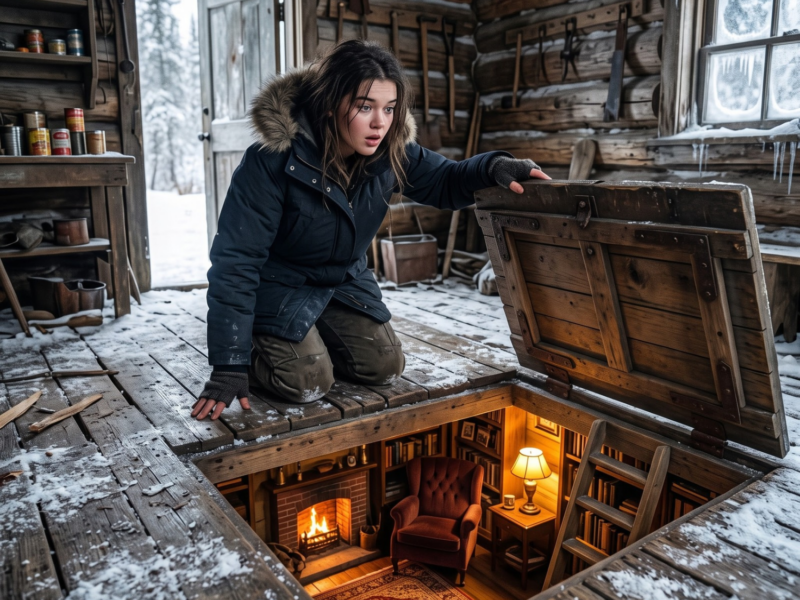
Her Parents Left Her in a Freezing Cabin and Took Everything—Then She Opened a Hatch Beneath floor
THE STRONG-BOX OF BONDS
For a long moment, nobody spoke. The mountain wind shoved against the cabin walls and rushed past into the pines.
Then Ren stood up, walked to the corner, lifted the hatch, and climbed down into the cellar while her parents watched in stunned silence. She re-emerged carrying the heavy iron strongbox, setting it on the wooden table between them with a dull, echoing thud.
She flicked the rusted iron hasp open.
It wasn’t filled with loose cash—though there were bundles of old twenties, softened by age, stacked neatly inside. Most of it was paper: United States savings bonds, dozens of them, stiff and official, each one made out in meticulous pencil to the exact same name: Ren Sailor.
The earliest was dated the year she was born. There was one for every single year following, purchased one bond at a time by a man on a fixed income—scraping together spare dollars he couldn’t really afford to lose, putting them away every spring around her birthday for a granddaughter he was legally forbidden to meet, funding a college education he hoped she’d someday pursue, investing in a life he knew he’d never be permitted to watch her live.
She had counted them the night she first broke the box open. There was a bond for every birthday of her life—including the ones where nobody sang to her. There was one for the year she turned nine and cried herself to sleep because a schoolmate asked why no grandparents ever came to watch her play in the school production. He had bought a bond that year too. He had shown up for every milestone she had ever crossed. In the only currency a locked-out man had left, he had quietly deposited his love in pencil down in the dark.
Garrett made a sound like he’d been struck in the chest. “He was saving for me,” Ren whispered, her voice trembling. “My whole life. While you were telling me he didn’t care whether I existed, he was building me a future a little bit at a time and locking it under his floor.”
She touched the stiff paper of the bonds, reading her own name written over and over in that hard, slanted hand. “This is what you came up here to make me sign away. Not a ruin. Not a burden. This.”
Sandre looked at the strongbox and said nothing at all, because there were no words left that wouldn’t make the wreckage worse.
She tried once more near the end, purely out of habit, because bargaining was the only language she truly understood. “We could do this together,” she said quietly, not quite begging. “As a family. You wouldn’t even have to trust us—we can get lawyers, split it fairly. Everyone walks away better off than when they came.”
And Ren understood, listening to her, that Sandre genuinely could not picture a human being looking at that much money and choosing anything else. To her, the bonds were the ultimate treasure and the letters were just trash; and that fatal disconnection, more than anything else, was the most broken thing about her stepmother.
It was Garrett who moved first. He stood up without a word, pushed open the heavy cabin door, and stepped out into the falling snow. Ren heard the truck door open and shut, and for one cold second, she thought he was fleeing—driving away just as he’d run from every hard truth his entire life.
But he returned a minute later carrying the cardboard box.
The box containing the photographs, the cassette tapes, and the little glass bird—the very box they had stripped from this porch just two days prior. He set it down on the table gently, as if it might shatter at a touch.
“I couldn’t throw it out,” he said, staring at the floor. “Sandra wanted to after the funeral—said it wasn’t healthy keeping it around. I told her I did. I lied and said I took it to the dump. It’s been sitting in the crawl space under our bedroom this whole time. I’d go down there sometimes when things got bad and just sit with it in the dark.”
He stepped back, his hands empty, looking across the table at his daughter. “It’s the only brave thing I ever did, and I did it in a crawl space where nobody could see me. That’s the kind of man I turned out to be.”
Ren placed both hands flat against the worn cardboard, feeling the hard contour of the glass bird through the side. “Take Sandre and go home,” she said quietly. “Tonight.”
Garrett nodded. He didn’t argue—though it was a vastly different kind of silence than his compliance of old. “What do you want me to do about any of it? The will, the land, all of it? Tell me, and I’ll do it.”
“I don’t know yet,” Ren said. And it was the absolute truth.
“But you’re going to leave it to me to decide,” he murmured. “For once, somebody in this family is going to leave a choice to me.”
Garrett studied her face for a long, quiet moment. Whatever he saw there, it wasn’t the terrified, compliant kid he had driven up that road forty-eight hours ago. It was someone who had walked down a mountain in a blizzard and climbed back up it on pure principle.
He nodded slowly, as if filing the fact away in a secure place he wouldn’t lose—recognizing it as the single piece of grace he’d been handed all night, realizing that the daughter he’d failed had turned out infinitely harder to break than anyone in that house had calculated.
She walked them to the door. Sandre slipped out into the dark without another word, looking physically smaller than when she’d arrived.
Emtt paused on the threshold, snow swirling around his shoulders, looking as though he wanted to reach out and touch her. Then his eyes drifted to Dutch standing guard by her knee, and to the cardboard box on the table housing his dead wife’s memories, and he seemed to understand that he hadn’t earned the right to reach. Not yet.
“I’m sorry,” Garrett whispered. It was a miserably small offering to set against a lifetime of damage, and he seemed to know that too. He glanced down at the dog one last time. “He’s yours now, I guess. The shepherd.”
“He was always somebody’s,” Ren said softly. “He just had to wait for the right person to come back for him.”
Garrett took the words square in the chest. He swallowed hard. “Yeah. I guess that’s the going rate up here.”
Pulling his coat collar up, he stepped down the porch steps into the snow after his wife. The truck doors slammed, the heavy engine roared to life, and the headlights swung around, cutting through the timber as they headed back down the mountain her father had run from his whole adult life.
Ren stood in the doorway of the cabin that was legally hers, surrounded by the dog, the savings bonds, and the box holding her mother’s life, watching the red tail-lights shrink and wink out among the pines. She was alone at the top of the mountain in the truest, most complete sense of the word—for the first time she could remember.
EPILOGUE: THE CHAIR FINISHED
The snow held firm for another six weeks, and then it finally began to break.
It retreated slowly at first, and then all at once: the massive drifts shrinking back from the cabin’s south wall, the frozen ruts running brown with rushing meltwater, and the wild columbines Emtt had sketched in his letters pushing up green along the spring path behind the woodshed.
By the time the dirt road was dry and stable enough for a vehicle to navigate, the cabin had transformed into something entirely different from the bleak trap her parents had abandoned her in.
Smoke rose from the stone chimney every single day. The windows shone clean and bright. The primitive outdoor water barrel was gone, replaced by a permanent supply line Wendell had helped her trench from the sweet mountain spring.
Inside the workshop, she had built a second bed frame out of standing dead pine—rough-hewn but structurally square, the joinery tight on the very first try.
Dutch had filled out over the winter into a magnificent, thick-coated animal with a fierce protective instinct and had taken to sleeping squarely across the threshold of the workshop door, guarding the one room in the cabin that mattered most.
Ren had changed too, hardening in ways that were harder to point at. She had regained the weight she needed. Her hands were calloused and completely sure of themselves on the tools. Some mornings, bent over the workbench in the early light, she caught herself humming low—a melody she didn’t consciously know, but whose rhythm lived deep in her bones.
She had finished the rocking chair.
It had taken her most of February, working by lamplight after the mountain cold drove her indoors. She had ruined two separate cherry wood blanks before finally mastering the exact compound curve her grandfather had envisioned, sanding the surface until her fingertips felt baby-smooth.
Rubbing the entire chair down with linseed oil from the shop until the wood emerged warm, deep, and gold, she set it proudly beside the stove where the light caught it best.
On the first night it was completed, she sat in it for a long time without rocking, because the mere act felt like more than she had earned. Then she let herself sway forward once, very slowly. The chair moved beneath her as if it had been waiting decades for her weight—custom-fitted to a body it was built for long before that body ever climbed the mountain.
That was the night she finally opened the very last letter.
It sat at the absolute bottom of the tin—the newest one, written in a hand noticeably shakier than the rest, dated the spring before he died. He must have known the end was close, though he didn’t dwell on it.
He wrote to tell her that the roof over the workshop needed a fresh course of cedar shakes on the north side, and exactly where to locate the best timber. He wrote that the dog—if he was still hanging around—was a brilliant judge of character and a terrible judge of porcupines.
And at the very bottom, where another man might have penned something grand or dramatic, he had written simply:
A cold house can still be a home, Ren. You just have to be the one who decides to light the stove. I’m sorry I never got to teach you that in person. I think you’ll figure it out. People like us generally do.
Ren read it twice while sitting in the chair he had crafted, inside the warm house she had fought to illuminate. Then she folded it neatly and slid it back into the tin.
She didn’t cry, because some truths eventually carry past the point of tears into a place that is quieter and far more permanent.
The money she left largely untouched. She had debated it extensively—the savings bonds, the cash, and the standing buyout offer from the timber company that could have made her, at nineteen, richer than anyone she had ever served at the diner.
In the end, she cashed a single bond—the oldest one—to pay for roofing materials, new cedar shakes, and a modest safety buffer, leaving the rest locked away untouched. She called the lawyer and instructed him to deliver her official answer to the timber corporation: No.
The old-growth pine on the north slope was the one thing her grandfather had stubbornly refused to surrender his entire life, and she found that she would refuse it too. Some inheritances weren’t about the cash value; they were about having the courage to say no.
“He’d have liked that, Fay said when Ren dropped by the store to share the news. “Lord Almighty, he’d have liked that a lot.”
In March, she got her grandfather’s old truck running—a faded green flatbed that had sat under a rotting tarp behind the shop since the winter he died. It required a new battery, a flushed fuel line, and a long, freezing afternoon with Wendell leaning under the hood beside her, naming each mechanical part as she cleaned it.
When the engine finally coughed, caught, and shook itself into a steady, throaty rumble, Ren sat behind the wheel with her hands at ten and two. She realized with sudden clarity that she could leave this mountain anytime she wanted to now.
The staying had become a deliberate choice rather than something inflicted upon her. There was a whole universe of difference between those two states of mind, and she had crossed the threshold without even noticing the exact day she did it.
Ren began coming down off the mountain once a week, just like her grandfather before her, and the little store had naturally evolved into a place where she belonged. Fay fed her hot soup, asked no intrusive questions, and slowly—over coffee cups across the counter—filled in a thousand small details about a mother Ren barely remembered and a grandfather she had never met.
She learned that Sylvie had originally dreamed of becoming a schoolteacher; that she possessed a fiery temper and a laugh that could carry across the entire store; and that she had carved her childish initials into the frame of the workshop door when she was twelve years old, and Emtt had deliberately left them there for thirty winters without ever sanding them out.
Ren went home that week, found the initials S. VOSS carved chest-high beside the doorframe, and stood for a long time with her thumb pressed into the grooves her mother’s knife had cut.
That same week, she took her own utility knife to the wood and carved her initials right beside her mother’s: W.S. under S.V.—a daughter signing her name beneath a mother who had never gotten the chance to teach her how.
Emtt would have left them both standing. She was certain of that, so she left them undisturbed. On quiet evenings, she would run her thumb over both sets of grooves simultaneously—the old ones worn soft by time, the new ones still crisp—and feel the crooked, unbreakable lineage of her family right there in the solid wood beneath her hand.
It was Wendell who gave her the first real money she ever earned with her hands.
He drove up one Saturday in April, stepped into the workshop, and turned a small, three-legged child’s stool over in his large, calloused hands. It was one she had crafted by copying her mother’s design, burning a name into the underside just as Emtt had taught a nine-year-old girl to do a lifetime ago.
He wanted six of them, he announced, for his daughter’s new kitchen. And he was going to pay her their full market value, and she wasn’t going to argue him down out of some misplaced notion that she owed him for plowing her road.
“You don’t owe me a damn thing, Ren,” Wendell said gruffly, cutting off her protest. “Your grandpa squared all my debts and then some years back, and I’m a long way from paying him off, even with these stools.”
He set the furniture piece down carefully on the workbench. “I’ll tell you what I told him once when he was feeling low: Out here, a person’s life is measured entirely by what they leave standing. The talk and the paper money burn off in the end. What’s still standing on its feet after a man’s gone? That’s the measure.”
He looked around the clean, warm shop—at the rocking chair by the stove, and at the young woman who hadn’t been broken after all. “He left you standing. That’s the whole of it. That’s the only score that ever counted up here.”
She manufactured the six stools for him. He paid her in cash peeled off a thick roll in his coat pocket and flatly refused to take a single dollar back. She dropped the bills into her old coffee can on the shelf—money she had earned entirely on her own terms.
And that night, sitting in the rocking chair, she realized she wasn’t waiting for anything anymore.
That was the realization that had taken the longest to settle into her bones. Her entire life, she had been waiting: waiting to be picked, waiting to be wanted, waiting for the day her father would look at her and not flinch, waiting for someone to decide she was worth keeping.
She had finally stopped waiting to be chosen the day she understood she had already been left everything that truly mattered—hidden under the floorboards by a man who had chosen her every single spring of a life she never got to share.
One warm evening near the end of summer, with the shop swept clean and Dutch stretched out across the threshold in a contented, gray-fuzz sleep, Ren carried her coffee out onto the porch her grandfather had built.
Sitting down on the top step, she looked out over the country he had bequeathed to her. The far ridges were turning a deep, velvety blue in the dusk, stacked one behind the other to the edge of the sky—the exact same view she had stared at on her first terrifying morning, when all she had owned was a frozen landscape she couldn’t eat.
She owned vastly more than the view now. She owned the right to say yes and the right to say no; she owned the stove, the door, and the hand on the latch. She owned a loyal dog, a found grandmother down the road, a chair she had finished with her own hands, and a name written over and over in a tin box by a man who had never given up on her once.
It wasn’t the life anyone else had chosen for her. It was the one she had been handed in the dark under the floorboards by the only person who had ever believed she was worth the saving.
Up here, with the twilight turning gold and her own smoke rising steadily from her own chimney, that turned out to be far more than enough to build the rest of a life upon.
Lifting her mug, Ren breathed in the crisp, cold pine air. And for the first time she could genuinely remember, she wasn’t waiting for anything at all.









