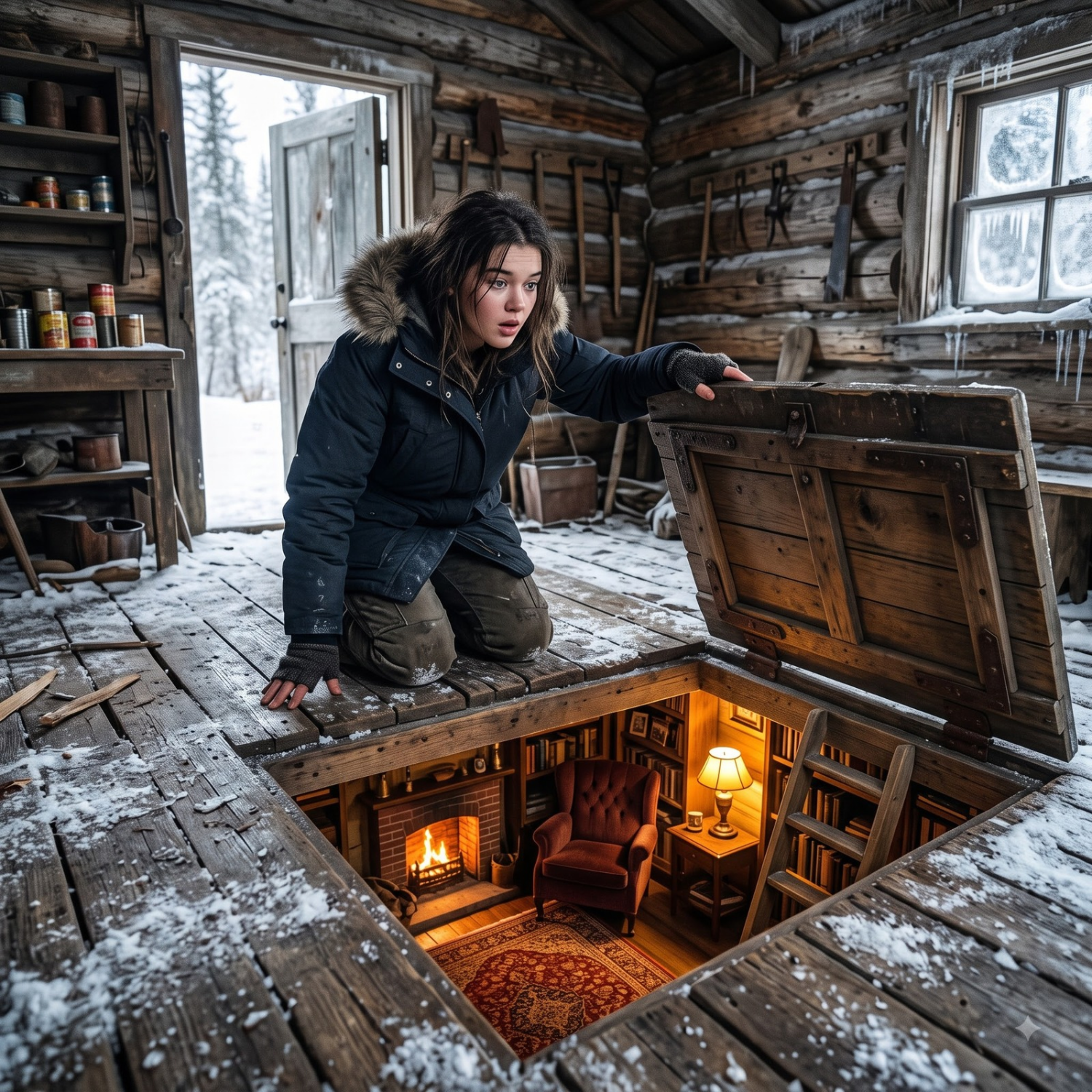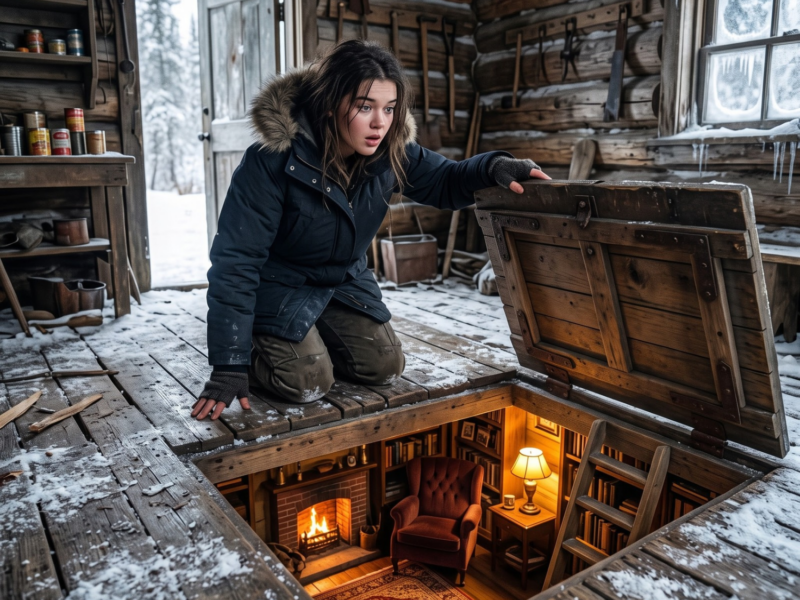
Her Parents Left Her in a Freezing Cabin and Took Everything—Then She Opened a Hatch Beneath floor
THE LONG DRIVE UP
The drive up had taken most of a gray, suffocating afternoon. She had ridden in the back seat with her knees pressed against a cardboard box, watching the paved highway devolve into a cracked county road, and the county road splinter into two frozen ruts climbing blindly through black, unyielding timber.
Sandre sat up front with the heater blasting and a travel mug of coffee she did not offer to share. Her father drove with both hands gripping the steering wheel, his knuckles white, saying almost nothing—which was how he handled everything now.
“It’s a real opportunity,” Sandre said around the second hour, breaking the silence. “Your own place. A lot of girls your age would kill for that.”
Ren looked at the back of the woman’s head. “Whose place was it?”
“Family land. It came to your dad.” Sandre took a sip of her coffee. “It’s been sitting empty. Somebody should use it.”
That was not quite an answer. But Ren had learned a long time ago that pushing Sandre only made the car feel colder. So, she watched the trees instead, noting how early the light died up here in the peaks, and told herself that maybe, just this once, the thing she was being handed was actually a thing, and not a trap.
The cabin sat in a small clearing at the end of the ruts. It was built of dark, squared logs gone silver at the corners, topped with a steep tin roof and a stone chimney furred green with old moss. A woodshed leaned heavily against one side, and a covered porch sagged near the steps. Snow had drifted up against the north wall in a long, clean curve. There were no tracks, no smoke, no light. The place possessed the absolute stillness of something that had been waiting a long time for a ghost to inhabit it.
Her father killed the engine. For a moment, none of them moved.
“Well,” Sandre said brightly, “here we are.”
They carried Ren’s two bags up onto the porch. Her father set them down by the door and stood there rubbing his hands, looking out at the heavy treeline instead of looking at his daughter. Sandre pushed the heavy wooden door open with her shoulder.
Inside, the cabin smelled of cold ash, old dust, and cedar. The light filtering through the small, grime-caked windows was thin and blue. There was a rough wooden table and two chairs. A cast-iron stove squatted against the stone chimney, a dented kettle still resting on its burner. A narrow iron bed frame stood along the far wall under a window, and a faded braided rug covered most of the wide-plank floor in the center of the room. Everything was coated in a soft, even film of dust—the untouchable dust of a place nobody had visited in years.
“There’s wood out back,” her father said, his voice rough and dry, as if he hadn’t used it in months.
“I saw the shed. I’ll be all right for the stove, Dad.”
He looked at her then, finally, and something flickered across his face—an expression she couldn’t quite name before it vanished. He still had her mother’s photograph in his wallet; Ren knew because she had caught a glimpse of it once. She also knew he couldn’t look at his own daughter for more than a second or two without breaking, and she had spent the years since the funeral pretending not to understand why.
“I need my phone back,” Ren said.
Sandre was already moving briskly toward the car. “No reception up here anyway. It would just die in the cold. We’ll hold it for you.”
“That’s mine. The money’s mine. I earned it—”
“And we are holding it for you,” Sandre interrupted in the flat, patient tone she reserved for decisions that were already final. “Until you’ve got yourself sorted out, you’ll thank us.”
Her father did not argue. That was the part Ren would turn over and over in the quiet days to come—he didn’t argue a single word. He reached down, picked up the cardboard box that held what was left of her mother—the photographs, the cassette tapes, and the little glass blue-and-gold bird Sylvia used to keep on the kitchen windowsill—and carried it back out to the car, placing it carefully in the trunk.
“That’s Mom’s,” Ren said, following them out onto the porch. The mountain air hit her like freezing water. “Dad, that’s all I have left of Mom.”
“It’ll be safer at the house,” Sandre said, sliding into the passenger seat. “You don’t want it getting damp up here.”
They got in. Her father started the engine. Ren stood at the top of the porch steps in her thin jacket, her arms wrapped tight around herself, watching the brake lights flare red as the car backed up and turned. And then she watched it slide away down the ruts into the dark timber, moving slow and careful, the exhaust hanging white in the still air.
It did not stop. Neither of them looked back.
She stood there until the mechanical whir of the engine died entirely away, leaving nothing but wind moving high up in the pines and the sharp, metallic tick of the cooling porch contracting under the frost. Then it was just Ren, the cabin, and the dark coming down.