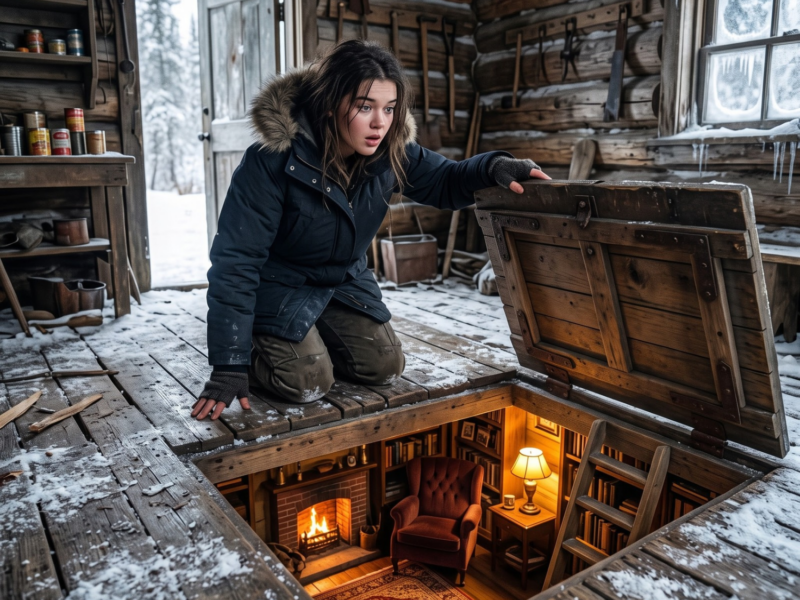
Her Parents Left Her in a Freezing Cabin and Took Everything—Then She Opened a Hatch Beneath floor
THE ROOT CELLAR
The light hit the bottom, revealing that the cavity was not a grave at all.
It was a room—small, but meticulously constructed. The walls were made of dry-laid, fitted stone, and the floor was packed earth, swept clean and bone-dry despite the heavy snow piled against the cabin exterior above. Someone had built this space with fierce, deliberate care. A low stone shelf ran along two sides at knee height.
This was no animal den; it was a root cellar—the kind a deeply self-reliant person digs so that their winter survival depends on no one but themselves.
Ren set the lamp on the stone edge and lowered herself down through the hatch. The drop was short. Her boots touched the swept earth, and she stood there, hunched beneath the low stone ceiling, turning slowly in a circle.
What she saw made her chest tighten in a way the winter cold never had.
The shelves were fully stocked. There were jars—dozens of them—quart jars of home-canned beans, tomatoes, and pickled vegetables. Dark shapes hung suspended in cloudy brine, each metal lid carefully wiped, coated with sealing wax, and labeled in neat pencil on strips of yellowed masking tape.
Sacks of rice and dried corn hung securely from ceiling nails out of the reach of mice. There was a fresh tin of lamp oil, a box of candles, several heavy wool blankets folded neatly inside a feed sack to protect them from dampness, a coil of sturdy nylon rope, a handax, a sharpening stone, a first-aid kit, and a rusted metal lunch pail.
Everything a person would need to silently wait out a hard winter on a mountain. Stocked and maintained as though whoever built it had known that one day, someone would come down here cold, hungry, and terrified—and would need to find precisely this.
She pressed the back of her hand against her mouth, struggling for breath.
“Dutch,” she called up softly.
The dog’s pale face peered down over the square of light above her, ears pricked forward. “It’s okay. We’re okay.”
She had come up the mountain certain of two things: that she had been discarded like trash, and that she would have to claw through the winter on a sack of weevilly flour and whatever meager rations she could scavenge.
Both of those things had just stopped being true. She didn’t fully understand it yet, but she understood the jars. And the jars told her that someone had thought of her—or thought of someone—long before she had ever climbed those frozen ruts.
Scanning the shelves, she noticed one row near the bottom labeled in a different hand: rounder, less confident letters, the careful printing of a child practicing patience. Plum, one label read, and underneath it, a name: Sylvie.
The date beside it came from a summer when her mother could not have been more than nine years old. The jam inside had long since turned dark, heavily sugared, and past eating, yet it had been preserved down here in the dark earth all this time. Ren crouched in front of her mother’s childhood handwriting until the chill in her knees reminded her she still had a fire to maintain upstairs.
On the stone ledge at the far end sat two items that were not food.
The first was a metal box the size of a thick book—gray-green and dull, resting on a folded square of oilcloth to keep it away from the stone moisture. The second was a heavy iron strongbox equipped with a hasp and a formidable padlock that wouldn’t yield without its key.
She tested the strongbox lid out of sheer reflex, but it didn’t budge. Her fingers came away dusted with bright orange rust.
Instead, she took the metal box and the bundle of letters leaning against the wall—tied tightly with twine and as dry as the day it was bound—handed them up through the hatch, and climbed out after them.









