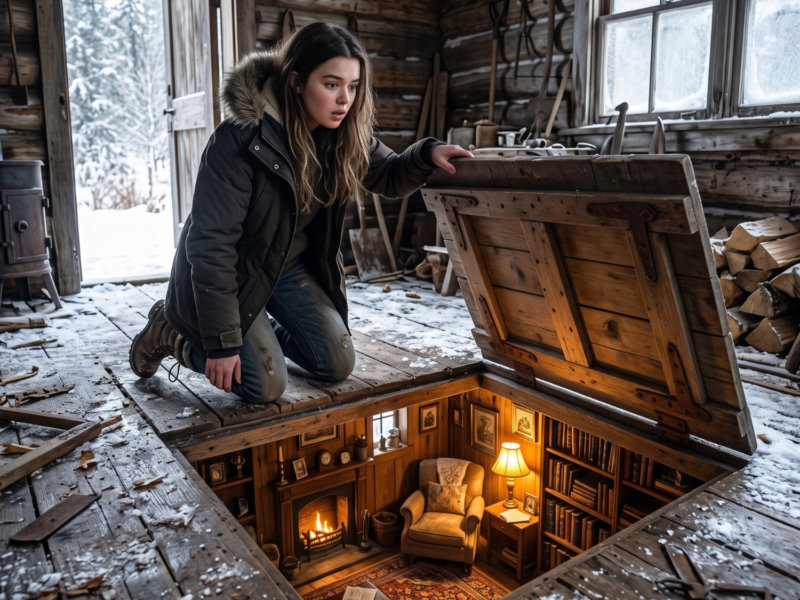
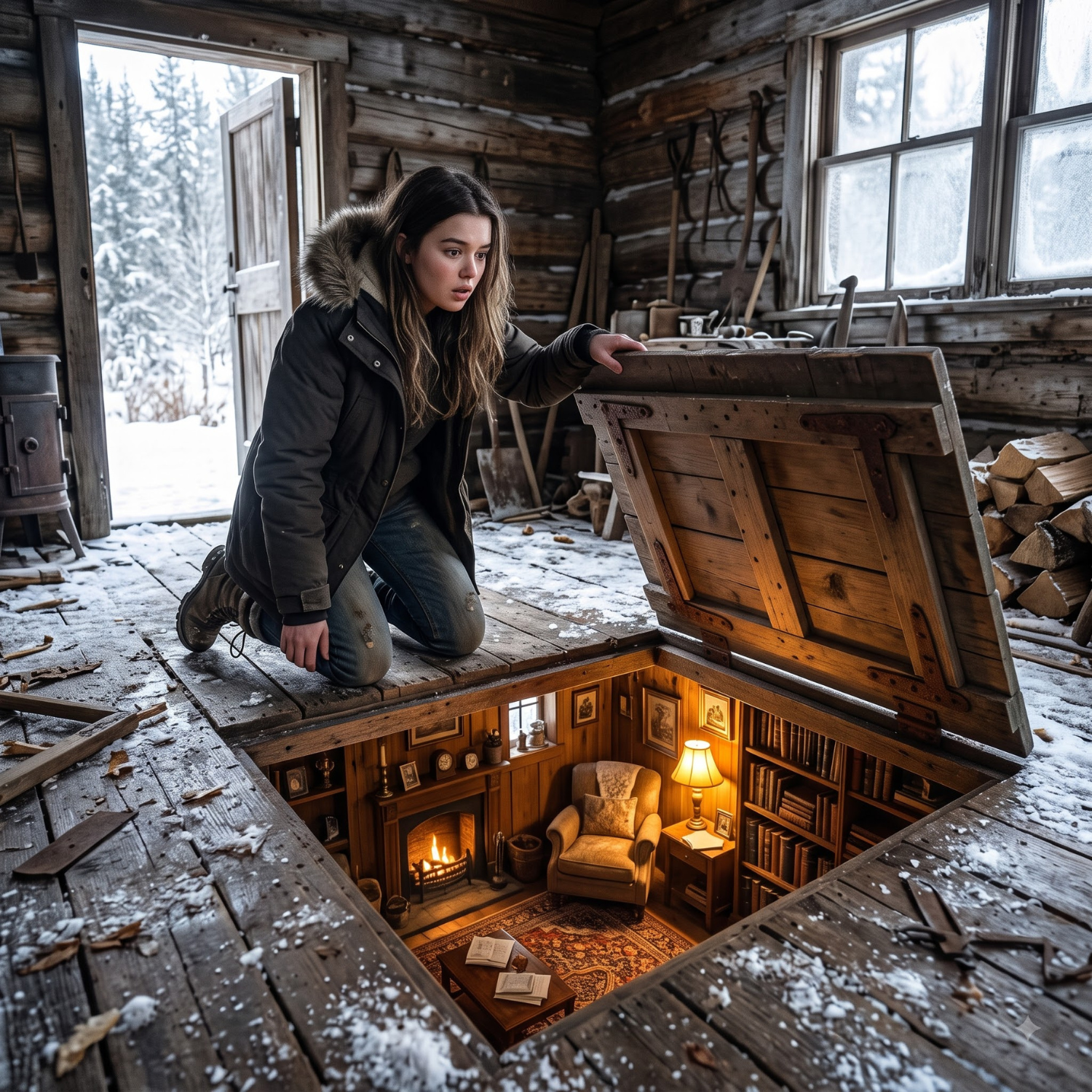
Her Parents Left Her in a Freezing Cabin and Took Everything—Then She Opened a Hatch Beneath floor
Her Parents Left Her in a Freezing Cabin and Took…
At nineteen, Ren Sailor had stopped expecting much from anyone. Life had trained her to anticipate the drop, to brace for the moment when a promise turned into a penalty. So when her father, Garrett, and her stepmother, Sandre, drove her up a brutal, ice-choked logging road in the worst week of winter and told her the cabin at the top was hers now—a gift, a fresh start—she almost let herself believe them. Almost.
The drive up had consumed the better part of a gray, suffocating afternoon. Ren rode in the back seat of the sedan, her knees pressed hard against a cardboard box that contained the fragile, meager remnants of her dead mother’s life. She watched the interstate highway narrow into a county road, and the county road dissolve into two frozen ruts climbing steeply through a canyon of black timber.
Up front, Sandre sat with the heater blasting, her manicured hands wrapped around a stainless-steel travel mug of coffee she did not offer to share. Garrett drove with both hands strangled on the steering wheel, his jaw locked tight. He said almost nothing. That was how he handled most things now: with a profound, cowardly silence.
“It’s a real opportunity, Ren,” Sandre said, somewhere around the second hour, not turning around. “Your own place. A lot of girls your age would kill for that kind of independence.”
Ren looked at the back of the woman’s perfectly styled blonde head. “Whose place was it?”
“Family land,” Sandre said smoothly. “It came to your dad. It’s been sitting empty for years. Somebody should use it.”
It was not quite an answer. But Ren had learned a long time ago that pushing Sandre only made the atmosphere in the car colder than the weather outside. So, Ren watched the pines blur past, noting how early the light died at this elevation. She told herself that maybe, just this once, the thing she was being handed was actually a gift, and not a trap.
The cabin sat in a small, desolate clearing at the absolute end of the ruts. It was built of dark, squared logs that had gone silver at the corners from years of weather, topped with a steep tin roof and a stone chimney furred green with ancient moss. A woodshed leaned heavily against the north wall. A covered porch sagged a little at the near end. Snow had drifted up against the structure in long, unbroken curves.
There were no tire tracks. No footprints. No smoke. No light. The place possessed the eerie, heavy stillness of something that had been waiting a very long time.
Garrett killed the engine. The silence that rushed in was absolute.
“Well,” Sandre said brightly, clapping her hands together. “Here we are.”
They carried Ren’s two duffel bags up onto the porch. Garrett set them down by the heavy wooden door and stood there, awkwardly rubbing his gloved hands together, looking at the treeline instead of at his daughter. Sandre pushed the door open with her shoulder.
Inside, the cabin smelled of cold ash, dry cedar, and undisturbed dust. The light filtering through the small, frosted windows was thin and blue. There was a rough-hewn table and two chairs. A heavy cast-iron stove squatted against the stone chimney, a blackened kettle still resting on its iron grate. A narrow bed frame stood along the far wall, and a large, braided oval rug covered most of the plank floor in the center of the room.
Everything was coated in a soft, even film of dust—the dust of a place nobody had breathed in for years.
“There’s wood out back,” Garrett said, his voice coming out rough, like he hadn’t used it in a week. “I saw the shed. You’ll be all right for the stove.”
“Dad,” Ren started.
He looked at her then, finally, and something agonizing crossed his face. It was gone before she could name it. He still carried her mother’s photograph in his wallet; Ren knew because she had seen it by accident months ago. She also knew he could not look at his own daughter for more than a second or two without flinching, and she had spent the years since the funeral pretending not to understand why.
“I need my phone back,” Ren said, holding out her hand.
Sandre was already moving swiftly back toward the open door. “No reception up here anyway, sweetie. The battery would just die in the cold. We’ll hold it for you.”
“That’s mine,” Ren said, her voice tightening. “And the money. The envelope of cash from the diner. I earned it.”
“And we are holding it for you,” Sandre said, deploying the flat, infinitely patient tone she used when a thing was already decided and debate was terminated. “Until you’ve got yourself sorted out up here. You’ll thank us later.”
Garrett did not argue.
That was the part Ren would turn over and over in her mind in the dark days that followed. He did not argue. Instead, he walked back to the car, opened the rear door, and picked up the cardboard box. The box that held what was left of Sylvie: the photographs, the cassette tapes, and the delicate little blue-and-gold glass bird Sylvie used to keep on the kitchen windowsill. He carried it to the trunk and set it inside.
“That’s Mom’s,” Ren panicked, rushing out onto the porch. The brutal cold hit her like a physical blow. “Dad, that’s all I have of Mom.”
“It’ll be safer at the house,” Sandre called out, climbing into the passenger seat. “You don’t want it getting damp up here. Love you, Ren!”
They got in the car. Garrett started the engine.
Ren stood at the top of the porch steps in her thin, canvas jacket, her arms wrapped tightly around herself. She watched the brake lights flare red against the snow as the car backed up and turned around. She watched it slide away down the icy ruts into the dark timber, moving slow and careful, the exhaust hanging white in the still air.
It did not stop. Neither of them looked back.
She stood there until the sound of the engine was entirely gone, swallowed by the mountain, until there was nothing left but the wind moving high up in the pines and the sharp tick of the cooling porch wood under the frost.
Then, it was just Ren, the cabin, and the dark coming down.
Related Articles

They Mocked the Widow’s Dirt Cellar—Then the Freeze Left Every Cabin Cold but Hers Warm
They Mocked the Widow’s Dirt Cellar—Then the Freeze Left Every Cabin Cold but Hers Warm…

A Homeless Veteran and His German Shepherd Inherited a Ridge No One Wanted — 35 Feet In, They Found
Chapter 1 / 7 A Homeless Veteran and His German Shepherd Inherit… A Homeless Veteran…

Neighbors Laughed When He Built A Cabin Inside An Old Barn—Until It Kept His Home 35 Degrees Warmer
Chapter 1 / 8 Neighbors Laughed When He Built A Cabin Inside An… Neighbors Laughed…

His Sod House Had No Woodpile in January – Until the Trains Stopped and the Town Came Begging
Chapter 1 / 10 His Sod House Had No Woodpile in January – Until t……

She Built Her Cabin Over the Woodshed and Never Burned Wet Wood Again
Chapter 1 / 8 She Built Her Cabin Over the Woodshed and Never Bu… She…

The Duke Abandoned Her on Their Wedding Day—Years Later, He Discovered What He Had Lost
Chapter 1 / 7 The Duke Abandoned Her on Their Wedding Day—Years… The Duke Abandoned…

He Wedged a Tiny A Frame Into a Crevice Before Winter and His Family Slept at 75°F While Town Hit
Chapter 1 / 7 He Wedged a Tiny A Frame Into a Crevice Before Win……

He Was Too Old to Ride—So He Bought the Ruined Ranch and Found the Room Behind the Fireplac
Chapter 1 / 5 He Was Too Old to Ride—So He Bought the Ruined Ran……

Settlers Laughed at His Underground Heat Recovery Duct — Until It Kept His Cabin 71°F Warmer
Chapter 1 / 9 Settlers Laughed at His Underground Heat Recovery… Settlers Laughed at His…

A Navy SEAL Built a Home Inside a Mountain—Then His Dog Warned Him Before the Storm
Chapter 1 / 5 A Navy SEAL Built a Home Inside a Mountain—Then Hi… A…