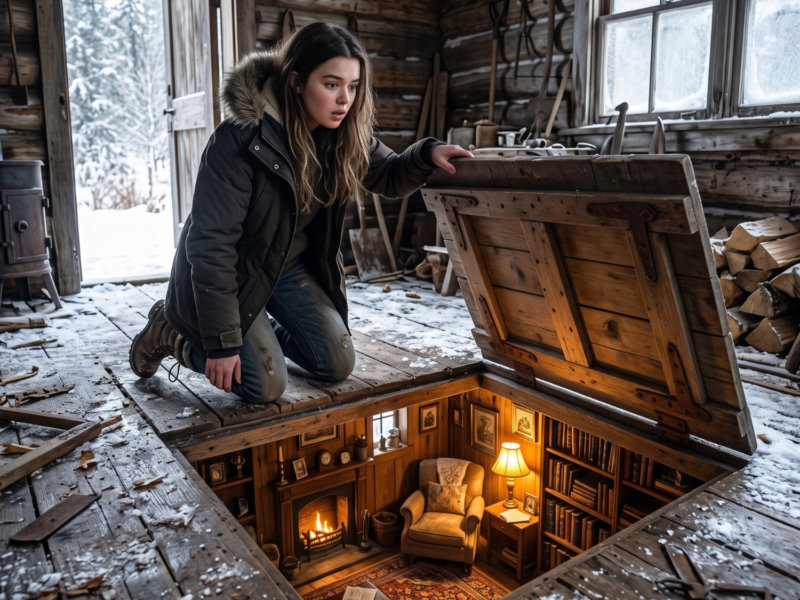
Her Parents Left Her in a Freezing Cabin and Took Everything—Then She Opened a Hatch Beneath floor
Thaw
The snow held its grip on the mountain for another six weeks, and then, finally, it began to go.
It went slowly at first, and then all at once. The massive drifts shrank back off the south wall of the cabin, the ruts of the road ran brown and loud with meltwater, and the vibrant purple columbines her grandfather had so painstakingly drawn in the margins of his letters pushed up aggressively green along the spring path behind the woodshed.
By the time the road was bare enough for a normal car to make it up the grade, the cabin was a fundamentally different place than the one her parents had left her in to break.
Smoke rose from the stone chimney now all day, every day. The windows were sparkling clean, letting the sun pour in. The frozen water barrel was gone, replaced by a permanent PVC line Wendell had come up and helped her run directly from the sweet spring. And there was a second bed frame she had built herself out of standing dead pine. It was rough but perfectly square, with the complex joints cut incredibly tight on the very first try—which had surprised her, until she simply stopped being surprised by what her hands innately knew how to do.
Dutch had filled back out over the winter into a massive, handsome animal with a thick, glossy coat and a very vocal opinion about everything. He had taken to sleeping directly across the threshold of the workshop door, fiercely guarding the one room in the cabin that mattered most.
Ren had changed, too, in ways harder to point at in a mirror. She had put back on the weight she desperately needed. Her hands had gone hard, calloused, and exceptionally sure on the heavy tools. And some mornings, bent over the workbench in the early light, she caught herself humming low—a tune she did not consciously know she knew—and she did not always make herself stop.
She had finished the arms.
It had taken her most of February, working meticulously by lamplight after the bitter cold drove her indoors. She ruined two expensive pieces of cherry wood before she finally understood the exact, graceful curve her grandfather had wanted, sanding until her fingertips went completely smooth. But she had finished the arms, and she had rubbed the whole chair down with the linseed oil from the shop until the wood came up warm and gold. She had set it by the stove, exactly where the light was best.
The first night it was done, she sat in it for a very long time, and did not rock, because rocking felt like more luxury than she had earned. Then, she let herself push off once, slow, and the chair moved under her like it had been waiting a lifetime to do it. Fitted perfectly to a body it was built for before that body ever climbed the mountain.
That was the night she finally read the absolute last letter.
It was hidden at the very bottom of the tin, the newest one, written in a handwriting much shakier than the rest, penned the spring before he died. He must have known the end was close. He did not say so.
He told her the roof over the shop needed a new course of cedar shakes on the north side, and exactly where to find the good cedar in the valley. He told her the dog—if he was still hanging around—was a brilliant judge of people and a terrible judge of porcupines.
And at the end, where another man might have written something grand or melodramatic, he had written this:
A cold house can still be a home. You just have to be the one who decides to light the stove. I am deeply sorry I never got to teach you that in person. I think you’ll figure it out. People like us generally do.
Ren read it twice, sitting in the chair he made, in the warm house she had lit. And then she folded it and put it back in the tin. And she did not cry, because some things go past crying into a place much quieter and vastly more permanent.
The money she left mostly alone.
She had thought about it a great deal. The bonds with her name on them. The cash. The standing offer from the timber company that could have made her, at nineteen, richer than anyone she had ever served hash browns to at the diner.
In the end, she cashed exactly one bond—the oldest one—to buy supplies to fix the roof, buy the good cedar, and put a little cash by for emergencies. And she left the rest alone. She called the lawyer and told him to give the timber company her final answer, which was a definitive no.
The old growth on the north slope was the one thing her grandfather had fiercely refused to sell his whole life, and she found that she would refuse it, too. She realized that some inheritances are not the money; they are the right to say no.
“He’d have liked that,” Fay said, wiping a tear when Ren told her the news at the mercantile. “Lord, he’d have liked that a whole lot.”
She got her grandfather’s truck running in March. It was an old, faded green flatbed that had sat under a tarp behind the shop since the winter he died. It took a new battery, a fresh fuel line, and a long, cold afternoon with Wendell leaning under the hood beside her, naming each engine part as she cleaned it.
And when the engine finally caught and shook itself violently to life, she sat behind the wheel with her hands at ten and two, and understood that she could leave the mountain absolutely anytime she wanted to now.
The staying had become a thing she chose, not a thing that had been done to her. There is a whole world of difference between those two states of being, and she had crossed it without quite noticing the day she did.









