Her Parents Left Her in a Freezing Cabin and Took Everything—Then She Opened a Hatch Beneath floor
The Ghost in the Cellar
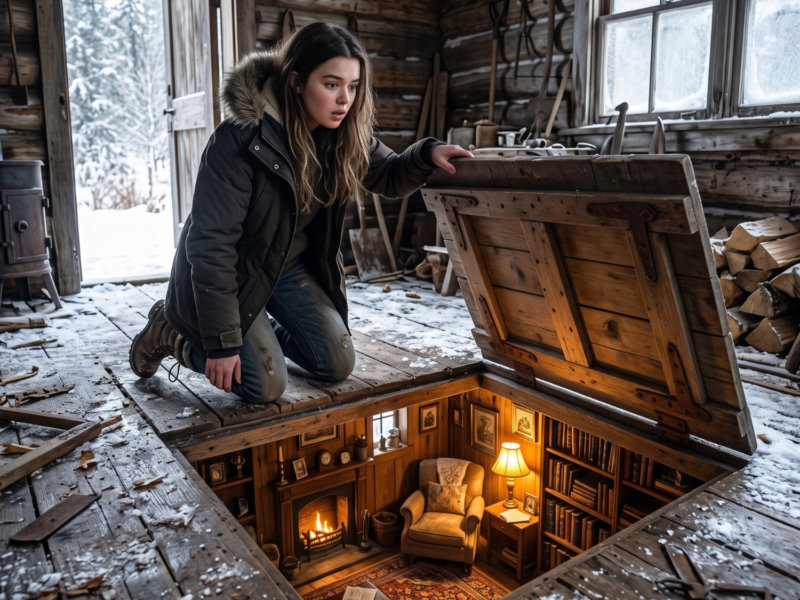
The light reached the bottom. It was not a grave.
It was a room. A small one, but a real, architectural room. Walls of flawlessly fitted stone and a floor of packed earth swept perfectly clean. It was as dry as a closet, even with tons of snow piled against the cabin above ground. Someone had built it with immense care, the rock chinked tight, a low, sturdy wooden shelf running along two sides at the height of her knee.
This was no animal’s den. It was a root cellar. The specific kind a careful, intelligent man digs so his survival in winter does not depend on anyone but himself.
Ren set the lamp on the stone ledge and lowered herself down through the hatch. The drop was short. Her boots touched the swept earth. She stood there, bent slightly under the low stone ceiling, turning slowly in the golden light.
What she saw made her chest go tight in a way the freezing air never had.
The shelves were fully stocked.
There were jars. Dozens of them. Heavy glass quarts of preserved beans, tomatoes, and pickled vegetables. Dark shapes suspended in cloudy brine. Each metal lid had been meticulously wiped, sealed with wax, and labeled in neat pencil on a strip of masking tape. There were heavy canvas sacks of rice and dried corn hung from iron nails out of the reach of mice. A massive tin of lamp oil. A wooden box of tallow candles. Three thick wool blankets folded inside a waterproof feed sack against the damp. A coil of good hemp rope. A sharp hand-axe. A whetstone. A metal first-aid kit, and a rusted metal lunch pail.
It was absolutely everything a person would need to comfortably wait out a brutal, hard winter on a mountain. Set down and kept in a state of perfect readiness, as though whoever had stocked it had known, with prophetic certainty, that one day someone would climb down here—cold, hungry, and terrified—and would desperately need to find exactly this.
She pressed the back of her hand against her mouth and breathed a shaky breath.
“Dutch,” she called up softly.
The dog’s pale, gray face hung over the square of light above her, his ears pitched forward.
“It’s okay, boy. We’re okay.”
She had been driven up this mountain completely certain of two horrific facts: that she had been utterly thrown away by her family, and that she would have to slowly starve through the winter on a single sack of weevily flour and whatever she could ration.
Both of those things had just violently stopped being true.
She did not fully understand it yet, but she understood the jars. And the jars explicitly said that somebody had thought of her. Or, thought of someone, long before she had ever climbed those frozen ruts.
She knelt closer to the shelves. One row near the bottom was labeled in a completely different handwriting. It was rounder, less sure. The painstaking printing of a child practicing care.
Plum, one label read. And directly under it, a name: Sylvie.
The date written beside it came from a summer when her mother could not have been more than nine years old. The jam inside had gone dark and heavily sugared, long past the point of safe eating, but it had been kept anyway. Kept down here in the cold dark all this time, preserved like a holy relic.
Ren crouched in front of her mother’s careful girlhood printing until the chill seeping into her knees reminded her she still had a fire to keep alive above ground.
On the stone ledge at the far end of the cellar sat two things that were absolutely not food.
The first was a heavy metal box, roughly the size of a thick dictionary. It was painted a drab gray-green, dull with age, with a folded square of oilcloth tucked carefully under it to keep the moisture off the stone. The second object beside it was a heavy iron strongbox, featuring a thick hasp and a massive brass padlock that would absolutely not give up what it held without the proper key.
She tried the lid of the strongbox out of reflex. It did not move a millimeter. Her fingers came away orange with old rust.
She took the gray metal box instead. She gathered the thick bundle of letters from where it leaned against the stone wall, tied tight with kitchen twine and as dry as the day it was bound. She handed the box and the letters up through the hatch, and climbed out into the cabin after them.
Upstairs, the stove had burned dangerously low. She fed it two large splits of pine, and then a third, until the roaring flames came back and threw their warm, orange light across the floorboards.
She dragged the heavy wooden table closer to the heat, set the metal box in front of her, and sat down with Dutch leaning his heavy head against her leg.
The box was not locked. It had a simple latch, stiff with the cold. She worked it back with her thumb and lifted the lid.
On top, folded exactly once, was a single sheet of lined notebook paper. Across the front, written in pencil in a hand that pressed hard into the paper and slanted heavily to the right, were two words:
For Ren.
Her own name. Written by someone who had been dead for a year, and who—she had been told her entire life—had absolutely never wanted to know her at all.
Her hands were not steady. She unfolded the paper, held it toward the glow of the kerosene lamp, and she read.
If you’re reading this, then they finally brought you here, and I am deeply sorry it took so long.
My name is Emmett. I am your mother’s father, which makes me your grandfather, though I fully expect by now you’ve been told entirely different. You’ve maybe been told I didn’t want you. You’ve maybe been told a lot of ugly things. I am not going to spend this letter calling other people liars. Let me just tell you what is true, and you can sort the rest for yourself.
This cabin is mine. I built it the summer your mother turned four, log by heavy log, with a borrowed mule and a chainsaw that quit on me twice a day. I cut the trees off this very ground. The cellar you climbed down into—I dug it myself, because I wanted to leave this letter where the freezing cold would lead an honest person to it eventually.
The table you’re sitting at, the bed, the chairs—these hands made all of it. Nobody gave me this mountain. I built what stands on it with these two hands. And I am leaving it to you, because you’ve got the exact same hands, even if nobody ever bothered to tell you so.
Ren stopped breathing. She read that line again. The same hands.
She turned her own palms face up in the lamplight and stared at them. The calluses were already starting to form from just two days of wielding the hatchet and the broom. She did not know what to do with the overwhelming, swelling feeling that came up in her throat. So, she kept reading.
It’s all yours now. Not how they’ll tell it to you. Yours, with official papers signed and filed and perfectly legal, with a lawyer down in town who has the rest of the documents and is just waiting on you to come down and ask. They will try to make you believe this place is nothing. A ruin. A burden. They have their greedy reasons, and those reasons are locked in that strongbox you can’t open yet. We’ll get to that.
For now, I just need you to know one thing before you know anything else. You were wanted, Ren. You have always been wanted by me, and by your mother, who loved you vastly more than her own life, and who would have brought you up here every single summer of your childhood if the world had been a kinder place than it turned out to be.
Hold on to that. Light the stove. Read the rest when you’re ready.
It was signed simply: Your grandfather, Emmett Voss.
Ren sat very, very still.
The fire ticked and popped inside the iron box. The wind came howling around the corner of the cabin and went on by, unable to touch her. Dutch let out a long breath against her knee and settled his chin heavily onto her boot. She put one trembling hand down into the warm, thick fur at the back of his neck and held on to it like a physical handrail.
They had taken her phone. They had taken her car. They had taken her money, and the cardboard box of her mother’s things.
And they never knew—because it would have absolutely horrified them to their core to know—that the one thing in the whole world that was truly, legally hers had been waiting under the floorboards the entire time. In the dark, in the cold, possessing the infinite patience of stone.
She looked around the room then, seeing it with entirely different eyes.
He had made the table her elbows were resting on. He had hand-built the bed she had shivered in. The two chairs. The sturdy shelf holding the dishes. The heavy oak door that held the killing cold out. A whole house, built lovingly by the grandfather she had been systematically raised to hate. Every single joint of it cut by the exact same hands that wrote the letter now shaking in hers.
She had spent two nights crying and calling this place a dumping ground. And it had been a man’s whole life, meticulously set out and waiting. The only welcome they had ever allowed him to give her.
Tucked into the lid of the metal box, folded very small, was a second slip of paper. This one was not tender or emotional at all. It was pure instructions.
The stove damper sticks. Hit it twice on the left side with a wrench, and it drops. Sweet water comes from the spring fifty yards behind the woodshed; follow the blue paint blazes on the trees. It beats drinking from the barrel. The beans in the blue glass jars are good. The ones with the green lids went off—throw them out. Split the standing dead pine first; it burns the driest.
He had thought of every single, minute piece of it. A man planning an intricate welcome for a beloved guest he could never be absolutely sure would ever arrive. Leaving her the small, vital mercies that would keep her alive just long enough to work up the nerve to read the rest.
She thought of all the insidious ways she had been told the story of her grandfather.
She had asked once, when she was thirteen, why she had no grandparents coming to school events like the other kids. They had been sitting at the dinner table. Garrett had instantly gone quiet and looked down at his plate. Sandre had answered for him, as she answered most things.
“Your mother’s father is not a kind man, sweetheart,” Sandre had said, her voice dripping with fake sympathy. “He completely cut your mom off when she married your dad. He said some terrible, unforgivable things to her. When she passed away, we reached out. We tried to mend bridges. And he wanted absolutely nothing to do with us, or you. Some people are just bitter and toxic. It’s better you don’t carry that rejection around.”
“Did he ever try to see me?” Ren had asked, her voice small.
“No,” Sandre had said, shaking her head sadly. “He never did. I’m sorry, honey. I know it’s hard.”
And Garrett had said absolutely nothing at all. He had reached over, refilled his water glass, and cowardly changed the subject to the weather.
Ren had carried that no in her chest for the rest of her childhood. It sat there like a small, flat, freezing stone. The terrible knowledge that her own blood, the only piece left of her mother’s side of the family, had taken one look at the idea of her and violently turned away.
She looked down at the letter in her hand. At the hard, slanted pencil graphite. At the words: You have always been wanted.
And the small, flat stone in her chest cracked clean down the middle, shattering into dust.









