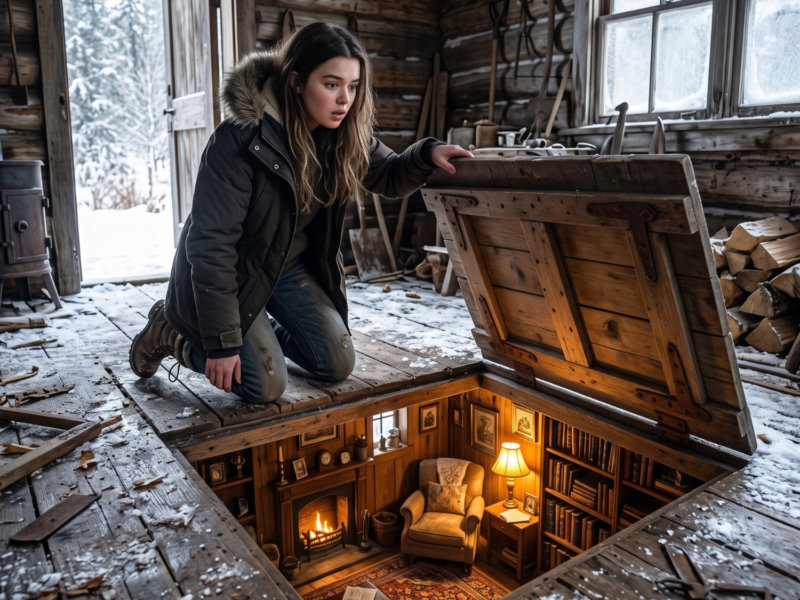
Her Parents Left Her in a Freezing Cabin and Took Everything—Then She Opened a Hatch Beneath floor
The Ambush
It did not last.
Dutch lifted his head first. Then his ears came up sharply. A low, vibrating growl started deep in his chest, and he rose to face the front door, his posture stiff and certain.
A moment later, Ren heard it, too. Under the howling wind, the unmistakable, grinding sound of an engine in low gear on the grade. Climbing. Headlights swung pale and blinding across the cabin windows as a vehicle crested the ruts her grandfather had cut, moving slow and careful toward the only door for eleven miles.
She knew that engine block. She had ridden in the back of it her whole life. They were coming back to close the trap.
The truck stopped in the clearing and the engine died. For a terrifying moment, nothing moved but the headlights—two white cones full of falling snow pointed directly at her grandfather’s front door.
Then, the doors opened. Sandre got out first, then Garrett, moving slower. They came up through the deep snow toward the porch. Her father walked with his shoulders hunched defensively against the cold, and Sandre followed behind him, picking her steps daintily in expensive town boots that were never meant for a mountain.
Ren did not go out to meet them. She stood defiantly in the open doorway, with the bright lamp behind her throwing her shadow long into the snow, and Dutch pressed warm and protective against her knee. And she waited.
She had gotten the iron strongbox open that evening, long before the headlights ever appeared. The little brass key she’d found in the tin had fit a shallow, hidden drawer tucked under the workbench. And in that drawer, buried under the stubs of carpenter’s pencils and a roll of sandpaper, a flat steel key had been waiting patiently for the padlock all along.
So she already knew exactly what was inside it. She already knew everything they had driven up the mountain in a blizzard to keep her from finding out.
“Oh, honey!” Sandre’s voice arrived ahead of her, dripping with fake warmth, pitched perfectly for a dramatic rescue. “Look at this place! Look at you! We have been worried absolutely sick about you up here.”
She stopped at the bottom of the wooden steps, her breath smoking in the cold. “I told your father on the drive home we never should have left you so long. It simply isn’t safe. Get your things, sweetheart. We’re taking you home.”
“You said this was home,” Ren said coldly. “Yesterday you said it was a gift.”
“Well, I didn’t know it was this bad, did I?” Sandre laughed, light and quick, dismissing the reality. “There’s no power. There’s barely a functioning stove. No daughter of ours is spending another night freezing in a place like this.”
Dutch’s growl escalated, coming up low and steady from the floorboards.
Sandre’s eyes dropped to the massive dog, and her fake smile thinned considerably. “Where on earth did that come from?”
“He lives here,” Ren said. “Same as me.”
Garrett had not said a single word. He stood off to the side at the absolute edge of the lamplight, staring at the cabin, at the stone chimney, at the squared logs. And something was working violently in his face that Ren had not seen there before. He looked like a man standing in a place he had spent a very long time aggressively pretending did not exist.
“Can we come in?” Sandre demanded, shivering. “It’s freezing. Let’s just talk inside like civilized people.”
Ren stepped back and let them in. She wanted them inside. She wanted them standing right in the dead middle of everything they had lied about.
She had watched Sandre work a room her entire life. And now that she finally knew what the performance was for, she could see every rusted gear of it turning. The warmth that arrived a half-second too early to be genuine. Her hands, constantly worried, never quite still. The word sweetheart laid down strategically like a trump card in a poker game.
For a long time, that manipulative performance had made Ren feel small, crazy, and ungrateful for not melting under it. Tonight, she watched it happen with a cold, clear, absolute quiet in her soul. The magic trick had been revealed; the illusion was dead.
Sandre came in rubbing her hands together, taking the room in with a quick, calculating, flat sweep of her eyes. The fire. The table. The braided rug pulled completely back from the floor in the corner—where she conspicuously did not look twice.
She set her expensive leather bag on the table and started talking before she had even sat down.
“Alright, here’s the thing, and I want you to hear me out, because your father and I have been going back and forth for weeks on how to do this gently.” She pulled a crisp manila folder from the bag. A nice, heavy pen was clipped to it.
“The cabin and the land are completely tangled up in your grandfather’s estate, Ren, and it is a massive legal nightmare. Back taxes, county liens, missing paperwork going back years. Your dad and I have been trying to sort it out for you for months to protect you. The simplest thing—the thing the estate lawyer highly suggested—is for you to simply sign the property over to your father so we can handle all the legal liability under one name. Then it’s entirely off your shoulders. You don’t have to deal with any of it.”
She set the folder on the table and slid it smoothly toward Ren. She placed the pen on top.
“Sign right here, and here, and you can sleep in your own warm bed tonight.”
Ren looked down at the folder. She did not touch the pen.
“Which lawyer?” Ren asked softly.
Sandre blinked, taken aback by the lack of immediate compliance. “What?”
“You said ‘the lawyer’ suggested it. Which lawyer? What’s his name?”
“Our lawyer, Ren,” Sandre said, her tone sharpening. “Does it really matter?”
“It matters,” Ren said, stepping forward. “Because I met the lawyer today. The one who actually drew up my grandfather’s will. A thin man, kind eyes, office right over the hardware store in town. He told me you came to see him in March. And he had to tell you the cabin absolutely doesn’t go to Dad. It goes to me, by name. Free and clear.”
Ren leaned over the table, locking eyes with her stepmother. “So, I’m wondering which imaginary lawyer told you to put a quitclaim deed in front of me. Because it wasn’t that one.”
The room went deathly, terrifyingly quiet. The fire popped loudly. Garrett closed his eyes as if bracing for a physical blow.
Sandre recovered incredibly fast. She always did.
“You walked down that mountain in this weather, Ren?” Sandre gasped, pivoting instantly to maternal panic. “That was incredibly dangerous! You could have frozen! I am so worried—”
“Don’t.”
Ren’s voice did not rise in volume. It just stopped her cold.
“Don’t do the worried thing. Not anymore.”
“I am worried! I am your—”
“You are not my mother.”
The words came out flat, certain, and completely without heat, and they landed infinitely harder because of it. “You never wanted to be, and that’s entirely fine. I stopped needing you to be a long time ago. But I need you to stop talking for one single minute and listen to me. Because I know exactly what this is now.”
Sandre’s mouth snapped closed.
“You’re broke,” Ren stated. “Dad’s logistics business went under. The trucks got taken by the bank in the fall. You’ve been selling things online. I saw the empty spaces in the garage. I’m not stupid.”
She pointed at the folder. “And then you found out my grandfather—the wicked, abusive old man who supposedly wanted nothing to do with us—left a piece of timber land worth more money than any of us has ever seen. To me. Not to you. To me. And you couldn’t sell it out from under me to save your lifestyle because it was never legally yours to sell.”
She nodded slowly toward the dark window. “So, you brought me up here. You took my phone so I couldn’t find anything out. You took the car so I couldn’t leave. You took my saved cash so I’d be completely desperate. And you figured a few freezing nights with no food would have me eagerly signing absolutely anything you put in front of me, just to get back to a warm house.”
Ren stepped back, her voice dripping with disgust. “That’s not a rescue, Sandre. That’s the plan finally going wrong.”
“That is a disgusting, paranoid thing to say to the people who raised you!” Sandre flared, but her voice had fundamentally changed. The manufactured warmth was entirely gone out of it, and underneath was something much harder, older, and genuinely afraid.
“Then tell me I’m wrong,” Ren challenged.
Sandre stared at her. She did not tell her she was wrong.
Garrett spoke then, for the very first time, and his voice was utterly wrecked.
“Sandre, stop.”
“Garrett, we can—”
“Stop!” he shouted.
He pulled one of the heavy wooden chairs out from the table and sat down heavily, as if his legs had completely quit on him. He put his face in his hands for a long moment. When he took them away, his eyes were wet and red. He looked up at his daughter.
“He really left it to you. All of it.”
“You knew that in March,” Ren said. “You both did.”
“I knew,” Garrett confessed, his jaw working as he fought tears. “I let her tell me it was legally complicated. I let her tell me a lot of things… because it was vastly easier than facing the truth. And the truth was, I couldn’t stand to look at any of it. The cabin. Your grandfather. You.”
He shook his head slowly, miserably. “You have her face, Ren. You came out of the hospital with her exact face. And I have spent the last eight years not being able to look straight at my own kid, because every single time I do, I see Sylvie. And I couldn’t carry the weight of it.”
His voice dropped to a choked whisper. “She used to hum when she cooked. Your mother. Some songs she never even knew all the words to. After the car accident, the house went so agonizingly quiet I thought it would kill me. And you were eleven years old, with her exact eyes, looking up at me, desperately wanting me to make it okay… and I couldn’t. I was a hollow hole in the shape of a man.”
He glanced at his wife. “Sandre came along, and she filled the quiet. She made the decisions. And I let her make every single one of them, because deciding meant feeling, and I was done feeling.”
He looked back at Ren, his eyes begging for an understanding he knew he didn’t deserve. “And one of the decisions she made was him. Your grandfather. He kept calling. Writing. Wanting to see you.”
“You sent his letters back.”
“She did,” Garrett’s voice broke on the admission. “And I let her. God forgive me, I stood in that kitchen and watched her write Return to Sender on a grieving, dead woman’s father, over and over and over again. And I told myself it was for the best. That he’d just confuse you. That we were a fresh start. I told myself whatever lie I had to.”
He looked up at the ceiling. “There’s no version of this story where I’m not a coward, Ren. I know that. I’ve known it a long time.”
Ren found that her own eyes were burning furiously, and she let them, but she did not move toward him. Not yet.
“He kept them,” she said, her voice shaking. “Every letter you maliciously mailed back. They’re under this floor in a tin, tied up with string. He kept the ones you returned, and he wrote new ones anyway. He saved absolutely everything for me, all that time.”
She turned and locked eyes with Sandre.
“You can keep the house,” Ren said. “I don’t want it. You can keep the car. You already kept eight years of his letters, every single one of them. So, I guess you’re exceptionally good at keeping things that aren’t yours. But you do not get to stand in his cabin and tell me I wasn’t loved. You don’t get to have that one. I’ve got the physical proof in a tin box, and there is nothing you can write on the envelope to send it back.”
Sandre had gone incredibly pale and still. She lowered herself slowly into the other chair. The fight went entirely out of her, and for a moment, she was not the arrogant woman who ran the house with an iron fist. She was just deeply, profoundly tired.
“You think I don’t know what I am?” Sandre said quietly, staring blankly at the fire. “I know exactly what I am.”
She traced the grain of the wood table. “I grew up with absolutely nothing, Ren. And I don’t mean we were tight on money. I mean nothing. I mean the lights shut off, the car repossessed in the middle of the night, and my mother crying on the floor over a shoebox of bills she could not pay. I swore to myself I would never be cold, and broke, and at somebody else’s mercy again as long as I lived.”
She let out a bitter laugh. “And then I married a broken man with a daughter, and a failing company, and a dead first wife he still kept a photo of in his wallet. And I watched it all start sliding right back toward that shoebox.”
Her hands were visibly shaking now. “And there was a fortune in timber sitting up on a mountain, going to a teenager who didn’t even know she had it. I told myself you’d never miss what you never knew about. I told myself a lot of things, too.”
“That doesn’t make it right,” Ren said.
“I’m not asking you to think it’s right.” Sandre’s eyes came up, and there were no tears in them, only the flat, dead exhaustion of somebody who has finally been seen all the way down to the bone. “I’m telling you why. You wanted to know why. There it is.”
For a long moment, nobody said anything. The wind pushed against the cabin walls and went on.
Then, Ren walked to the corner. She lifted the heavy hatch and climbed down into the cellar while her father and stepmother watched in stunned silence. She came back up carrying the heavy iron strongbox, and set it on the table right between them with a resounding metallic thud.
She opened the lid with the key she’d found.
It was not full of cash, though there was cash—banded twenty-dollar bills, soft with age. Most of it was paper. U.S. Savings Bonds. Dozens of them, stiff and official. Each one made out in careful pencil to the exact same name: Ren Sailor.
The earliest was dated the year she was born. There was one for every single year after. Bought a single bond at a time by a man living on a fixed income, using a few dollars he could not really spare. Put away every spring around her birthday for a granddaughter he was legally forbidden to meet. For a college tuition he hoped she would get to go to. For a life he would never be allowed to watch her live.
She had counted them the night she got the box open. There was a bond for every single birthday of her life, including the ones nobody bought her a cake or sang to her on. There was one for the year she turned nine and cried herself to sleep because a girl at school asked why no grandparents ever came to watch her in the school play. He had walked into a bank and bought a bond that year, too.
He had shown up for every birthday she ever had. In the only currency a locked-out man had left. Quietly, in pencil, in the dark.
Garrett made a terrible, choking sound, like he had been physically hit in the stomach.
“He was saving for me,” Ren said, her tears finally falling. “My whole life. While you were telling me he didn’t care whether I existed… he was buying me a future, a few dollars at a time, and locking it under his floor because it was the only safe place left.”
She looked at the bonds, at her own name written over and over in that hard, slanted hand. “This is what you drove me up here to make me sign away. Not a ruin. Not a burden. This.”
Sandre looked at the open strongbox and said absolutely nothing at all, because there was nothing left to say that would not make her look worse.
She did try once more near the end, because desperate manipulation was the only language she really knew how to speak.
“We could do this together,” Sandre pleaded quietly, not quite begging but close. “As a family. You wouldn’t even have to trust us. We’ll get lawyers, arrange a fair split of the timber sale. Everyone walks away better than they came in.”
And Ren understood, listening to her, that Sandre honestly, truly could not picture a person looking at that much money and choosing anything else over it. To her, the bonds and the timber were the treasure, and the letters were the trash. And that, more than anything she had done to Ren, was the most fundamentally broken thing about her.
It was Garrett who moved.
He got up without a single word and walked back out into the snow. Ren heard the truck door open and shut, and for one cold, cynical second, she thought he was leaving. Just driving off, the same way he ran from everything else that hurt.
But he came back.
He came back carrying the battered cardboard box. The one with the photographs, and the cassette tapes, and the delicate little blue-and-gold glass bird. The box they had ruthlessly taken off this very porch the day before.
He set it down on the table in front of her, so incredibly gentle, like it might explode.
“I couldn’t throw it out,” he whispered. “Sandre wanted to after the funeral. She said it wasn’t healthy keeping it around. I told her I did it. I told her it went to the city dump.” He swallowed hard. “It’s been hidden in the crawl space under our bedroom this whole time. I’d go down there sometimes and just sit in the dirt with it.”
He stepped back, his hands empty now, looking at his daughter with utter devastation. “It’s the only brave thing I ever did. And I did it in a dark crawl space where nobody could see me. That’s the kind of man I turned out to be.”
Ren put both of her scarred, working hands flat on the box, on the soft-worn cardboard, and felt the distinct shape of the glass bird through the side.
“Take Sandre and go home,” Ren said quietly. “Tonight.”
Garrett nodded. He did not argue. But it was a vastly different kind of not-arguing than before.
“What do you want me to do?” he asked, his voice broken. “About any of it. The will, the land, the business. All of it. Tell me, and I’ll do it.”
“I don’t know yet,” Ren said. And it was the absolute truth. “But you’re going to leave it to me to decide. For once, somebody in this family is going to leave a thing to me.”
Garrett looked at her for a long moment. And whatever he saw standing there, it was absolutely not the scared, compliant kid he had driven up that road the day before. It was somebody who had walked down a mountain in a blizzard, and climbed back up it on purpose.
He nodded slowly, like he was filing the image of her away somewhere safe where he would not lose it. Like it was the one piece of genuinely good news in the whole ruined night—that the daughter he had catastrophically failed had turned out significantly harder to break than anybody in that family had counted on.
She walked them to the door.
Sandre went out into the dark without another word, looking physically smaller than she had when she came in.
Garrett stopped on the threshold, the snow coming down hard behind him. For a agonizing moment, he looked like he wanted to reach out and pull her into a hug. And then he looked down at Dutch, standing stiffly on guard at her side, and at the box on the table with his dead wife inside it, and he seemed to understand that he had not earned the right to reach for her. Not yet.
“I’m sorry,” he said. It was a terribly small thing to set against all the years of betrayal, and he seemed to know that, too.
He looked down at the dog one last time. “He yours now?” he asked. “The shepherd?”
“He was always somebody’s,” Ren said, stroking the dog’s head. “He just had to wait for the right one to come back for him.”
Garrett took that emotional blow in the chest square. She watched him understand that she was not only talking about the dog.
“Yeah,” Garrett breathed. “Low, I guess that’s the going rate up here.”
Then he turned his collar up and went down the steps into the snow after his wife.
The truck doors thumped shut. The headlights swung around, illuminating the pines, and started back down the mountain her father had run from his whole adult life.
And Ren stood in the open doorway of the cabin that was finally, legally hers, with the dog, and the bonds, and the cardboard box that held her mother. She watched the red taillights shrink and wink out completely among the dark trees going down. Leaving her at the top. Alone. In the best and truest sense of the word, for the very first time she could ever remember.









