Her Parents Left Her in a Freezing Cabin and Took Everything—Then She Opened a Hatch Beneath floor
The Floorboards
The box was the part that kept catching at her throat. The phone she could live without. The car had never really been hers anyway, bought in Garrett’s name and insured in Sandre’s. But the box held her mother. Sandre had said it would be safer at the house. Ren had watched it go into the trunk, and she understood with chilling clarity that safer at the house was simply a polite, maternal phrase for gone forever.
She did not cry. There was no body heat to waste on weeping.
She went back inside and shoved the heavy door shut, dropping the iron latch. She stood in the middle of the freezing room and forced herself to think instead of feel, because feeling was not going to light the stove.
There was wood in the shed, exactly as Garrett had said. Half a cord of it, split, stacked, and bone-dry. There was a hatchet sunk deep into a chopping block, and a rusty coffee can full of kitchen matches—gone a little soft from the ambient damp, but still viable.
It took her three desperate tries and most of the matches before the kindling finally caught. She fed it agonizingly slowly: a twig, then a curl of dry bark, pausing breathlessly whenever the small orange flame shrank back toward nothing. When the first real flame climbed up and licked the split pine, she let out a breath she felt she had been holding since the car door slammed.
The cast-iron stove ticked and groaned as it warmed. She found an old kerosene lamp on a high shelf and a glass jug of oil half-full beside it. She got that lit, too. The room came up out of the dark in a small, fragile circle of yellow light.
She took inventory. There was a shelf of mismatched dishes. A wooden cabinet held a paper sack of flour that had gone to weevils, a rusted tin of stale coffee, and a few glass jars she did not look at closely. A wooden water barrel stood by the door, covered with a thick skin of ice that she had to shatter with the handle of the hatchet.
She was not going to freeze tonight. That was as far as she allowed herself to plan.
She ate two crushed granola bars from the bottom of her duffel bag, sitting cross-legged on the floor with her back pressed against the warming iron of the stove. She watched the fire through the little mica window in the door, aggressively trying not to think about the eleven miles of deep snow between her and the highway, or the envelope of tips in Sandre’s coat pocket, or the box of her mother riding down the mountain.
She slept on the bare metal bed frame, wrapped in both blankets and wearing her jacket. She did not sleep much.
In the morning, the world outside the windows was brilliantly white, silent, and blindingly bright. The storm that had been threatening all week had moved off to the east, leaving a foot of fresh powder and a sky scrubbed hard and blue.
Ren stood on the porch, her hands wrapped around a tin cup of black coffee she had boiled in the kettle. For a few minutes, the country was so magnificent it physically hurt to look at. The dark timber was heavy with snow, the clearing was completely untouched, and the far, blue ridges were stacked one behind the other to the very edge of the earth.
It was a view wealthy people drove a long way to see. And it was hers now, apparently. She could not eat it. She could not call anyone with it. It would not drive her down to town. But it was hers.
That was when she heard the sound.
It came from the woodshed. A low, broken whine, followed by a faint scuffle, and then silence.
Ren set her coffee down. She picked up the hatchet and moved carefully down the porch steps, her boots crunching in the snow.
At the very back of the shed, wedged tightly into the narrow gap between the stacked cordwood and the log wall where the wind could not reach, was a dog. He was a large animal—or had been. A shepherd mix of some kind, black and tan, gone heavily gray around the muzzle. His ribs showed in sharp, shadowed lines under a coat violently matted with burrs and ice.
He lifted his heavy head when he saw her. He watched her with dark, incredibly steady eyes. He did not growl. He did not try to run. He looked at her the way a wounded old soldier looks at a stranger on a battlefield—taking her measure, but too exhausted to do much about whatever that measure came to.
“Hey,” Ren said softly, lowering the hatchet. “Hey, easy.”
The dog thumped his tail exactly once against the frozen ground.
She did not have much to offer. She went inside, retrieved her last granola bar and the rock-hard heel of a sandwich from her bag, crouched a careful distance away, and set them on the snow. She waited.
The dog dragged himself up. His back left leg was stiff. He limped over and ate the food in two desperate bites, taking the last crumbs gently from her outstretched fingers without grazing her skin with his teeth. Then, he sat down directly in front of her, leaned his entire, bony weight against her knee, and let out a long, shuddering sigh.
And that was that. They had decided about each other.
“Where’d you come from?” she asked him, burying her cold hands in the thick fur behind his ears. He had no collar. His paw pads were cracked and bleeding from the ice. But underneath the starvation, he possessed the heavy, broad bones of a dog that had once been well-kept. Somebody had loved this animal. Somebody, somewhere, had either let him go or been forcibly taken from him.
She knew the feeling intimately.
“Come on, then,” she said. She stood up, and the dog followed her up onto the porch, through the door, and into the cabin. He circled once and lay down in front of the warm stove, exactly like he had done it a thousand times before. He fell asleep almost instantly—deep, twitching sleep. The sleep of a creature that had finally, safely let down its guard.
Ren sat beside him on the floor, put her hand on his rising and falling side, and for the first time since the car drove away, she was not entirely alone.
She spent the daylight hours surviving. She hauled more wood in from the shed. She melted snow for drinking water in the kettle. She found an old straw broom and swept the worst of the dust out the front door. She went through the cabinets properly this time and found enough in the glass jars to make a thin, desperate soup: dried pinto beans, a string of withered garlic, and a sealed jar of tomatoes someone had put up by hand years ago. She fed half of it to the dog.
She named him somewhere in the late afternoon, without quite deciding to. She called him Dutch, because he had a stubborn, squared-off face like a man she had seen once in a history book photograph. The name fit him, and he answered to it by the second time she said it, looking up as if he had only been waiting for somebody to bother giving him a title.
Later, when the soup was gone and the kerosene lamp was the only light pushing back the shadows, she found herself talking to him. She spoke low and easy, telling him things she had never said out loud to a human being.
She told him about the diner where she worked, and the secret envelope of tip money she had hidden inside the drywall behind her bed, which Sandre had somehow found. She told him about the art classes she had desperately wanted to take at the community college, but had never mentioned, because Sandre frequently called drawing “a hobby for people with money to waste.” She confessed that the sound of her mother’s voice was getting harder to remember with every passing spring.
Dutch listened with his chin resting heavy on his paws, his gray eyebrows moving expressively. It was the longest anyone had allowed her to talk in years.
Night came down fast and hard, the temperature plummeting with the sun. The cast-iron stove could not quite keep up with the deep freeze. The cold crept in aggressively along the floorboards and around the window frames. Ren dragged the metal bed frame closer to the chimney stones. She built the fire as high as she dared without risking the flue, got under both wool blankets wearing her jacket, and Dutch pressed his warm, heavy body firmly against her back.
And still, the cold found her.
It came directly up through the floor. She noticed it because her feet would not warm up, no matter how she curled them. A thin, steady, biting current of freezing air was moving laterally across the planks. It was colder than the ambient cabin air—colder than it had any physical right to be—rising out of the floorboards as though the floor opened onto somewhere much deeper and colder still.
She lay there for a long time, her feet aching, trying to tell herself it was nothing. Just an old log cabin breathing in the wind. But the draft was relentless.
Around midnight, with the lamp guttering low, Dutch suddenly sat up awake beside her. His ears pitched forward, his nose working the air, a low, vibrating sound starting deep in his chest.
Ren gave up on sleeping. She sat on the edge of the bed and looked down at the massive, braided oval rug in the center of the floor. The draft was billowing from directly beneath it.
She had walked across that rug a dozen times that day without a second thought. Now, she crouched down and ran her bare hand along its heavy wool edge. She felt the freezing air pouring up through the weave, as steady as a faucet left running.
“Yeah,” Ren whispered to the dog. “I feel it, too.”
She took hold of the heavy rug and hauled it back.
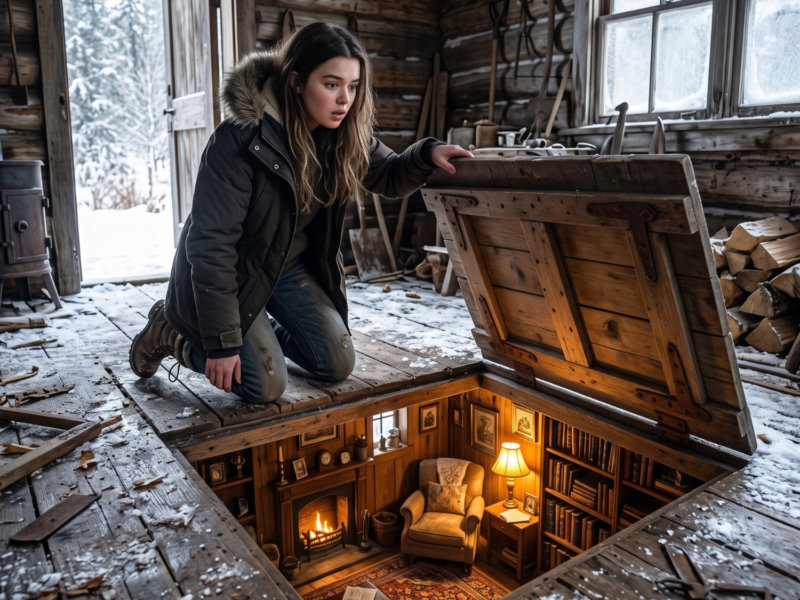
Underneath was the plank floor, exactly the same as everywhere else, dark with age and worn smooth. But here, in the dead center of the room, the planks had been meticulously cut. A perfect square of them. Cut clean and fitted back so flawlessly that the rug had hidden it completely. The narrow seams had been packed with dried dirt to kill the draft and disguise the lines.
And set into one edge, lying perfectly flush in a shallow, carved notch so it would not catch a boot heel, was a heavy, black iron ring.
Ren knelt there, her heart hammering against her ribs, and stared at it.
People did not cut a massive hatch into a cabin floor for nothing. They did not hide it under a heavy rug, meticulously pack the seams with dirt, and forget it. Somebody had built this to be found—or built it to stay hidden. And either way, it had been sitting right here under her feet the entire time she was being told by Sandre that this was a worthless place, a dumping ground, a problem her parents were generous enough to saddle her with.
She hooked two trembling fingers through the iron ring. It was cold enough to burn her skin. She braced her other hand flat on the floorboards and pulled upward with all her strength.
The packed dirt cracked along the seams. The square of heavy planks lifted with a low, agonizing wooden groan. The smell of deep earth and cold stone rose violently up into the room.
Below her was pitch darkness. A square hole, dropping perhaps four feet down, lined perfectly with fitted river rock.
The lamplight slid down into the void and caught on shapes. The dull metal corner of a box. A glass jar with something pale suspended inside it. And along one side, a bundle of flat, rectangular things tied with twine, stacked carefully on a dry stone ledge—a bundle that looked, in the flickering, bad light, very much like a stack of letters.
Dutch leaned his massive head over the edge beside her and went completely still.
Ren reached back without looking, grabbed the kerosene lamp by its wire handle, and brought it close. She lay flat on her stomach on the freezing floorboards and lowered the lamp slowly into the dark. Down toward the shapes. Down toward whatever it was somebody had gone to so much intense trouble to bury beneath the only thing in the world that was finally, truly hers.









