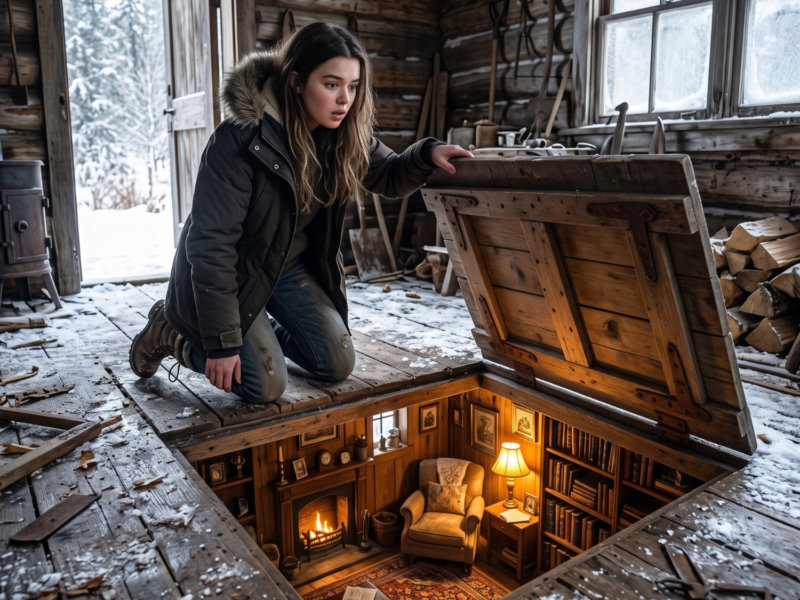
Her Parents Left Her in a Freezing Cabin and Took Everything—Then She Opened a Hatch Beneath floor
The Open Door
Ren started coming down off the mountain once a week then, driving the green truck like her grandfather before her, and the general store had become a place she truly belonged.
Fay fed her, asked her nothing she did not want to answer, and slowly, over hot coffee and over the counter, told her a thousand small, beautiful things about a mother she barely remembered and a grandfather she had never met.
She learned that Sylvie had meant to be a school teacher. That she had a fiery temper and a booming laugh you could hear clear across the store. That she had carved her initials into the frame of the workshop door when she was twelve years old, and Emmett had left them there for thirty winters and never once sanded them out.
Ren went home that week and found them. S.V. Chest-high beside the door. She stood a while with her thumb pressed deep into the grooves her mother’s pocketknife had cut.
That same week, she took her own chisel to the doorframe and cut her initials into the wood right beside her mother’s. R.S. under S.V. A daughter signing on under a mother who never got the chance to teach her how. Emmett would have left them both. She was sure of that, so she left them, too. And some evenings she would run her thumb over both sets at once, the old grooves worn smooth and the new ones still sharp, and feel the whole, crooked, beautiful line of her family right there in the wood under her hand.
It was Wendell who gave her the very first real money she ever earned with her own hands.
He came up one Saturday in April and stood in the workshop, turning a small, three-legged wooden stool over in his big, cracked hands. It was one she had made, explicitly copying her mother’s design, burning her name into the underside the same as Emmett had taught a nine-year-old girl to do a lifetime before.
He wanted six of them, he said, for his daughter’s kitchen. And he was going to pay her exactly what they were worth, and she was absolutely not going to argue him down out of some misguided idea that she owed him for the winter plowing.
“You don’t owe me, kid,” Wendell said sternly. “Get that out of your head right now. Your grandpa squared all my debts, and then some, years back. And I’m a long way from paying him off, even with buying these stools.”
He set the stool down carefully on the bench. “I’ll tell you what I told him once, when he was feeling low about things. Out here, a man’s measured by what he leaves standing. The talk and the money burn off in the end. What’s still on its feet after a man’s gone? That’s the only measure.”
He looked at her. At the clean, warm, organized shop. At the finished rocking chair by the roaring stove. At the girl who had not been broken after all.
“He left you standing,” Wendell said softly. “That’s the whole of it. That’s the only score that ever counted up here.”
She made him the six stools. He paid her in cash off a thick roll in his coat and would not take a single dollar back in change. And she put the money in the coffee can on the high shelf. Money of her own. And that night, she sat in the rocking chair and understood that she was not waiting for anything anymore.
That was the part that took the longest to notice. Her whole life she had been waiting. Waiting to be picked. Waiting to be wanted. Waiting for the day her father would look at her and not flinch. Waiting for somebody, anybody, to decide she was worth keeping.
She had stopped waiting to be chosen the exact day she understood she had already been left everything that mattered under a floorboard, by a man who chose her every spring of a life she never got to share.
One evening in the spring, she found the old, dusty cassette player in the back of the shop, and she put in the tape from her mother’s box. The one she had been terrified to play since the funeral, because she thought the voice on it might have gone strange and foreign in her memory.
It had not.
Her mother sang along loudly to a song from a radio station that had gone off the air a decade ago. She was off-key and joyous. Dutch lifted his head at the sudden sound of it, and Ren sat down on the floor of the warm shop and let her mother be vibrantly alive for three and a half minutes. When it clicked off, she rewound it and played it again.
The letter from her father came in May.
Fay handed it across the counter without a word, watching her face closely. It was Garrett’s familiar handwriting on the envelope, her name and the cabin’s address spelled out carefully, a stamp neatly in the corner.
Ren held it for a long moment, and the bitter irony of it landed on her slow and heavy. Now it was a letter from him, coming up the mountain to her. And the power of the choice of whether to send it back was entirely hers to make.
She thought about it for three days. She set it on the windowsill next to the little glass bird, which had its rightful place again, and she let it sit there while she worked. Dutch sniffed at it twice and lost interest.
She was not sure she owed her father a reading. She was not sure she owed him anything. But she kept thinking about a broken man sitting alone in a dark dirt crawlspace with a dead woman’s photographs, because it was the only brave thing he could find in himself to do.
And on the third night, she opened it.
It was not a defense. That was the first thing she noticed, and the only thing that let her keep reading. He did not try to explain himself away or ask her to understand his weakness.
He wrote that the business was completely finished, and they were selling the large house and moving into something very small, and that it was right, and that he was absolutely not telling her so she would feel sorry for them. He wrote that he had started seeing a counselor—an actual one—because Sandre had finally agreed they both desperately should.
He wrote that he was not asking to be forgiven, because he did not think he had the right to ask her for anything ever again. But that if she ever wanted him to drive up and just look at the place her grandfather built—just see it—he would come. And he would not bring legal papers, and he would not bring Sandre. And if she never, ever wanted that, he understood completely.
Either way, he wrote, he was going to keep writing. One a month. And she could read them, or burn them, or send them back marked Return to Sender, and he would keep writing regardless.
Ren sat with that for a while.
She did not write back. Not that month. But she did not send it back either, and she did not burn it. She carried it to the corner, lifted the heavy hatch, and climbed down into the cellar her grandfather had dug. And she set it on the stone ledge beside the tin of Emmett’s letters. The start of a second bundle. The first piece of a story that had not finished telling itself.
Some doors you do not have to nail shut, and you do not have to throw wide. You can leave them unlocked and see who keeps knocking.
In June, a girl came up the road.
Fay had called ahead on the new landline phone Ren had finally run a line for to say there was a kid asking around town. Seventeen years old. Put out by a mother’s new husband with a garbage bag of clothes and forty dollars. And did Ren maybe have a use for somebody who could sand, and sweep, and keep her own counsel?
Ren met her at the bottom of the porch steps and looked at the black garbage bag, the cheap, thin jacket, and the careful, blank face of somebody bracing to be turned away.
And she remembered every inch of it.
“There’s a room in the back of the shop,” Ren said, wiping sawdust from her hands. “It’s warm. There’s a stove. You stand straight and you don’t waste the cedar, and we’ll see how it goes.”
She stepped forward and picked up the garbage bag herself. “You eat yet?”
The girl shook her head, watching her suspiciously, not trusting the kindness.
“Come on then,” Ren said.
And it was the exact same thing she had said to a starving dog in the snow. And it meant the exact same thing: which was that the girl was not alone anymore, even if Ren was not going to embarrass either of them by saying so out loud.
The girl’s name does not matter to the story yet, just as Ren’s had not mattered to anyone for the longest time. What mattered was the warm room, and the stove, and the work waiting for her hands, and the absolute certainty that nobody up here was going to take a key off her or drive her somewhere cold and leave.
She slept fourteen hours the first night. In the morning, she came out into the shop with her sleeves aggressively pushed up, asking what to do. Ren put a block of scrap cedar in front of her and a sheet of sandpaper in her hand, and showed her exactly where to start.
By July, the girl could cut a clean tenon joint.
Ren caught herself one afternoon standing at the girl’s shoulder, guiding her hands on the chisel—applying the same patient pressure her grandfather had once used on her mother, and then thrown into a tin box and a stack of returned letters on her.
She had never planned to become a teacher. Her mother had wanted to be one, and died before she got the chance. And the chance had not been thrown away after all, it turned out. It had only been set down a while, waiting under the floorboards of things for somebody ready to pick it back up.
Some evenings the two of them worked until the light went. The girl sanding, Ren shaping, the dog asleep between them. The shop closed and quiet and smelling of cedar and warm oil. And it was the warmest a room had felt to Ren since she was small.
Emmett would have liked the girl. He would have made her a chair.
The man who had spent his whole life quietly saving other people—the carpenter half the valley owed and could never repay—had reached forward through everything that was done to keep him out, and saved his granddaughter after all, long after he was in the ground.
And now his granddaughter, with his tools in her hands and his chair by her stove, was reaching forward in her turn.
That is how it works. The only way it ever has. The person you save ends up saving somebody else, and the warmth gets passed down the line like a fire carried cupped gently against the wind.
Ren kept the cellar stocked after that. Jars, oil, blankets, candles, a hand-axe, the whetstone. Everything set back exactly as she had found it. She split the standing dead pine and stacked it dry. And she left a spare key with Fay at the store, and told her that if anyone ever got stranded on that road, or turned out, or driven up the mountain by people who meant to leave them broken, there was a stocked cellar and a warm stove and a hatch under the rug. And they should be told about it before they ever started to despair.
She moved the rug by the door where boots could knock the snow off. The cold had stopped coming up through the floor a long time ago. She sealed the hatch tight when she wanted it sealed, and opened it when she wanted it open. And that, she had come to think, was the whole difference between a place that holds you down and a place that holds you up: which is who has their hand on the door.
On a warm evening near the end of summer, with the shop swept clean and the girl asleep in the back room, and Dutch stretched gray and content across the threshold, Ren carried her coffee out onto the porch her grandfather built.
She sat down on the top step, and looked out at the country he had left her.
The far ridges were going blue with dusk, stacked one behind the other to the absolute edge of the sky. It was the exact same view as the first morning, when all she had owned was a view she could not eat.
She owned more than the view now. She owned the saying yes and the saying no. The stove and the door and the hand on it. A dog, a found grandmother down the road, a chair she finished, a name written over and over in a strongbox by a man who never gave up on her once.
It was not the life anyone had chosen for her. It was the one she had been left in the dark, under the floor, by the only person who ever thought she was worth the saving.
And up here, with the light going gold and her own smoke rising from her own chimney, that turned out to be more than enough to build the rest of a life on. She lifted her coffee and she breathed the cold pine air. And for the first time she could remember, she was not waiting for anything at all.









