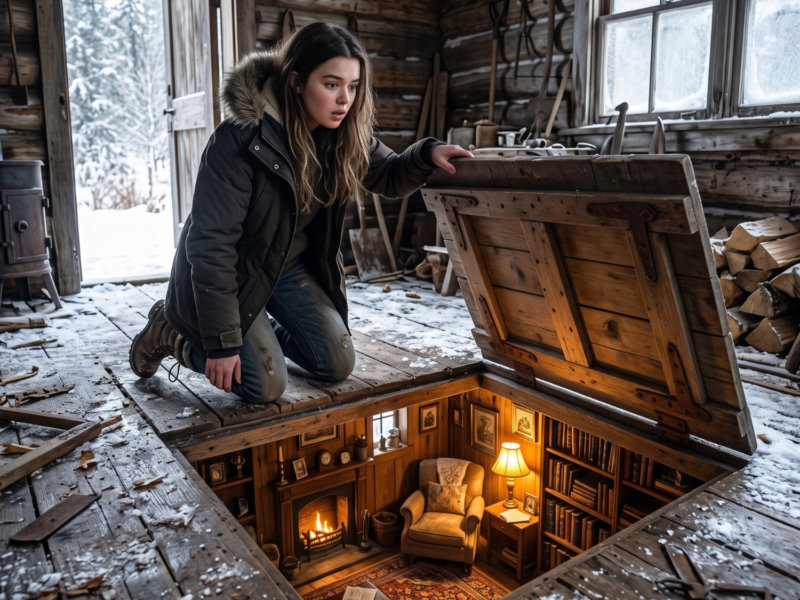
Her Parents Left Her in a Freezing Cabin and Took Everything—Then She Opened a Hatch Beneath floor
The Descent
In the morning, she knew exactly what she had to do.
She could not call anyone. There was no cell phone reception, and there had never been a landline phone installed in the cabin. And the lawyer her grandfather had written about sat eleven brutal miles down the mountain, in a town she had passed through exactly once in the back of a car.
So, she would walk. She had walked further for far less important things.
She banked the stove carefully, filled a glass jar with spring water, and put the very first letter and two of the photographs inside her jacket, flat against her chest. Proof of exactly who she was, if anyone asked.
She stepped out into a morning so fiercely cold the packed snow squeaked loudly under her boots. Dutch came off the porch stiff-legged and fell in beside her without being asked. When she pointed to the door and told him to stay where it was warm, he looked at her with ancient eyes and just kept walking. So, they went down the mountain together.
The ruts of the road were completely buried. She followed the physical gap in the dark timber where the road logically had to be, post-holing through drifts up to her knees. The cold bit aggressively into her boots, and then deep into her bones. The mountain was so profoundly quiet she could hear the rushing of her own blood in her ears.
An hour passed. Then another. Dutch labored heavily on his bad back leg, but stubbornly refused to be left behind. Twice she stopped, knelt in the snow with her arm around his thick neck, and told him they were almost there, which was a desperate lie.
She had completely stopped feeling her feet when she finally heard the engine.
It came up the steep grade behind her, low and mechanically grinding. She turned, shielding her eyes from the glare, to see an enormous, old plow truck breaking the road open. It was more rust than orange paint, the massive steel blade throwing a long, beautiful curl of white snow to the side.
The truck slowed to a crawl when the driver saw her standing in the road. The window cranked down with a screech. The man behind the wheel was somewhere past sixty, sporting gray stubble and a heavy wool cap pulled down to his eyebrows, with the permanent squint of someone who has spent his entire life looking into harsh weather.
“You’d be the girl they left up at Emmett’s place,” he said. It was a statement of fact, not a question.
“I’m walking to town,” Ren said, her teeth chattering.
“In this? On foot?” He looked down at her snow-packed boots, then at the shivering dog, and his gruff expression instantly softened. “Get in before you lose a damn toe. Both of you.”
The cab of the plow truck was blissfully hot and smelled heavily of diesel fuel and old, burnt coffee. The man drove expertly with one hand and worked the plow hydraulics with the other. For a solid mile, he said absolutely nothing at all.
Then, he glanced down at Dutch, who had wedged himself as tightly as possible against Ren’s warming legs, and the man’s gray eyebrows shot up in surprise.
“Well, I’ll be,” he said softly, shaking his head. “That’s Emmett’s dog.”
Ren turned to look at him. “He was at the cabin. Half-starved.”
“Of course he was. That’s exactly where he keeps going back to.” The man shook his head slowly, keeping his eyes on the road. “I’m Wendell. I plow this county road when there’s anybody up it actually worth plowing for. I’ve been trying to keep that fool dog fed down at my place since the old man passed away last winter. I feed him, I warm him up by my stove, and as soon as my back is turned, he’s gone again. Eleven miles uphill through the snow, just to sit on a freezing cold porch and wait.”
Wendell reached over the console and put one rough, gloved hand affectionately on the dog’s head. “He wasn’t waiting for me. I figured that out a while back. I just didn’t know who he was actually waiting for.”
Ren pressed her face against the cold passenger window and did not answer. Because if she opened her mouth to speak, she knew she was going to completely come apart, and she fiercely did not want to do that in a stranger’s truck.
“Emmett built the cradle my granddaughter sleeps in,” Wendell said after a while, as if he completely understood her silence and meant to fill the uncomfortable space for her. “He wouldn’t take a single dime for it. I plowed his road for twenty winters for free, and we called it even. And we both knew it wasn’t. That’s just how he was. Half this valley owes him something they can never pay back, and he never once mentioned it to a living soul.”
He downshifted the heavy truck for a steep grade. “You favor your mother a lot. Sylvie used to ride down the mountain with him when she was little. Sat right exactly where you’re sitting.”
Ren looked down at her own raw hands in her lap. “I found his shop,” she whispered. “There’s a rocking chair in there he never finished.”
Wendell nodded slowly, his eyes fixed on the road ahead. “He talked about that chair all the time. Told me he was building it specifically for his granddaughter. For when she finally came up to stay.” He glanced over at her. “Folks down here in town figured the old man was going soft in the head, going on and on about a girl nobody had ever laid eyes on. Guess he knew something the rest of us didn’t.”
The town of Ridgemont was barely a town. It was a single strip of low, weather-beaten buildings along the highway where the mountain finally flattened out. A fuel pump, a feed store, and a grocery all housed under one rusting tin roof with a hand-painted sign Ren did not bother to read.
Wendell pulled the massive plow to a stop in front of it. “Fay’ll want to see you,” he said, gesturing to the door. “Go on inside. I got to finish plowing the road, but I’ll be back through in an hour. Don’t you try to walk anywhere.”
The general store was sweltering warm and close. It smelled of roasting coffee, sweet cornmeal, and the large wood stove burning fiercely in the corner.
A woman stood behind the main counter. She was sixty-something, with striking silver hair and a pair of reading glasses pushed up on her head. When the brass bell over the door rang, she looked up.
She saw Ren standing in the doorway, snow melting off her shoulders, with a gray dog pressed against her knee. And all the color instantly drained right out of the woman’s face.
“Oh,” Fay breathed, putting one hand flat on the glass counter to steady herself. “Oh, Lord. You’re hers. You’re Sylvie’s girl.”
“I’m Ren.”
“I know exactly who you are, honey.” Fay came rushing around the counter, moving incredibly fast for a woman her age. She took Ren by both freezing hands and just held them, staring intensely into her face. “I have known exactly who you are since the day you were born. He brought a box of cigars in here, gave one to my husband, and completely broke down crying in the canned goods aisle. Emmett Voss. A man who never let a soul see him so much as flinch.”
Fay’s eyes were shining with wet tears. “Sit down. You’re frozen clear through. Sit down by the stove, let me feed you, and I will tell you absolutely anything you want to know.”
She sat Ren by the roaring stove with a steaming bowl of venison chili, a thick slab of buttered cornbread, and a mug of black coffee. She got down on her knees on the floor with a groan and happily fed Dutch prime meat scraps from behind the butcher counter.
And then, she talked.
“Your grandpa came down off that mountain once a month for the better part of thirty winters,” Fay said, wiping her hands on her apron. “And every single time, he stood right exactly where you’re sitting now, and he bought his coffee and his lamp oil. And then he stood at that counter, and he asked me, real quiet, if anybody had mailed him anything back. A letter. A photo. Anything from you.”
She wiped her eyes roughly with the heel of her hand. “Somebody told that man you didn’t want him. They told him that you’d been raised to think he was wicked, and that you wanted absolutely no part of him. And every month, he’d nod like he believed it. And every month, he’d buy a stamp from me, and write another one. He never once believed it, honey. Not for a single day. He just kept knocking on a door somebody else had aggressively nailed shut.”
Ren set down the spoon. The hot chili had turned to ashes in her mouth.
“My stepmother sent them back,” Ren said, her voice hollow. “All of them. I found them last night. Hidden under the floorboards.”
Fay closed her eyes in pain. “I always wondered where they went. I hoped, you know… I prayed maybe you secretly read just one of them.” She opened her eyes again, fierce and clear. “He left you everything, child. Do you understand that? Whatever lies they told you. Every last acre.”
The massive, ugly question she had carried up and down that mountain her entire life finally forced its way out.
“Why did my mom leave him? They always said he drove her off. That he was abusive. That he said terrible things to her.”
Fay’s mouth tightened into a hard line. “Is that what they told you?” She lowered herself heavily onto the wooden stool beside Ren with a profound sigh. “Your mama left because she was seventeen, rebellious, and deeply in love. And your grandpa was an incredibly proud, stubborn man who said the wrong thing on the wrong night, exactly like proud men do. They had a fight. A bad one. I won’t pretend otherwise.”
Fay looked out the front window at the snow. “She got in a car with your daddy, and she drove away, and she didn’t come back. And Emmett was far too stubborn to chase her down and beg. And by the time he finally stopped being stubborn, she’d moved on, and the letters were already coming back unopened, even then.”
She shook her head sadly. “He spent the entire rest of his life desperately trying to take back one bad afternoon. Then your mama passed away, and you were the only piece of her left in the world. And they walled you off from him, too. That man grieved the same girl twice, honey. Once when she drove away, and once when she died. And he never stopped reaching for you, because you were the absolute last piece of her he had any hope of holding.”









