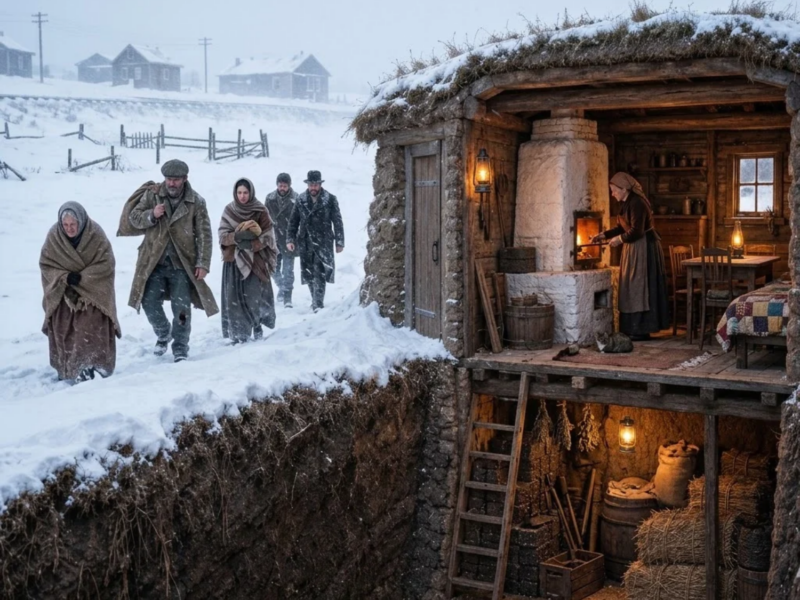
His Sod House Had No Woodpile in January – Until the Trains Stopped and the Town Came Begging
The Green Grass and the White Wall
The rest of that Dakota winter was long, biting, and hungry. The coal had to be rationed with extreme care, and people continued to twist slough grass well into the bitter month of March, but not a single house in Tolbeck went truly cold again.
On quiet, sunny afternoons, long after the drifts had begun to slump and settle, Thea Bowmont would walk out across the melting prairie to sit on Jacob and Katherina’s wide brick bench, learning the delicate, rhythmic art of twisting marsh grass so tightly that a single handful would burn with the steady, reliable heat of a split oak log.
Jacob’s underground store of bricks finally ran out during the very last week of March, just as the frost was loosening its grip on the soil. By then, however, the town board had arranged for a fresh sack of coal to be left on his doorstep every other day. Nobody asked him to pay a single penny for it.
The first steam locomotive of the season finally pushed its way through the deep clay cuts in early May, shoving walls of slush aside with a triumphant shriek of its whistle. It brought fresh flour, household goods, mail, and a thin, hollow-eyed man who turned out to be Thea’s husband, lighter by twenty pounds but sound of limb.
On that exact same train, heading east out of the territory, a solitary man in a black overcoat and a scuffed bowler hat rode quietly in the second-class car with two heavy leather trunks. He had sold his coal yard, his lumber inventory, and the empty storage shed to a rival merchant from the county seat for a fraction of what they were worth.
Garvin Pelum never set foot in Tolbeck again.
Ivor Quist lost the two damaged toes on his left foot that April when the warmth finally brought the dead tissue away. He walked with a slight, permanent hitch for the rest of his long days on the prairie, but whenever anyone asked him how it had happened, he told them the unvarnished truth—naming every man, every ledger, and every gate he had stood before in the dark.
In June, when the prairie turned a brilliant, rolling green under the summer sun, Yakob and Katherina walked out behind the sod house to spread the first fresh batch of straw and manure for the coming year.
The section foreman sent another wagonload of rich bedding from the stockpens without being asked. Ferris Collie sent six heavy loads of clean wheat straw over from his storehouse and flatly refused to take any money for the delivery. And old Dora Eastston walked out one scorching afternoon, stood respectfully at the edge of the treading yard with a lace handkerchief pressed to her nose, and asked precisely how many bricks a large boarding house might need to face the winter.
When the short summer finally ended and the first crisp breath of autumn swept down from the north, the new stacks stood tall and proud along the edge of the property line once again—higher, straighter, and more numerous than before.
Nobody brought a petition. Nobody sent a marshal with a warrant. Nobody came calling with an angry wagon.
Instead, three different houses in Tolbeck now boasted no towering woodpile beside their exterior walls at all.
One was a stout sod house standing proudly half a mile out along the buried railway grade.
One belonged to the section foreman and his tired, happy wife.
And the third was a respectable boarding house right on Main Street, where a brand-new, whitewashed brick stove as long as a wagon bed stood warm and steady in the parlor, complete with a heavy wooden trapdoor in the floorboards and a dark ladder leading safely down into the earth below.









