His Sod House Had No Woodpile in January – Until the Trains Stopped and the Town Came Begging
The Locked Shed
The first blizzard came in the middle of October—abnormally early, savage, and utterly without warning—and shrieked across the flatlands for three relentless days.
When it finally blew itself out, leaving drifts ten feet deep against the shacks, Jacob hitched his oxen to the sled and drove into town. He had the money in his pocket that they had carefully laid aside for next spring’s seed grain. He stopped his team in front of Pelum’s coal yard, where a small, shivering crowd of townspeople stood waiting on the snow-swept scale platform.
“Mr. Pelum,” Jacob said evenly, stepping up to the office window. “One ton of coal, please. I will pay today, in full.”
Pelum looked down at him from the raised wooden threshold, letting his eyes sweep over the crowd so everyone could witness the humiliation. “No.”
“I have the money. Right here.”
“I know you do. But I don’t want to sell it to you.” Pelum raised his voice so it carried across the platform. “You told me back in June that you had your own fuel, Risig. Well, go burn it. When that runs out, you come and ask me properly on the store porch, in front of the whole town, with your hat in your hands. Then—and only then—we’ll talk about a price.”
A harsh, nervous laugh rippled through the crowd, and then most of them joined in, eager to curry favor with the man who held the keys to their warmth.
Back at home, Katherina pulled the slate down from its nail and worked the figures by the dim light of the window.
“On the steppe,” she reminded him quietly, “we fired the big oven twice a day through the dead of winter. Here, we can fire it once at dawn, and let the brick carry the house through the night. We can twist dried slough grass for the cooking range and not light the big stove at all until the deep frost sets in for November.”
“How many?” Jacob asked.
“Fifteen bricks a morning,” Katherina said, placing the chalk down on the wood. “Not a single one more. Then we come through to the spring.”
“And if someone comes to the door?”
She looked at the slate, then out at the white emptiness of the prairie. “Then we will count again.”
The winter storms kept coming, one brutal gale in November and two monstrous blizzards through December. The railway cut through low, clay ridges east of town, and every single storm packed them level with hard, wind-driven snow that set like concrete. Railroad crews shoveled them open with frozen hands, and the very next gale filled them right back up again.
The last passenger train reached Tolbeck in the second week of January. After that, the line went dead.
Thea Bowmont’s husband had gone east with a shovel crew just before the final storm hit and was now stranded in a junction town forty miles away. He managed to send a scratchy wire stating he was well and safe, but utterly unable to get home.
In Tolbeck, the woodpiles vanished with terrifying speed. Frame shacks were miserable, drafty things, cold even with a small iron stove glowing cherry-red, and to keep them habitable, those stoves had to be fed constantly, day and night.
By the end of January, the neat stacks of cordwood that had served as the town’s social yardstick in September were gone—nothing more than dark, rotting stumps buried beneath the snowdrifts.
That was when Garvin Pelum raised his prices.
First, he doubled them overnight. A week later, he doubled them again, demanding payment in gold or hard-to-find collateral. Then, one bitter morning, Pelum nailed a heavy iron padlock onto the long, timber-walled coal shed at the back of his yard and hung a neat, printed notice on the gate: OUT OF COAL FOR PUBLIC SALE. REMAINING STOCK RESERVED EXCLUSIVELY FOR RAILROAD OPERATIONS.
The townspeople read the sign more than once, standing in the stinging wind until their eyes watered. Then they walked home in silence and began to twist hay.
You took a thick hank of coarse prairie grass pulled from the sloughs, wound it around your wrists into a tight, dense cylinder as thick as a forearm, and tied it off. It burned hot and blindingly quick, and the moment it turned to ash, you had to twist another. A family could spend an entire winter day doing nothing but frantically braiding hay just to keep the stove from going stone cold.
At night, however, if you knew who to ask and had something left to pawn, a desperate man would come creeping to your back door with a heavy burlap sack of coal—at a price that consumed a workingman’s wages for an entire month.
Everybody in Tolbeck knew whose coal it was. And nobody could prove a damn thing.
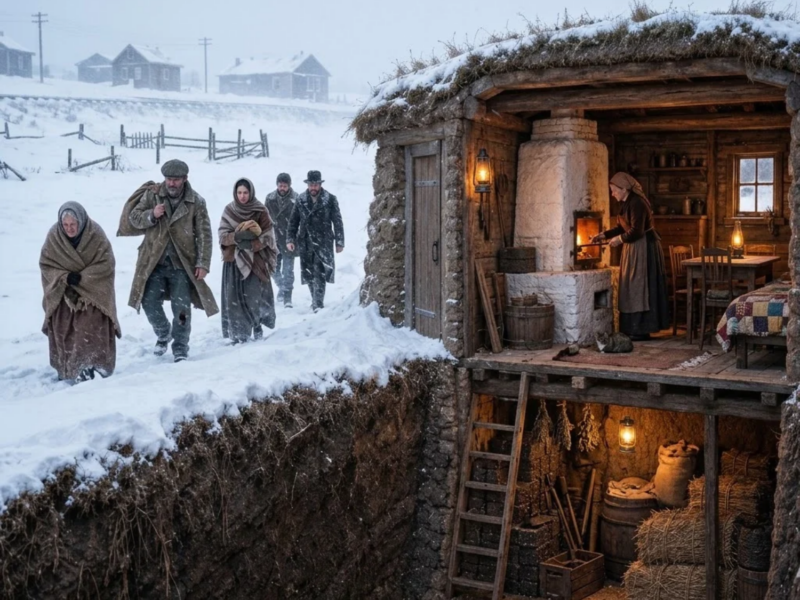
Every morning, smoke rose from Garvin Pelum’s large frame house near the center of town. People watched it with bitter, hollow eyes. Still, at the edge of town, Jacob’s sod house showed a different pattern: smoke came up sharply at dawn, thick and dark for an exact hour, and then ceased entirely. Yet in the afternoons, Katherina could occasionally be seen sweeping the snow from her doorstep without even wearing a woolen shawl.
“He’s stealing coal off the siding at night,” Pelum told the men gathered around the stove at the general store. “Where else is a man getting heat with nothing stacked by his wall?”