His Sod House Had No Woodpile in January – Until the Trains Stopped and the Town Came Begging
The Slurry
The Tolbeck Town Board met in the cramped, airless back room of the general store. It had three members. The chairman was the storekeeper himself, Ferris Collie, sixty-three, a cautious, graying man who sold everything from calico to horse nails but made his real margin on coal.
Pelum read the petition out loud with theatrical disgust: Offensive odor, flies, danger to health, danger of fire so close to the depot.
“Dung does not burn in a stack,” Jacob said quietly, standing before them with his battered felt hat held tightly in both hands. “Not in August. Not unless you want it to.”
“You’ll forgive us if we don’t take a dung-burner’s word on what burns and what doesn’t,” Pelum snapped, leaning back in his wooden chair.
Jacob looked past him to the chairman. “Mr. Collie, on the steppe there are no trees. This is how my people stay alive when the sky turns white. When it is dry, it does not smell. In two weeks, it is completely dry. Give me two weeks, and I will carry all of it down into my cellar, and nobody in Tolbeck will ever see it again.”
Ferris Collie looked down at the paper, then at the signatures scrawled across it—every single one of them his steady customers. He folded his hands over his stomach.
“The board has a duty to the public peace and health, Mr. Risig. Three days. Anything left standing on the roadside of your quarter after that is a public nuisance and will be summarily removed.”
“Three days is not enough time. It is not dry enough to move without breaking.”
“Then I’m sorry for it,” Collie said, and the vote was two to one.
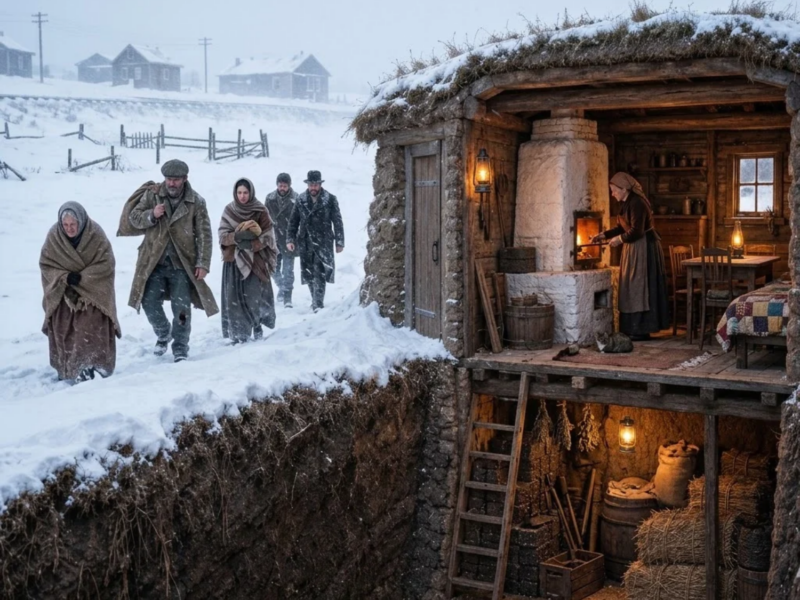
Jacob and Katherina worked through the night by the light of a single smoking lantern, carrying the driest, hardest bricks down the narrow ladder into the cellar. A wet brick would rot and crumble in the dark, damp earth, so they selected only the ones that rang with a clear, sharp tone when knocked together.
On the second afternoon—a full day before the board’s arbitrary order ran out—Pelum’s heavy yard wagon came rumbling down the track with four of his hired men and the town marshal riding high on the bench.
Jacob met them at the edge of the stacks. “There is one more day. The paper says three days.”
“Three days from notice,” Pelum said from his buggy, not even bothering to step down into the dirt. “I served notice on the board’s behalf the night before the formal meeting. You were standing right at your door.”
Jacob remembered a dark figure looming at his threshold after nightfall, thrusting a paper he could barely read by the flickering light of an oil lamp.
“Go ahead, boys,” Pelum ordered.
The men did not carry the stacks anywhere. They didn’t have the time, nor did they care. With brutal, casual efficiency, they lowered their shoulders and shoved them over, row after row after row, tumbling thousands of carefully cured bricks straight into the deep drainage ditch running alongside the road. The half-dried bricks, still vulnerable at their cores, shattered and crumbled into brown dust as they hit the dirt.
Katherina ran from the house, screaming in German, and grabbed the nearest man by the sleeve of his wool coat. The town marshal stepped forward with a heavy hand and pulled her roughly away, setting her back on her heels in the grass.
That night, the weather broke.
It did not rain a gentle summer shower; the sky opened in a violent, torrential cloudburst that lashed the prairie for six unbroken hours. The drainage ditch filled to the brim with rushing, muddy water.
In the pale, washed-out light of morning, Jacob stood at the edge of the ditch and looked down at the ruined labor of a whole summer. Softened into a thick, uniform brown slurry under the swirling brown water, the fuel was gone. A dung brick is fuel only when it is dry. Soaked through, it was nothing more than muck again.
Katherina came up behind him, holding the wooden slate. She had done the math in the damp quiet of dawn.
“Twenty-one hundred down in the cellar,” she said, her voice entirely flat. “That is all of it.”
It was barely a third of what they had made. There would be no more drying weather that year; the autumn rains were settling in for good.
As they stood there in the mud, Pelum’s buggy rolled past at a slow, mocking walk. The merchant tipped his bowler hat to Katherina with exaggerated politeness.
“Now you’ll buy coal like a Christian,” he called out.