His Sod House Had No Woodpile in January – Until the Trains Stopped and the Town Came Begging
The Town and the Merchant
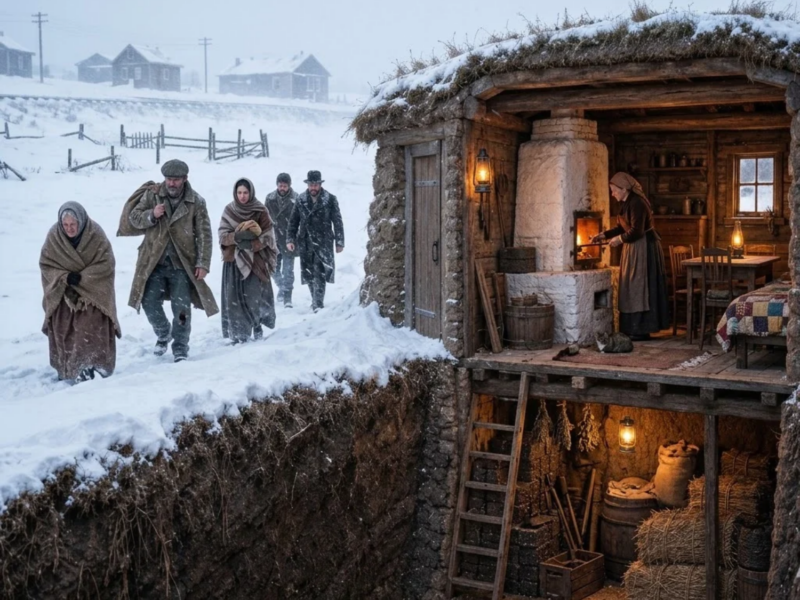
The great stove went up in July, built straight through the center of the sod house like the central pillar of a cathedral. Jacob bought one small load of fire bricks from the county seat for the firebox itself, knowing that the heart of the fire had to take real, unyielding heat. The rest he made himself.
He and Katherina dug rich clay from the slough behind the house, mixed it thoroughly with coarse sand and chopped straw, pressed the gray-brown muck into heavy wooden molds, and laid the bricks out in endless, orderly rows in the blinding summer sun.
It was nothing like the little, thin-iron box stoves in the town shacks, which roared for twenty minutes and went stone cold the moment the wind shifted. This was a massive masonry mass, nearly as long as the house was wide, with a serpentine labyrinth of internal flues. The smoke did not go straight up a metal pipe; it turned, climbed, doubled back, and twisted through channels carved inside the brick before it ever reached the chimney.
That was the whole secret, an ancient technology passed down through generations of landless peasants. You did not keep a small, sputtering fire going all day long. You built one short, intensely hot fire, burned it fast and clean, and then closed the iron door and the heavy damper tight when it died down. The incredible heat that would normally rush straight up a stovepipe and vanish into the freezing sky was absorbed entirely by the dense mass of the brick. And the brick gave it back to the room slowly, evenly, hour after hour, long after the fire itself had reduced to a bed of gray ash.
Katherina whitewashed the entire structure in August, sealing the clay with a clean, hard coat of lime, and Jacob built a wide brick bench along its warm side where a person could sit, read, or sleep through the howling of a gale. On Sundays, curious people walked out from town just to stare at it.
“Where does the smoke go?” asked a bewildered railroad man, peering into the dark mouth of the oven.
“Around,” Jacob said simply. “Until it has given up everything it has to give.”
While the heavy stove dried in the summer heat, Jacob dug a deep cellar under the floor, square and dry, with a heavy trapdoor beside the stove and a wooden ladder leading down into the dark. That was where the winter would live.
Filling it was the back-breaking work of the whole summer. He owned two patient oxen. He paid the town livery stable a small fee for its stable manure, and the railroad section foreman let him clean out the reeking stockpens beside the siding for nothing. Katherina forked in dry straw; Jacob carried heavy yokes of water from the well. They spread the rich, fibrous mixture on a hard-packed treading yard behind the house and drove the oxen round and round on it for hours under the merciless sun until it lay as flat and uniform as a polished floor.
When it had set just right, Jacob cut it with a sharp spade into square, heavy bricks the exact size of a man’s two hands. Every few days, Katherina turned them over to catch the bottom air. When they were firm and resonant, the two of them built them into tall, open-air stacks that looked like small castles across the prairie. Each brick crossed over the ones below so that the dry summer wind could pass completely through the gaps, curing them to a stone-like density.
In late July, the stacks stood in a long double row along the edge of the quarter section nearest the town road. Katherina kept a tally on a slate hung by the door. The number passed six thousand.
That was when the smell reached Main Street.
Fresh mist holtz had a distinct, earthy, pungent smell, and a hot south wind carried it straight into the nostrils of Tolbeck. The dried stacks smelled of very little—barely more than sun-baked earth and dry straw—but nobody in town was interested in the difference.
At the general store on a Saturday morning, Garvin Pelum leaned casually on the wooden counter and gave Tolbeck its favorite phrase of the season.
“I found out what Risig means to heat his house with,” Pelum announced to the Saturday crowd. “The man burns dung. He’s building it up like a fortress wall out there by the road so we can all enjoy the bouquet.”
A wave of laughter went round the store. Thea Bowmont, thirty-six, the section foreman’s wife, laughed until she had to press her hand against the scarred wood of the counter.
“My husband gave him the stockpens,” she gasped, wiping her eyes. “I thought he wanted to raise pigs!”
“Come January, that heap will freeze solid or blow away into the next county,” Pelum said, his voice dropping into a smug cadence. “And then he’ll come crawling to my yard with his hat in his hands.”
Dora Eastston, fifty-eight, who kept the boarding house at that end of town, declared loudly that she could not even open her bedroom windows for the stink. By Monday, a petition was circulating from door to door, demanding that the town board do something about the sanitary outrage at the edge of the settlement.
Garvin Pelum’s name was at the very top of the list.









