His Sod House Had No Woodpile in January – Until the Trains Stopped and the Town Came Begging
Mist Holtz
Jacob Risig was fifty-two years old that winter, broad-shouldered as a draft ox, with a gray-flecked beard and hands that had worked other men’s stony fields in the old country before earning his own. He was born in a German village on the steppe north of the Black Sea. That endless, windswept grassland had grass to the horizon and almost no trees.
A family could not buy firewood there for any conceivable amount of money, so every family made it. They called it mist holtz—dung wood. In the spring, the accumulated manure of the winter barns was hauled out, mixed thoroughly with straw and water, trodden flat by men and beasts, cut into neat bricks, and baked dry in the relentless summer sun. Kept dry, it burned all winter long in the great clay ovens that heated the houses and baked the heavy loaves of rye bread.
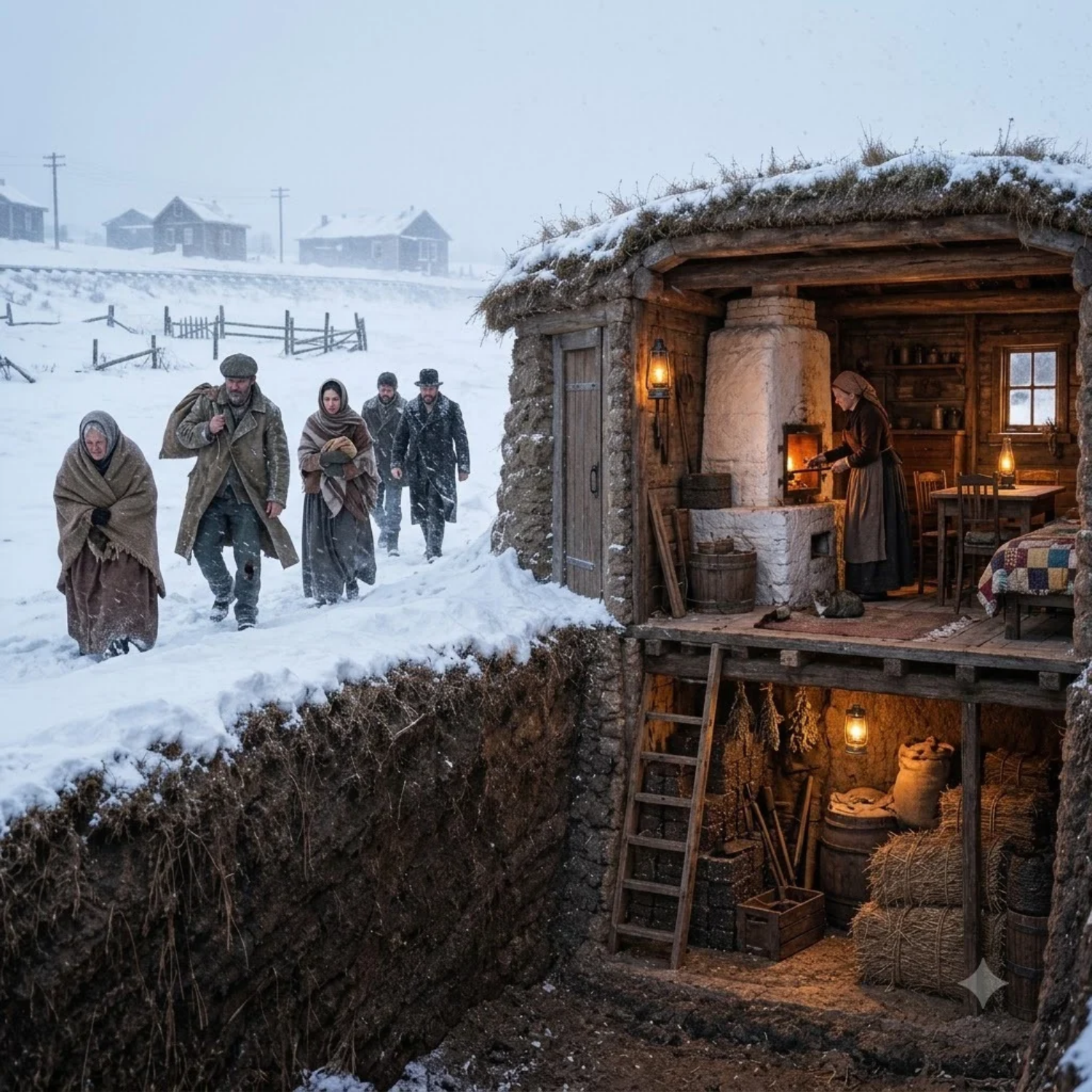
In the spring of 1880, Jacob and his wife, Katherina, came to Dakota Territory and filed on a quarter section at the edge of a miserable little railroad town called Tolbeck. The railway grade ran along one side of their land, a raised earthen spine cutting through the tall grass, and the town itself stood half a mile up the line.
Katherina was fifty. She looked at the flat, rolling ocean of grass going away on every single side and threw back her head and laughed, her breath catching in the warm spring air.
“The first time since the ship, Yakob, you have brought me home,” she said.
“No trees,” Jacob agreed, a slow smile breaking through his beard. “So we know what to do.”
Tolbeck, however, did not know. It was a miserable speck on the map: a depot, a section house, a general store, a boarding house, a saloon, and two dozen frame and tar-paper shacks that possessed no fuel of their own. Every stick of cut wood and every glittering ton of anthracite coal came in on the railway and was sold exclusively from one muddy yard beside the depot.
That yard belonged to Garvin Pelum, forty-five, who dealt in coal and lumber and also held the railroad’s lucrative contract to keep the depot and section house supplied. In Tolbeck, a towering, frost-defying woodpile was how you measured a man’s worth, his prudence, and his standing in the community. By September, a careful settler had cordwood stacked against his wall as high as his shoulder, a brown bulwark against the coming dark.
Pelum had driven out in his shiny black buggy in June to inspect the new sod house. He sat in the carriage under a parasol while Jacob cut thick ribbons of turf from the prairie floor with a spade.
“You want to order your winter coal early, Risig,” Pelum had called out, his voice smooth and transactional. “Freight gets dear in the fall. I’ll write you a contract today.”
“Thank you,” Jacob said, wiping his brow. “A little for the cooking, perhaps. For the heat, I have my own.”
Pelum looked across the vast, empty prairie and smiled, a thin, patronizing tightening of the lips. “Your own what?”
Jacob did not explain. He went back to cutting sod. Pelum told the story at the general store that very evening, laughing as he poured himself a glass of whiskey, because there was nothing to burn on Jacob’s land for fifty miles around except grass and buffalo chips.