His Sod House Had No Woodpile in January – Until the Trains Stopped and the Town Came Begging
The Ledger and the Rails
They climbed onto the high railway embankment behind the section house because its raised stone and earth ballast was the only landmark left in that blinding white purgatory that a human foot could still navigate without dropping into a ravine.
Pelum went first, clutching his freezing collar with both hands, his white-crusted bowler pulled low down to his eyebrows. Ivor stumbled along between Ferris and Thea, throwing a dead weight of an arm over each of their shoulders, walking on feet he could no longer feel.
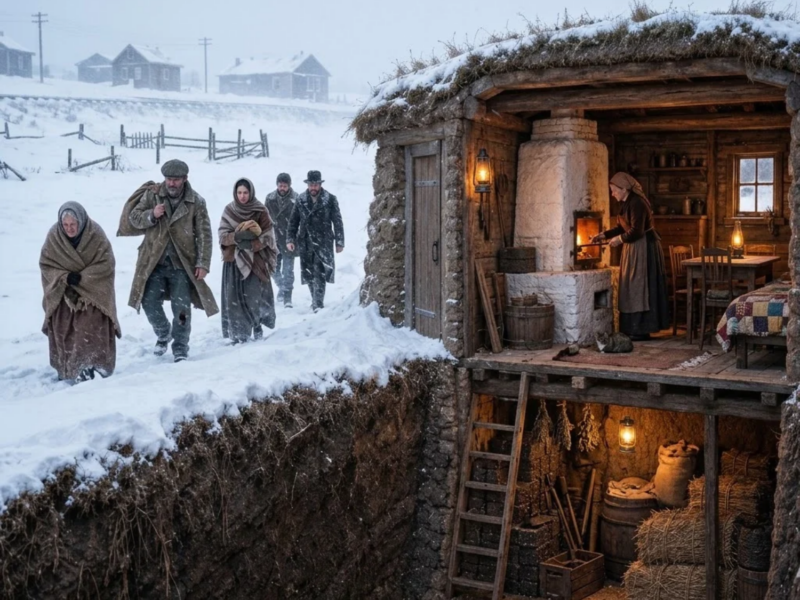
That half-mile took them nearly an hour of agonizing, breath-gasping labor against the gale. At the end of it loomed a low, rounded shape half-buried in the snowdrift, a faint, comforting smell of wood-smoke hanging in the air, and a stark sod wall with absolutely nothing stacked beside it at all.
Pelum found the heavy oak door and beat against it with his bare fists until his knuckles split.
Inside, Jacob had just opened the iron door of the big stove for an unscheduled third firing—something he had never done in all the bitter months of winter. The storm had battered the turf walls for four days straight, testing every inch of mortar. He stood with one dark brick in his hand, heard the frantic hammering, and knew instantly whose fist was striking the wood.
He didn’t hesitate. He dropped the brick into the heart of the roaring fire and shoved the iron door home with his boot.
Katherina came hurrying up the cellar ladder with the oil lantern and the wooden slate in her hand. “Six hundred and forty,” she said quietly, her eyes wide. “For the two of us, to carry us to the end of March. With five more people and two fires a day…” She shook her head slowly. “Three weeks, perhaps.”
The knocking came again, louder, desperate. “Risig! For God’s sake, open this door!”
Jacob walked over and laid his broad hand heavily on the iron safety bar. “Who is asking?” he called out through the thick wood.
A heavy silence fell outside, broken only by the whistling scream of the wind around the sod eaves.
“Pelum,” the voice came back, thin and stripped of all its merchant pride. “And Collie… and Mrs. Eastston… and Mrs. Bowmont… and Quist. Quist’s feet are frozen. Open the door, man.”
“In October,” Jacob said loudly through the panels, “you told me to come to your yard with my hat in my hands and ask properly before the town. You have the town right out there with you now, Mr. Pelum. Ask properly.”
For a long, agonizing moment, there was nothing outside but the fury of the storm.
Then Garvin Pelum, with frozen snow packed deep in his eyebrows and four desperate, frost-bitten neighbors standing half-frozen behind him in the drift, reached up with trembling fingers, took off his bowler hat in the teeth of the blizzard, and said loud enough for every single one of them to hear:
“Mr. Risig… please let us in.”
Jacob lifted the iron bar. He would have opened the door anyway—Katherina knew that, and so did he—but he had wanted Tolbeck to hear it said out loud.
They tumbled into the room on a wild gust of swirling snow, and Katherina slammed the heavy door shut and dropped the bar into place just as a fresh drift slammed against the panels.
The wave of radiant heat inside struck them like an open hand.
Thea Bowmont burst into sudden, racking tears and slid down against the wall, unable to explain why she was crying. Ferris Collie turned slowly on his heavy heel, his watering eyes searching everywhere for the source of the heat until they landed on the massive, whitewashed brick wall that filled half the room.
“Sit on the bench,” Jacob commanded gently, pointing to the warm masonry ledge. “It is warm there. Mr. Quist, bring your legs here.”
Katherina had Ivor’s boots off his swollen feet in a matter of seconds. She did not rub them, and she did not shove them directly against the hot stove—rules every plainsman knew, but panic often made men forget. Instead, she set his blackened feet gently into a wide basin of barely lukewarm water, adding a trickle of slightly warmer water every few minutes from the kettle. As the sensation slowly began to return to the dead tissue, Ivor’s face turned an ashen gray, and he bit his lower lip until it bled to keep from screaming.
Pelum stood awkwardly by the heavy oak door, holding his wet bowler hat tightly in both hands, staring around the room with shell-shocked eyes.
“Where’s your wood, Risig?” Ferris Collie asked at last, his voice raspy from the cold as he warmed his stiff fingers near the bench. “There’s nothing out there by the wall. I looked. Where is it?”
Jacob walked over to the corner of the room, lifted the wooden trapdoor with the toe of his boot, and held the oil lantern down into the dark opening.
At the bottom of the short ladder stood neat, orderly stacks of dark, square bricks, stacked as precise as a mason’s yard, alongside clean bundles of tightly twisted slough grass. They covered only a portion of the dirt-floored cellar, but they were there—silent, solid, and undeniable.
“This is the wood,” Jacob said quietly. “Dung and straw, Mr. Collie. And the summer sun. On the steppe, we burn nothing else.”
“It’s… it’s so little,” Thea whispered, staring down into the hole.
“It was three times more,” Jacob said, his eyes shifting from Collie to rest finally upon Pelum. “The rest your town order put into the drainage ditch. And then it rained that night.”
Ferris Collie sat down slowly on the warm brick bench, burying his face in his red, chapped hands. “He told us there’d be flies,” the old storekeeper said to no one in particular. “He told us it was a public nuisance.”
That night, Jacob fired the masonry stove a third time, and the slate on the wall lost fifteen more precious bricks. Seven exhausted people sat and lay along the warm brick bench and the clean floorboards beside it, and for the first time in a week, not a single one of them wore a heavy coat indoors.
Near midnight, in the quiet hush between gusts of wind, Thea broke the silence.
“Mr. Pelum,” she said, her voice cutting sharply through the room. “You told the town council you were entirely down to the railroad reserve. I was standing right at your fence the morning the storm started. I heard Mr. Quist offer you his entire team of horses for just one single sack of coal. You told him cash or nothing.”
Ivor lifted his head slowly from the horsehair pillow, his eyes dark. “That shed is three-quarters full,” he rasped. “I hauled every pound of it in there myself before Christmas. There is enough coal sitting in that locked shed right now to keep every single house in Tolbeck warm until the spring trains finally break through.”
Pelum stared at the floor, his mouth working silently. “It’s my coal,” he muttered at last, the defiance sounding hollow even to his own ears. “I bought it with my own capital, and I paid the freight on the line. What I charge for it is my own business.”
“And the railroad’s public reserve contract?” Ferris Collie asked quietly, his voice dangerously soft. “Is that your business too, Garvin?”
Nobody in the room helped him. Not a single person offered a word of defense. He had sat in his warm office and watched families burn their own dining room chairs for two weeks while selling sacks out the back door only to the few who could pay his extortionate prices. While telling the starving town that not an ounce of fuel remained, he had turned a freezing man away into a killer blizzard simply because he wanted another dollar. He had done it because every day of suffering pushed his profit margins higher, and he had meant every bit of it.