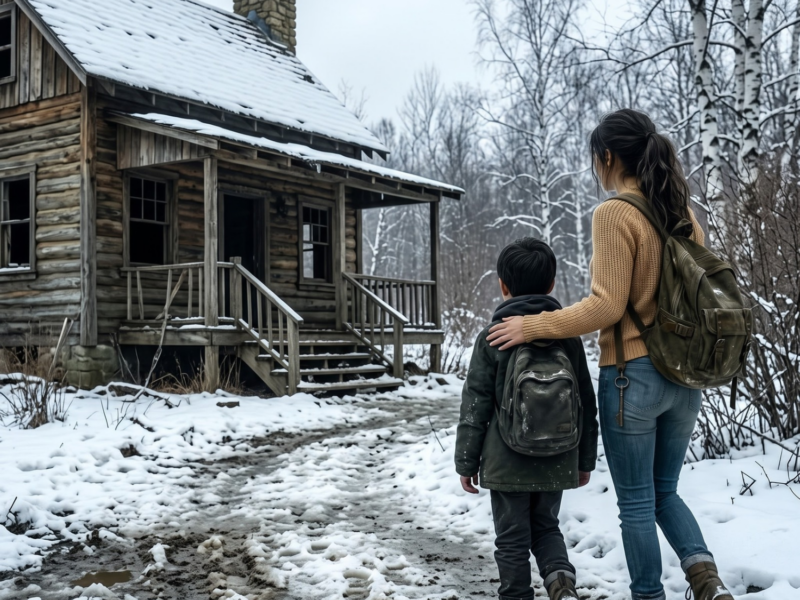
Kicked Out With Her Little Brother During Snowstorm, She Found a Forgotten Cabin Deep in the Pine
THE LETTER IN THE PARKA
If you have traveled this far up the mountain road with Marin and survived the sub-zero climb and the unlocked door, stay close now, because what the old man told her next is the exact reason this story had to be told.
Marin invited him inside. There was no rational reason on earth to trust a total stranger in the Montana wilderness—except that Gus’s journal had explicitly named him, the dog had walked straight to him as an old friend, and sometimes on the frontier, that is the only proof a person gets.
Hollis stepped across the threshold, stamping the melting snow from his heavy pac-boots, standing quietly in the warm cabin and turning his head in a slow, reverent 360-degree sweep. He took in the blazing iron stove, the neatly made iron cot, the canned goods arrayed on the pine shelves, and Marin watched two full winters of unexpressed grief ripple across his weather-beaten features.
“He’d be so damn glad,” Hollis rasped quietly. “Lord in heaven, Gus would give his last tooth to see smoke curling out of this chimney again.”
He lowered his heavy frame into one of the wooden table chairs, and the old shepherd immediately settled its weight against his shin.
“I read his journals, Hollis,” Marin said, pulling out the opposite chair and sitting down. “I hope that wasn’t an invasion of privacy. I just… I needed to know who built this place. Who left us all this?”
“Left you?” Hollis raised his bushy gray eyebrows. “What do you mean, left you?”
Without answering directly, Marin slid the folded letter from the tin box across the scarred table wood—the final testament of Gus Mercer.
The old man dug a pair of wire-rimmed reading glasses from his parka pocket, unfolded the paper with immense care, and bent his head over the crabbed handwriting. His lips moved soundlessly as he deciphered the lines. When he reached the signature at the bottom, he froze entirely—holding the pose for so long the cabin seemed to hold its breath with him.
When he finally looked up, his eyes were swimming with moisture.
“Laney,” he whispered. “Your mother’s name was Laney? The diner girl?”
“You knew her?” Marin breathed.
“I didn’t know her personally, but I knew of her because she was all this old man talked about for twelve solid years,” Hollis said, taking off his glasses and rubbing his eyes with a calloused thumb. “Gus Mercer was the best man I ever knew, and the loneliest. You’d have to search the whole state to find a soul who combined those two things so thoroughly, but he managed it.”
He looked from Marin to Toby and back again, a growing realization dawning behind his eyes. “He used to tell me: ‘A warm cabin ain’t worth a damn to a man with nobody to share it with.’ So he kept it warm anyway. Kept the pantry stocked, kept the firewood split every single autumn in case somebody finally showed up.”
The old man’s voice cracked. “He never knew your names. But it was you he meant. It was always, unequivocally, you.”
For a long moment, nobody spoke. The iron stove popped softly in the corner. The early blue twilight was beginning to pool outside the frosted windows.
“There’s something else you need to understand about Gus,” Hollis leaned forward across the table, his tone turning urgent, “and about what he arranged before his lungs gave out. Because it changes everything for you two, and you need to hear it from someone who was standing in the room.”
Juno suddenly lifted her head off the floor.
The dog rose with a low, sharp warning in her chest—not a casual growl, but a taut, defensive vibration, her notched ear swiveling sharply toward the front window.
Hollis stopped mid-sentence. And then Marin heard it too, cutting cleanly beneath the sigh of the pines: the low, mechanical grinding of a heavy-duty vehicle laboring up the steep, unplowed spur road in low gear.
Through the dark glass of the window, they watched a pair of amber headlights sweep across the tree trunks, swinging and dipping as a county four-wheel-drive sport utility vehicle fought the packed snowdrifts, pulling directly into the clearing alongside Hollis’s snowmobile.
The engine cut. The headlights clicked off.
The vehicle doors remained closed for a tense moment while the passengers inside evaluated the lit cabin.
Marin’s pulse spiked into overdrive. Four days of feeling secure and sovereign in her grandfather’s domain drained out of her veins in a single breath. She thought instantly of the deputy Carla had threatened to dispatch; she thought of state custody laws; she thought of how an unauthorized twenty-year-old girl hiding out with a twelve-year-old boy in a dead man’s cabin would appear to the official machinery of the county.
She shoved Toby gently behind her body and gripped the edge of the workbench.
“Easy, girl,” Hollis muttered, standing up slowly. “Let me handle the talking. I’ve known half the people wearing badges in this county since they were in diapers.”
The doors of the SUV finally creaked open.
Step one out into the snow was a county sheriff’s deputy in a heavy brown winter patrol coat—young, fit, his hand resting casually near his leather holster, though not actively gripping it.
Step two was a woman wearing a professional parka with a county welfare lanyard swinging around her neck, carrying a thick canvas case over her shoulder. Marin knew the instant she laid eyes on her that this woman was the ultimate hazard. A deputy could arrest you and clear the docket; a social worker with a file could reach out and permanently sever the only family you had left in the world.
And then the rear door of the SUV swung wide, and Carla climbed down into the snow.
She looked remarkably small and frail out here in the high alpine timber. The bitter mountain chill had instantly penetrated her thin suburban coat, and she stood hugging her arms tightly across her chest. When her eyes finally found Marin framed in the cabin doorway, they darted away, unable to hold her gaze.
The deputy mounted the wooden porch steps first.
“Evening,” the young officer said, his breath pluming white. “We’re looking for a Tobias Kesler, age twelve. We received an official missing-persons report stating he was removed from his legal guardian’s home four nights ago, and a vehicle registered to a Marin Kesler was discovered abandoned and snowed in down on the pass road this afternoon.”
His eyes slid past Marin into the warm interior of the cabin, instantly locking onto Toby sitting at the table. “That him?”
“That’s my brother,” Marin stated clearly, her voice steadier than her rattling bones.
The woman with the county lanyard stepped up smoothly beside the deputy. “My name is Sarah Lindstrom, with County Family and Children Services. I’m not up here to terrorize anybody, and I’m not here to play the heavy. I’m simply here to verify that a twelve-year-old boy is physically safe. Can we come in out of the cold and talk like civilized human beings?”
There was no diplomatic version of saying no.
Marin stepped back, pulling the door open. And the small, warm sanctuary that had felt so much like a divine rescue mission suddenly flooded with freezing drafts, official authority, and the heavy, suffocating dread of a room where strangers were about to arbitrate the parameters of your survival.









