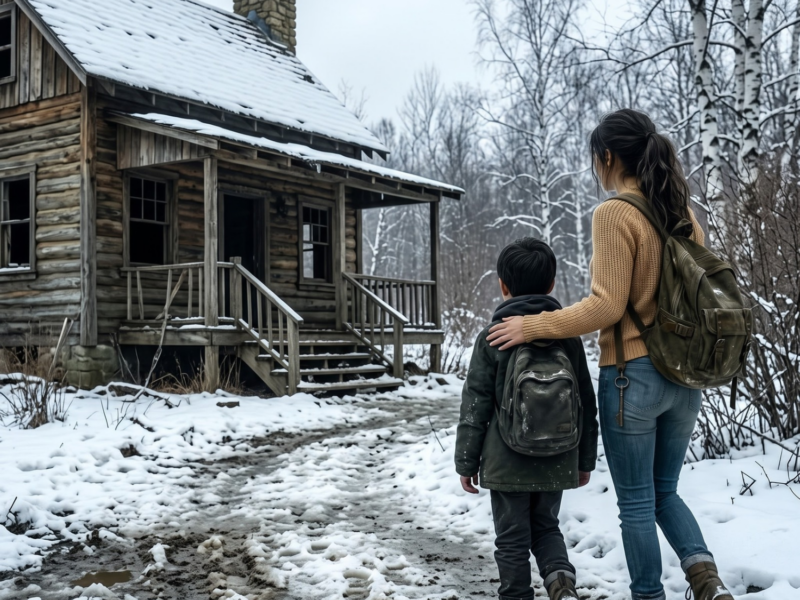
Kicked Out With Her Little Brother During Snowstorm, She Found a Forgotten Cabin Deep in the Pine
THE LETTER IN THE TIN
When Toby finally woke, smelling the fresh coffee and the warm embers of the stove, his eyes were bright.
She poured him a mug of coffee spiked with rich canned milk and heavy sugar—a luxury their mother would never have permitted, which made it taste all the more triumphant. They shared the last of the sliced peaches and a handful of salted crackers.
“Whose cabin is this, Marin?” Toby asked, wiping his mouth with the back of his sleeve.
“A man named Gus,” she told him gently. “He doesn’t live here anymore.”
“Did he die?” The plainness of a child’s question cut straight through romanticism.
“I think he did, bud. A while ago.”
Toby looked around the room—at the made bed, the folded reading glasses, the mug with the chipped name. He didn’t look frightened or spooked; if anything, his shoulders relaxed into the warm air.
“He left us his food,” Toby observed logically.
“He sure did.”
“That was nice of him.”
It was the longest conversation her brother had initiated in over a year.
Later that afternoon, while Toby sat cross-legged by the stove listening to the static-clogged pocket radio, Marin finally reached down and pulled the battered tin box out from beneath her duffel bag.
She had snatched it off the closet shelf back in town without thinking, carrying it through a dead car, a blizzard, and two miles of pitch-black timber, without once opening the lid. She hadn’t possessed the emotional strength to face what lay inside. It held the final physical residue of her mother, and the grief had simply been too heavy to unpack.
She pried the lid off.
The olfactory memory hit her first—a faint, ghostly trace of drugstore rosewater and spearmint gum. It nearly knocked Marin backward. She pressed her palm flat over her mouth, breathing shallowly through her nose until the dizziness passed.
Then she gently began sorting through the contents:
Photographs of her mother as a wild, laughing teenager; a group snapshot of their parents at a lakeside resort the one summer before their father permanently vanished; baby pictures of Toby; a crumpled paper graduation cap from Marin’s eighth-grade ceremony; a gold-plated nurse’s aide pin with a bent clasp; a pressed dandelion blossom flattened into brown dust; and a child’s crayon drawing of a house with impossibly many windows.
And underneath all of it, folded neatly into quarters and softened at the creases from decades of handling, lay a single sheet of lined notebook paper.
Marin unfolded it. The handwriting was instantly recognizable—a man’s careful, slanted script, pressed so hard into the paper the fibers were embossed.
She began to read aloud in a whisper:
Dear Laney,
You won’t remember me, but I’m the man you fed the night I decided not to need feeding anymore.
Marin stopped, her breath catching in her throat. She swallowed hard and forced her eyes back to the page:
The winter of ’84 was exceptionally cruel, and I was just one of many cold men standing outside warm windows. But you came out the back door of the diner where you were working a double shift, and you didn’t just hand me a paper plate and rush back inside. You sat down on the concrete step beside me in the freezing dark, asked my name, and waited for the answer as if it actually mattered to the universe.
I had walked to that diner intending to eat one final warm meal and then walk out onto the railroad trestle over the river. You talked me down without ever knowing you were holding a conversation with a ghost. You gave me back my name.
I spent years trying to track you down to say thank you properly, but I lost the thread of you. So I’m putting these words down on paper in case they ever find their way to you.
There is a parcel of land in the high timber off the old pass road. The cabin door is never locked. If you, or your babies, ever have nowhere else in this harsh world to go, you go there. Stay as long as you need. It is yours. It was always going to be yours.
Your friend, Gus Mercer.
Marin set the paper down on the wooden table, pressing both palms flat on either side of it.
Her mother had kept this letter folded inside a cookie tin for more than ten years. Through every eviction notice, every bitter winter when they had to keep the oven door open just to take the chill off the kitchen, through every silent tear shed at a kitchen table, her mother had known there was a cabin in the pines with an unlocked door and her name written on the threshold.
And she had never once gone.
Maybe out of misplaced pride; maybe because she felt she didn’t deserve a sanctuary she hadn’t earned. And then she had died without ever telling her children that a refuge existed in the mountains.
Yet here they were. A battered mountain dog had walked out of a blizzard and led two discarded children straight to the one unlocked door on the continent that had been waiting for them since before Toby drew his first breath.
“He meant us,” Toby whispered. He had crept over from the stove and stood beside her shoulder, his small eyes tracking the written lines. “When he said your babies… even before I was born, he meant us.”
“He sure did, bud,” Marin choked out, pulling him tightly against her ribs. “He meant us.”









