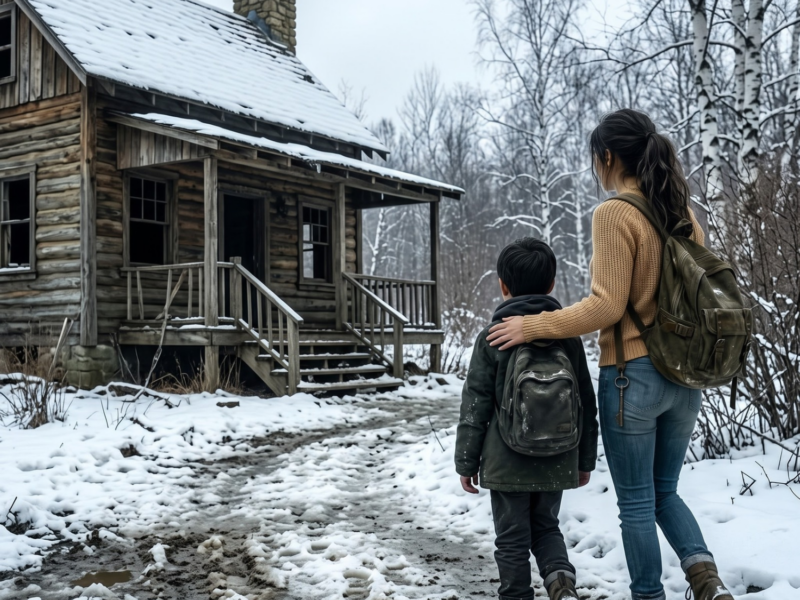
Kicked Out With Her Little Brother During Snowstorm, She Found a Forgotten Cabin Deep in the Pine
THE PROBATE OF THE MOUNTAIN
Marin’s hands were shaking violently as she took the envelope from Hollis’s grasp. Pulling out the single sheet of lined paper, she read it aloud into the silent cabin, her voice echoing off the squared timber walls:
To Laney’s kids,
You won’t know me, and that’s entirely fine. Your mother knew me for about ten minutes one cold night, and those ten minutes were enough to save a man’s life, though she never lived to find out she’d done it.
Your mother gave a meal to a stranger who had nothing left—not even a reason to want a tomorrow. I spent the remainder of my years trying to be worthy of that grace. I couldn’t repay her directly because I lost track of her trail. So I am executing the next best thing.
Everything I possess—this cabin, the forty acres of timber, and the cash reserves in the town bank—is legally bequeathed to her children, whoever and wherever you may turn out to be. There are registered documents filed with an attorney in town. It isn’t a fortune, but it is a roof paid in full, a quiet place, and a woodbox kept dry.
If you are reading these words, it means you found your way here. And I expect that means you desperately needed it. So it is yours. Stay warm. Look after each other. That’s the sum total of what I learned in the end.
— Gus Mercer.
At the bottom of the page sat a signature written in that same hard, slanted pencil. Marin couldn’t force the final syllables past the constriction in her throat, so she simply pressed the paper flat against her chest.
Toby stepped closer, leaning his head against her arm, reading the final lines over her shoulder with his lips moving silently: “Look after each other and leave the door unlocked for the next one who’s cold.”
He looked up at his sister with wide, solemn eyes. “He was just like Mom,” Toby whispered. “He did what Mom always did.”
“He sure did, bud,” Marin choked out, a tear finally cutting a clean path down her soot-smudged cheek. “They both did the exact same kind thing for strangers, and neither of them ever lived to know the circle closed.”
Juno rose from her spot on the floor, trotted over, and laid her heavy chin across Marin’s instep. For a sacred moment, the cabin held every single occupant within its small perimeter of warmth—the living, and the ghosts whose invisible architecture had successfully guided them home.
Sarah Lindstrom let out a long, ragged breath, letting her professional armor slip. She looked around the lit cabin with entirely fresh eyes, and when she finally spoke, her administrative coldness was entirely gone.
“Let me ensure I’ve processed this accurately,” the caseworker said softly. “This real estate and financial bequest was legally registered to the two of you?”
“There’s a verified will sitting with an attorney in town,” Hollis confirmed, stepping forward. “It’s been waiting two solid years for heirs nobody could locate. The county commissioners were just about to initiate foreclosure proceedings for back taxes. I have the lawyer’s business card right here in my pocket.”
The young deputy and the caseworker exchanged a long, meaningful glance that communicated an entire bureaucratic negotiation without a single spoken syllable.
“Give us a brief moment outside,” Sarah Lindstrom said decisively.
She and the deputy pushed open the heavy oak door and stepped out onto the wooden porch, pulling it nearly shut behind them. Through the narrow gap in the timber, Marin could see their breath pluming white in the freezing dark as they engaged in an intense, animated discussion.
Inside, the four remaining occupants stood in heavy silence.
It was Carla who finally broke it. She had quietly sunk down onto the wooden bench by the door, staring down at her own raw, chapped hands with a look of profound, horrifying self-recognition.
“I didn’t actually think you’d take him out into that,” Carla whispered, her voice stripped of all defensive pride. “There was no fight left in me… I thought you’d drop him off at a neighbor’s or go stay with a school friend, and I’d figure out some way to manage my mortgage.”
She shuddered violently. “I keep telling myself I’m not the kind of monstrous person who would do what I just did. And then I went right ahead and did it anyway.”
Marin didn’t offer immediate absolution. She didn’t say It’s okay, because it wasn’t okay. But looking at Carla—gray-faced, shaking, shivering in a town coat completely unsuited for the mountains—the burning rage in Marin’s chest gave way to a hollow, echoing pity. Carla had been monstrously cruel; but she had also been entirely alone, drowning in a financial undertow too strong for her to swim against. And Marin, of all people, understood the terrifying geometry of drowning.
“You could have asked me for help,” Marin said quietly, her voice devoid of malice. “Instead of packing his bag in the dark.”
“I know that now,” Carla wept softly into her palms.
Hollis stepped over to the iron stove, casually feeding another split log into the fire, giving them space. “For what it’s worth,” the old man murmured to nobody in particular, “Gus Mercer would have fed every single soul standing in this room—even the ones who actively earned the cold. That was the whole operational philosophy of the man.”
He slammed the iron stove door shut with a heavy, satisfying clunk.
The porch floorboards creaked under heavy boots. The door swung open, and Sarah Lindstrom stepped back inside, shaking a light dusting of fresh powder from her shoulders. Her face had settled into its professional, unreadable mask, but her eyes were remarkably kind.
“I believe you,” the caseworker announced, looking directly at Marin. “For whatever it’s worth in the eyes of the county, I believe every single word of this history. And I’ll tell you something else.” She pivoted toward Carla on the bench. “I have a legal guardian who put two minors out of a home into a lethal winter storm, and a state support check trail that is going to heavily interest our financial fraud division.”
Carla flinched as if struck with a riding crop.
“So here is how this is going to proceed,” Sarah Lindstrom turned back to Marin with absolute authority. “There will need to be an official administrative review. Given what I’ve personally observed in this cabin tonight, I can assure you the odds are exceptionally high that a family court judge will permanently place this boy with a stable, adult relative who genuinely wants him. Which happens to be you.”
She paused, letting the reality sink in. Then she shook her head slowly.
“However, I cannot legally sign off on that transfer inside an unheated, isolated mountain cabin in the middle of a blizzard. The rules don’t bend instantly for a miraculous story—they require proper paperwork, a home study, and a formal court docket. I’m sorry, but I can’t simply walk out of here tonight and leave a minor in an unverified living arrangement.”
She crouched down once more to Toby’s eye level, her voice dropping into a gentle register. “Tobias, honey? I need you to come down to town with me tonight—just for tonight, while the adults process the legal filings the proper way. I promise you aren’t in any trouble. I promise—”
“No.”
The single word exploded out of Toby. He had stood pressed and silent against Marin’s side through the entire interrogation; now, he let go of her shirt sleeve, stepped forward, and took her entire hand firmly in both of his, anchoring himself with every ounce of physical strength in his twelve-year-old body.
“No,” he repeated, loud, clear, and perfectly steady in a full, clean voice the cabin hadn’t heard in over a year. “I’m staying right here with my sister. We don’t leave each other. That’s the rule.”
The room plunged into absolute silence.
The caseworker stared down at the boy holding his sister’s hand, listening to the resonant, confident voice that every professional report had claimed was permanently locked away. Something in her professional defenses visibly fractured.
She was still shaking her head out of procedural reflex, gathering her arguments, when Carla slowly stood up from the bench.
“Don’t,” Carla choked out, her voice breaking down the middle. She wiped her nose with the heel of her hand and forced herself to speak again. “Don’t take him away from her.”
The caseworker blinked in surprise.
Carla turned her red, swollen eyes toward Marin. And for the first time all evening, they didn’t dart away. “He should be with her. He’s always been with her.”
A bitter, self-deprecating laugh escaped Carla’s throat. “I had the legal papers and the monthly check, and she had him. She’s the one who stayed awake with him through his night terrors. She’s the one who taught herself how to administer his breathing treatments by watching videos on a cracked phone.”
She pressed her lips together, fighting for control. “I was so busy drowning that I decided everyone else needed to sink with me. I told myself you were both grown enough to swim, because I couldn’t bear the thought of being failure number three in a long line of failures. So I just shut my eyes and made it your problem.”
She looked directly at Sarah Lindstrom. “I’ll sign whatever paperwork you put in front of me tomorrow morning. Give that boy to his sister. Please… don’t make him spend one more night away from the only person who never once abandoned him.”
The caseworker held absolute silence for a long, heavy minute. She glanced from Carla to Hollis, who gave a slow, deliberate nod; she looked at the warm stove, the full pantry shelves, and the old shepherd dog resting its head trustingly against the boy’s shin.
Slowly, deliberately, she snapped her notebook shut.
“All right,” Sarah Lindstrom said, a ghost of a smile touching her mouth. “Here is what I am authorized to do tonight, and it stretches administrative discretion well past its breaking point, so nobody interrupt me.”
She turned her gaze to Marin. “With the legal guardian consenting to an emergency kinship placement, and a responsible adult resident on this mountain willing to vouch for the premises, I am officially exercising emergency discretion to leave Tobias in your custody right here tonight.”
She held up a warning finger. “That is emphatically not the end of the bureaucratic process. There will be an official home study. There will be a formal court hearing, a pile of paperwork, and a family court judge who will need to sign off. You will both have to appear.”
Her face softened noticeably. “However… I’ve been doing this heartbreaking work for eleven long years, and I’ve finally learned how to distinguish between a child being cynically manipulated and a child who is genuinely held. That boy is held.”
She pulled a business card from her coat pocket and laid it on the scarred wooden table. “I’ll file my preliminary report the way I actually witnessed it tonight.”
EPILOGUE: THE UNLOCKED DOOR
They departed before full dark, the county SUV’s headlights cutting long, pale swaths through the falling pine snow as it navigated the downward grade.
The deputy shook Hollis’s hand firmly on the porch; Sarah Lindstrom paused at the threshold, smiled warmly, and told Marin to keep the wood box full; and Carla was the absolute last to leave.
She lingered in the open doorway for a second, looking at Toby as if she desperately wanted to say something redemptive, but recognizing she possessed no currency left to spend. In the end, she simply whispered, “Be good for your sister,” turned around, and walked out to the truck without looking back.
The tail-lights dipped down the mountain spur and vanished into the timber, leaving Marin, Toby, Hollis, and the dog entirely alone in the warmth of the cabin.
Toby let out a long, shuddering sigh of pure relief. “I didn’t want to talk to those people,” he admitted quietly, “but I thought for sure they were going to drag me away.”
“I know, bud,” Marin pulled him into her arms, burying her face in his hair. “You did the bravest thing in this whole county tonight. You know that, right?”
Toby thought about it for a second. “It wasn’t brave. It was just true.”
Juno rose, trotted over, and laid her heavy chin across Marin’s knees. For the first time in her life, Marin felt the absolute weight of the world lift entirely off her shoulders, leaving behind something light, clear, and enduring.
The high mountain snow did not fully retreat until late June of the following year. By the time the wildflowers burst across the alpine meadows, the cabin in the pines officially belonged to them in the unyielding eyes of state real estate law.
It took a probate lawyer in town and most of the spring to cut through the bureaucratic red tape, but Hollis drove them down every time a signature was required.
The lawyer pulled a file two winters thick with yellowed paper and read aloud the final testament of August Mercer, who had left everything he possessed to the children of Laney Kesler. The county’s foreclosure attempt was swiftly dismissed; the forty acres of pristine timber, the rustic outbuildings, the dry woodshed, and a savings account holding just over nine thousand dollars in a local bank were legally signed over to Marin and Toby.
It wasn’t an immense fortune by worldly standards. But it was a roof paid in full, located in a quiet place, equipped with a full woodbox. It was precisely what the old man had promised: no more, and certainly no less.
Marin used the initial disbursement to modernize the essentials: installing an upgraded, frost-proof water pump that didn’t require manual priming by a twelve-year-old; purchasing a reliable, flatbed farm truck older than she was; and replacing the cracked glass in the workshop window.
She opened a bank account in her own legal name for the first time in her life, standing at the teller counter with a strange, giddy sense of having outsmarted fate.
In the autumn, when the high timber turned a blazing crown of gold and scarlet, Toby climbed aboard the county school bus at the bottom of the mountain road for the start of seventh grade. He came home that first afternoon talking a mile a minute before he even cleared the front porch—chattering excitedly about a classmate named Diego who also liked carving wood, about an industrial shop class where they were building bluebird boxes, and about an art teacher who declared his carved wooden hound worthy of display in the school’s main trophy case.
He talked straight through dinner. He talked while he sat at the exact wooden table where Gus had once crossed off his calendar days in pencil.
Some evenings, Marin caught herself simply sitting quietly in the corner, listening to the plain, unbroken miracle of her brother’s voice filling the room, and she had to get up and busy her hands with chores just so the sudden, crushing wave of gratitude wouldn’t knock her flat.
As for Juno, the old dog grew pleasantly plump and increasingly gray-muzzled over the course of that year, permanently abandoning her nomadic roaming days. She slept exclusively in her worn wooden armchair by the stove and walked down to the bottom of the spur road every single afternoon to escort Toby back up the grade from the school bus stop.
Hollis hiked up most Sundays, teaching Toby how to safely drop deadfall pine without crushing his toes, and instructing Marin on how to bleed the subterranean water lines before an alpine freeze. He sat at their table, ate whatever simple fare they set before him, and spun endless yarns about Gus Mercer until the cabin felt less like a museum of a dead man and more like an active family hearth being actively handed down across generations.
“He’d have liked this, Lord knows,” Hollis muttered one Sunday evening, watching Toby and the dog wrestle playfully on the braided rug. “He would have given anything for a full, noisy house.”
Marin understood then that the old man at their table had been just as profoundly lonely as the one resting beneath the churchyard sod; and that two broken, freezing children and a battered mountain dog had successfully rewritten the final chapter of more than one life that winter.
Marin returned to her education as well. In January, the local community college in the valley valley permitted her to resume her nursing coursework, fitting classes around her flexible schedule. On the night she brought home her heavy anatomy textbook, she sat at the kitchen table and cracked the spine.
Toby looked up from his carving block. “What’s that for, Marin?”
“So I can finish what Mom started,” she answered softly. “Taking care of people who need it.”
“You already do that,” Toby remarked simply, before returning his attention to his knife work, entirely unaware he had just uttered the truest sentence in the county.
Carla lost her suburban rental house that spring—a piece of local gossip Marin heard secondhand through Fay down at the grocery store. The bank had foreclosed, the boyfriend had vanished, and Carla had relocated into a tiny rented room on the rough side of town, scrubbing office floors after dark.
Marin thought about that news for a long time. She remembered the packed duffel bag by the door in the dead of winter. The old, familiar anger flared up; but beneath it came her mother’s voice, worn smooth by repetition: Be kind to whoever is standing right in front of you. It costs you nothing, and it’s the only thing you get to keep.
So Marin sat down and wrote Carla a short, measured note.
She didn’t pretend the betrayal hadn’t occurred, and she didn’t offer cheap absolution, because some wounds require years to close. She simply informed her aunt that Toby was thriving, growing tall, and speaking freely, and that the door at the old Mercer place in the pines was never locked if she ever wished to drive up the mountain and see how well he had turned out.
It wasn’t an instant reconciliation. It was simply a hand held out across cold water to someone who was actively drowning—because Marin now understood intimately what it felt like to go under, and what one small, unexpected act of grace could mean to a person who had stopped expecting anything from the world.
Carla drove her battered sedan up the mountain once in early summer, sitting stiffly on the porch steps to watch Toby proudly show off his woodworking projects, before quietly weeping into her steering wheel at the bottom of the road where she thought nobody could see her. She returned twice more before the first autumn frost touched the aspens. It wasn’t a fairy-tale ending. But it was a valid beginning. And on the frontier, a beginning was more than enough.
People occasionally asked Marin during her rare trips into town why she didn’t sell the property. Forty acres of prime timberland and a water-secure cabin could easily command a small fortune in the modern real estate market—enough to buy a comfortable suburban life with central heating, neighborhood kids, and a supermarket five minutes away.
She always offered them the exact same unvarying answer, and it was the most honest thing she knew:
“Because somebody left the door unlocked for us when we were freezing,” she would say plainly. “Now it’s our turn to keep it open.”
She meant it metaphorically, but she executed it literally. Every single autumn, she filled the woodshed by the pass road to absolute capacity with split, seasoned firewood—far more than she and Toby could ever burn in two winters. She stocked a weather-sealed metal shelf inside with canned rations, dry matches, a hand-ax, and a clean wool blanket.
And on nights when the mountain gales screamed down off the continental divide like a freight train, she made sure a bright kerosene lamp burned steadily in the window facing the pass—just the way Gus Mercer had intended it to burn.
She left the cabin latch unfastened.
The following winter, on a night when a blinding whiteout swallowed the ridges, a lost backcountry hunter following the faint beacon through the black timber hammered frantically on the heavy oak door.
Marin pulled it open, took him in, fed him hot stew, and dried his wet gear by the roaring iron stove, listening to him stammer repeatedly that he would have surely perished in the drifts if he hadn’t spotted her lamp cutting through the dark.
“A man named Gus left that light burning,” Marin told him simply, handing him a steaming mug of coffee. “I’m just the one keeping the wick trimmed.”
The hunter didn’t understand the reference, and she didn’t bother elaborating. Some truths don’t need to be explained; they only need to be lived.
Hollis was dozing comfortably in his armchair across from Juno’s customary spot. After the stranger had drifted off to sleep wrapped in warm blankets on the floor, the old man looked around the vibrant, full room, listened to the snow hissing softly against the window glass, and offered his final verdict:
“Folks always talk about blood like it’s the only family that counts,” Hollis muttered, scratching the old dog behind her tattered ears. “Your blood relatives shoved you out into a lethal snowstorm. And a dead man you never met, a battered mountain dog, and a tired old forester took you in. Real family isn’t the people who are biologically scheduled to stick around. It’s the ones who actually do.”
Marin didn’t answer with words. She didn’t need to.
She rose from her chair and walked the perimeter of the room the way she did every single night now—the exact sequence of motions her grandfather had performed before her, and the sequence she would pass down in her turn.
She checked the damper on the iron stove and banked the embers. She walked to the heavy oak door, checked the latch, and deliberately left it unbolted. She filled the indoor woodbox to the brim so the morning fire would require zero effort.
Then she trimmed the wick of the kerosene lamp, carried it across the room to the north window that looked out over the dark, whispering pines and the buried pass road, set it down on the sill, and let it burn brightly into the night—just in case somebody else out there was cold, and needed a door left unlocked.









