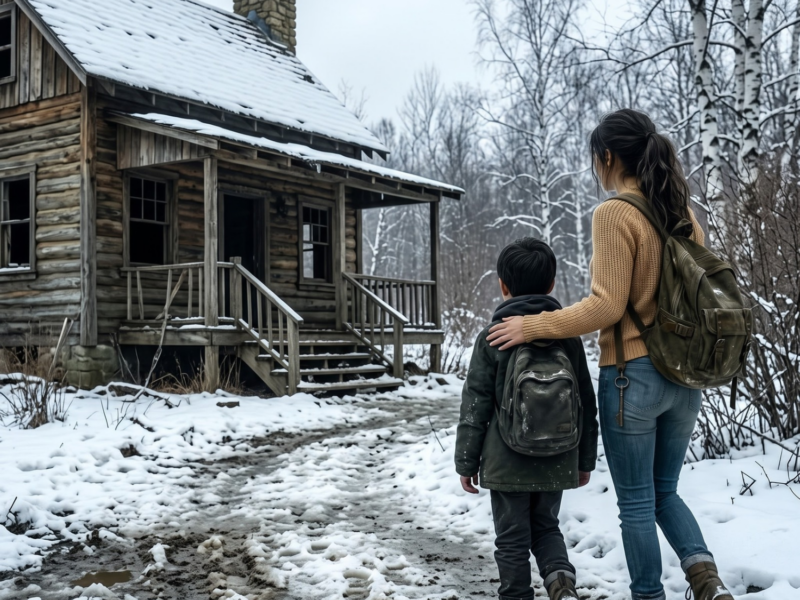
Kicked Out With Her Little Brother During Snowstorm, She Found a Forgotten Cabin Deep in the Pine
THE GRAY GUIDE
She never saw where the dog came from.
One moment there was nothing in the universe except howling wind, swirling powder, and the black, skeletal edges of the timberline; the next, a solid, four-legged shape materialized directly on the road shoulder ahead of them—large, low-slung, and gray against the white.
Marin stopped so abruptly that Toby stumbled straight into her back. Her first instinct, born of urban legends and isolated highway lore, was a timber wolf. Her hand clamped down protectively on her brother’s arm.
It wasn’t a wolf. It was a dog—a massive, rough-coated animal, its gray fur fading to stark white around an ancient muzzle, one ear torn cleanly down to a ragged notch. It stood dead center in the packed ruts, favoring its front left leg slightly, watching them with an unnerving, absolute steadiness. It didn’t snarl. It didn’t bark. It simply looked at them the way an experienced guide looks at travelers who are finally arriving at the rendezvous point.
“Easy,” Marin breathed, her voice shaking. “Easy, boy.”
The dog turned, trotted a few paces off the road into the shelter of the pine trunks, and stopped to look back over its shoulder. When they didn’t move, it trotted back, circled once in the fresh powder, and repeated the motion.
Stop. Look back.
“It wants us to follow it,” Toby whispered.
The words hung in the freezing air. They were the first complete sentence her brother had spoken in over twelve months.
Marin didn’t stop to analyze the miracle. She didn’t have the emotional bandwidth to weigh a stray mountain dog’s intentions against the freezing miles of highway behind them. The house with the porch light was miles away through deadly terrain; the dog was right here, radiating an inexplicable, unshakeable certainty.
“Okay,” Marin rasped, tightening her grip on Toby’s hand. “Okay. We follow the dog.”
They plunged off the asphalt into the dense timber. The moment they crossed beneath the pine boughs, the destructive kinetic energy of the wind dropped instantaneously, broken up by millions of trunks, and the snow began falling in softer, straighter flakes.
The dog stayed precisely twenty paces ahead—a moving gray smudge in the gloom, pausing whenever they lagged behind, picking a path through the boulders and deadfall with instinctive grace.
The ground climbed sharply and then leveled off. Marin’s feet had completely gone numb, a terrifying lack of sensation that frightened her far more than sharp pain ever could. She kept Toby moving by reciting a monotonous, rhythmic litany of encouragement: You’re doing great. Almost there. Lift your feet. Good. Until the words blurred into meaningless syllables and she wasn’t entirely sure which of them she was physically supporting.
Then the timberline suddenly broke.
The dog trotted forward with renewed purpose, and the black wall of trees opened onto a wide, flat expanse of unbroken snow—a high alpine clearing with the massive, jagged shoulders of the continental divide looming behind it.
And right in the dead center of the clearing stood a cabin.
It was small, low-slung, and constructed of heavy, squared logs turned silver-gray by decades of mountain weather. The steep tin roof humped beneath two heavy winters of accumulated snowpack. There were no lights glowing in the small windows, and no woodsmoke drifted from the stone chimney. It possessed the profound, untouched stillness of a place forgotten by time itself.
Yet it had a wooden porch, a solid front door, and four walls that offered sanctuary. To Marin, standing on the precipice of hypothermia, it was the most magnificent cathedral she had ever beheld.
“Look, Toby,” she choked out, pointing. “Look there.”
The dog was already up on the wooden porch, rhythmically scratching its claws against the heavy oak panels of the door. Marin half-carried, half-dragged her brother across the open clearing and up the two wooden steps. She shoved her frozen fingers into the iron latch.
The latch gave. The heavy door swung inward with a long, frozen groan of ancient hinges. She shoved Toby inside ahead of her and slammed the door shut against the howling mountain night.
The sudden absence of the wind made the silence inside ring like a struck bell.
It was pitch-black and only marginally warmer than the storm outside, but it was dry. It was out of the weather. And in that moment, that simple fact felt absolute and divine.
Reaching into her pocket with stiff fingers, Marin dragged out her cell phone, pressing the power button. Miraculously, the screen flickered to life, offering a pale, dying beam of light before flashing a warning about extreme cold.
Swinging the thin beam across the room, she revealed a single rustic space: a heavy cast-iron cookstove squatting in the corner on a thick slab of flagstone; a scarred wooden table with two chairs; a narrow iron cot against the far wall with woolen blankets folded with military precision at the foot; shelves lining every available inch of wall space, laden with green glass jars, tin cans, and hand tools; and a wooden box beside the stove, piled high with split, perfectly dry pine alongside a tin box of kitchen matches resting on the warming shelf as though placed there deliberately for an expected guest.
Marin didn’t stop to question the impossible convenience of it. She would unpack the mystery later. Right now, her frost-nipped hands knew the ancient liturgy of survival.
She built a fire in the cold iron belly of the stove the way her mother had taught her at a lakeside campground a lifetime ago: dry bark shavings first, followed by pencil-thin kindling, building up to the split pine. When the dry wood finally caught, crackling fiercely, and the first wave of genuine iron heat radiated out into the room, Marin nearly collapsed onto the floorboards.
Working with swift efficiency, she stripped Toby of his frozen boots, chafed his icy feet back to life, and wrapped him tightly in the clean wool blankets directly in front of the open stove door. A faint flush of color began to creep back into his pinched cheeks.
The dog had trotted inside with them, shaking a cloud of ice crystals from its heavy coat. It crossed the room with the unhesitating familiarity of an animal that owned the lease, walking straight to a low, wooden armchair beside the hearth. Not stopping near the chair—climbing into it, curling its battered body into the worn, depression-shaped seat, resting its gray-fuzz chin on the wooden armrest with a long, human-like groan of relief.
Marin froze, watching the animal. She lifted the dying phone light and panned it slowly across the interior once more, truly looking for the first time.
The canned goods on the shelves bore faded paper labels, but their metal seams were intact. The wool blankets were entirely free of moth-holes or dust. On the workbench beneath the window, neatly aligned beside a row of carving chisels, sat an empty coffee tin filled with folded paper bills.
And gouged directly into the thick oak surface of the workbench, worn completely smooth by decades of a human palm resting over it, was a name.
Carved in deep, clean letters: MERCER.









