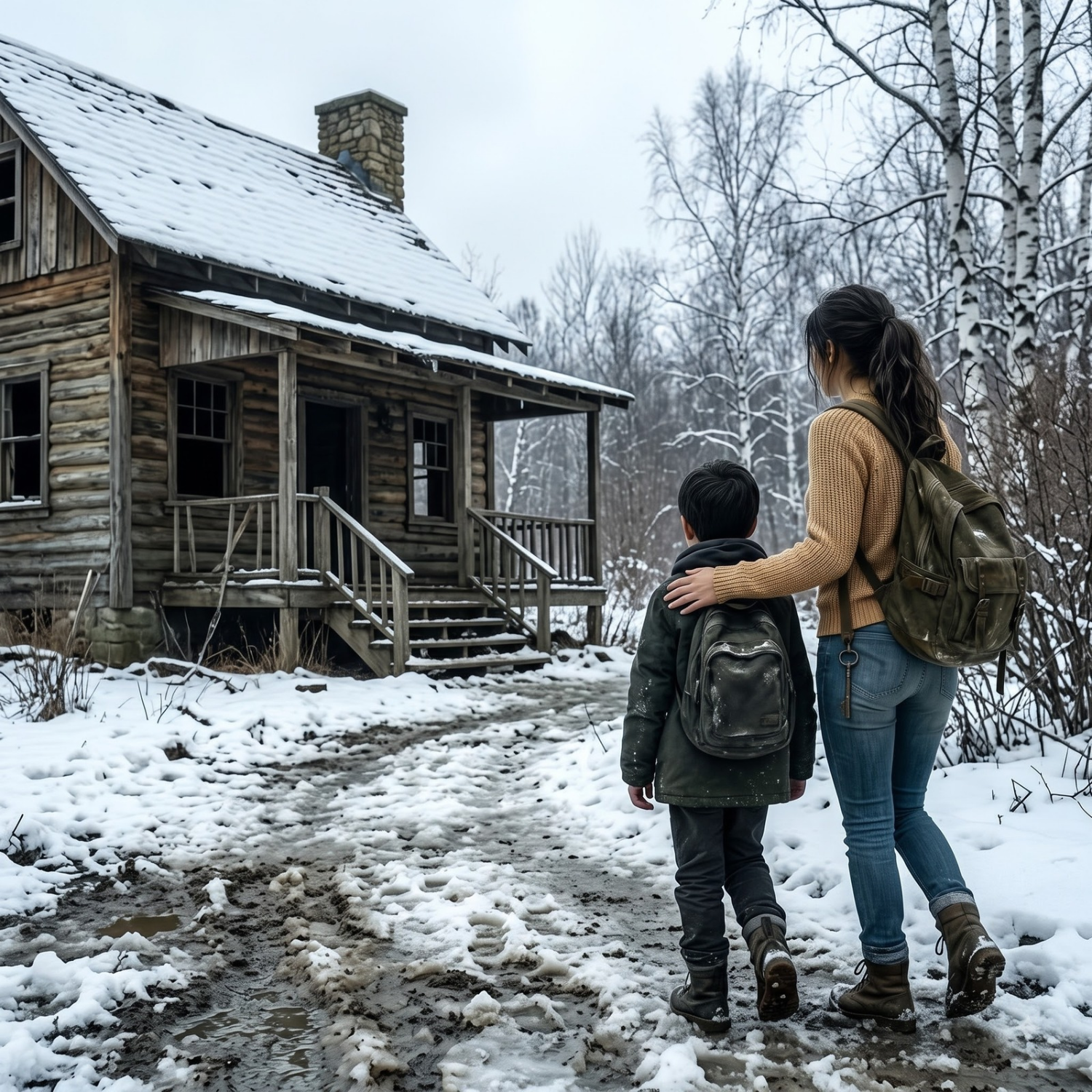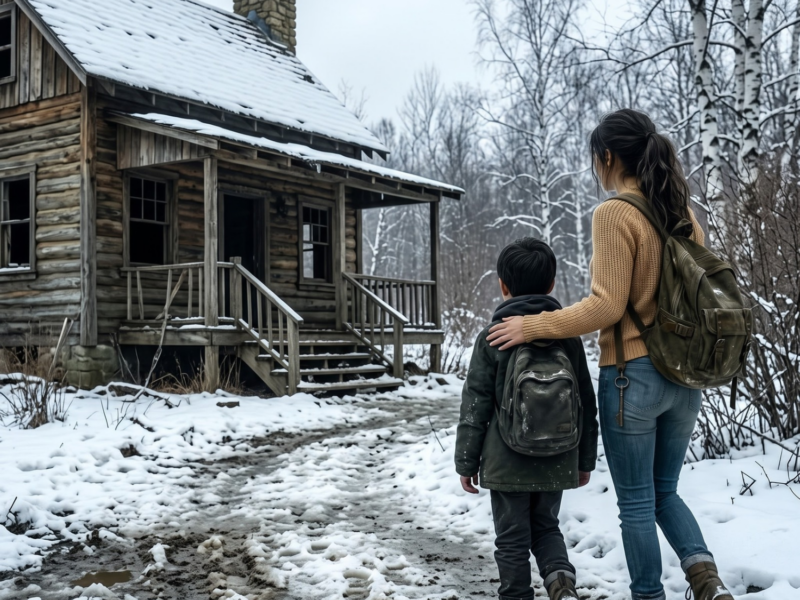
Kicked Out With Her Little Brother During Snowstorm, She Found a Forgotten Cabin Deep in the Pine
THE KITCHEN OF CINDER AND ASH
The trouble had started that afternoon in a cramped kitchen that smelled permanently of stale cigarette smoke and scorched instant coffee.
Marin had just come home from a double closing shift at the diner, her name tag—Marin—still pinned crookedly to her blouse, and forty-one dollars folded neatly into her back pocket, the combined total of her weekly wages and tips. Most of that money was already spoken for. Thirty dollars was earmarked for Carla, the woman who had ostensibly taken them in; the rest was supposed to cover the emergency refill on Toby’s asthma inhaler.
She never even made it to the hook by the door to hang up her jacket.
Carla sat at the Formica table with a man Marin had met precisely twice—a man who drove a newer four-wheel-drive truck and possessed an unsettling habit of looking at Marin and her brother as if they were boxes someone had left in a room he wanted to remodel for himself.
On the floor against the wall sat a blue nylon duffel bag. Marin recognized the frayed blue strap immediately. It belonged to Toby.
“We need to talk,” Carla said without looking up from her glowing cell phone screen.
Marin stayed frozen by the doorway. “About what?”
“About how this isn’t working anymore.” Carla finally set the phone face down. She was forty-six years old, though that winter she looked ten years older, ground down by a bone-deep tiredness that no amount of sleep could ever fix. “You’re a grown woman, Marin. You’ve been a grown woman for two years since your mom passed. This arrangement was supposed to be temporary.”
“I pay you,” Marin said, her voice dropping into a defensive register. “Every single week, I hand over my share.”
“You pay for your portion of the groceries you eat. That’s not the same as paying your own way in this economy.” Carla’s eyes flicked nervously toward the man across the table and then back. “I took you both in because somebody had to. I never said it was a blood-pact for eternity.”
The gas furnace kicked on with a heavy, hollow thud. Down the narrow hallway, Marin could hear the thin, static-laced electronic hiss of Toby’s little pocket radio—the one that had belonged to their mother—turned down low the way he always kept it now, as if sound itself were a fragile thing that might shatter if handled roughly.
“Where am I supposed to go?” Marin asked. It wasn’t really a question. She already understood the geometric shape of the afternoon: sharp, jagged, and designed to cut.
“You’ll figure it out. Girls your age move out into apartments all the time.” Carla picked anxiously at a peeling edge of the table laminate. “I packed Toby a bag. He stays.”
“He what?”
“The state still sends his survivor support check, and I’m still his legal guardian on paper, so he stays right here where it’s stable.”
There it was. The entire ugly mechanism laid flat on the table. Toby’s monthly state check would keep arriving in Carla’s mailbox; Marin, however, would not.
“He stays,” Marin repeated, her vision narrowing.
“It’s better for him.”
“Better for your four hundred dollars a month,” Marin corrected coldly.
The man at the table shifted his heavy weight, making the wooden chair shriek against the linoleum. “Watch your mouth, girl,” he growled.
Marin didn’t even look at him. She stared directly at the blue duffel bag on the floor, and then she thought of a sterile hospital room a year ago, where she had held her dying mother’s dry, papery hand and promised she would keep Toby close. Not safe—you couldn’t promise safety in a world like this. Close was the word her mother had whispered in her final clear hour. Keep him close.
“Toby,” Marin called out, keeping her voice meticulously even. “Get your boots.”
“He’s not going anywhere,” Carla snapped, rising to her feet. “Toby stays.”
“Boots and your coat now, bud,” Marin raised her voice slightly.
From down the hall, the faint static of the radio clicked off. That was the peculiar tragedy of her brother: he hadn’t strung four consecutive words together since the funeral, but he heard every shift in the air, and he always came when she called.
He appeared in the shadowy hallway in his wool socks, twelve years old and much too small for his age, his dark hair falling across his eyes, clutching the portable radio against his chest with both hands like a shield.
“Marin, I swear to God, if you take that boy out of this house,” Carla shouted, panic finally piercing her cold facade, “that is custodial interference! That’s a felony! I will call the sheriff right now!”
“Then call him,” Marin said, dropping into a crouch to jam Toby’s feet into his winter boots with swift, steady fingers, her heart hammering against her ribs like a trapped bird. “Tell him you left a twelve-year-old’s packed bag by the door in January and kept his support check. Go ahead. Tell him all of it.”
For a long, suspended second, nobody moved. The man looked at Carla; Carla looked wildly toward the front door. In that brief window, Marin understood that the threat was completely hollow. The last thing in the world Carla wanted was a county deputy standing in her kitchen asking uncomfortable questions about a packed duffel bag and an illegal eviction in the dead of winter.
Marin snatched up the duffel bag. She grabbed her mother’s heavy wool coat off the wall peg—the one that still retained the faint, ghostly scent of drugstore rosewater. Reaching up to the high closet shelf, she pulled down a dented tin box with a faded picture of a snow-covered village on the lid. It held every scrap of physical history left of their mother: a handful of photographs, a silver nurse’s aide pin, and a packet of folded medical bills. It tucked securely under Marin’s arm.
“You’re being completely dramatic,” Carla muttered, her voice dropping an octave, losing its sharp edge. “We don’t leave each other like this.”
“That’s the only rule we’ve ever had,” Marin straightened up, resting a firm, grounding hand on Toby’s thin shoulder, “and we’re keeping it.”
She walked her brother out into the freezing dusk. Behind them, the man muttered something ugly, and Carla said nothing at all.