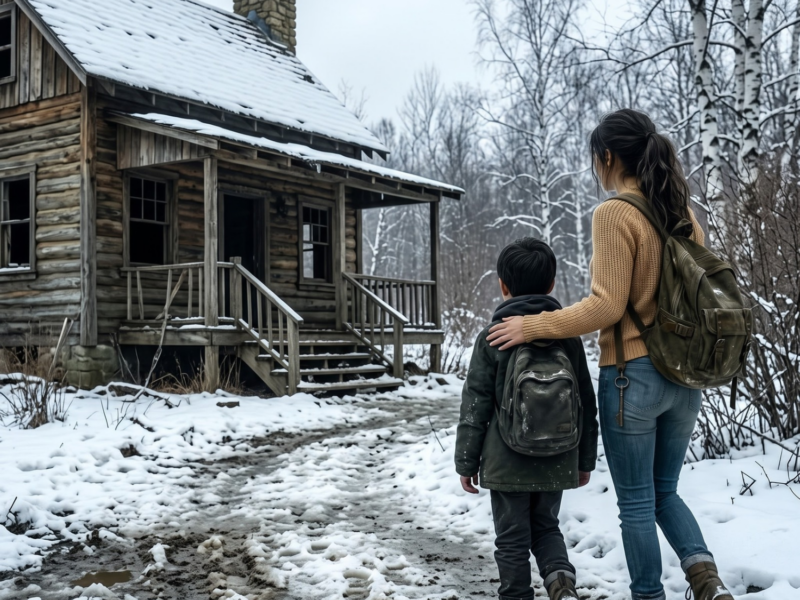
Kicked Out With Her Little Brother During Snowstorm, She Found a Forgotten Cabin Deep in the Pine
THE PHOTOGRAPH IN THE BIBLE
That night, as the storm shrieked its fury against the cabin logs and the fire held the perimeter against the cold, Marin sat on the floor with her back resting against the iron cot frame and let herself feel the full, staggering magnitude of their survival: They were not going to die tonight.
Toby had dragged his wool blankets over beside Juno’s wooden armchair, building a cozy nest directly on the floor. One of his thin hands rested securely deep in the dog’s rough neck fur, and the old animal had closed its eyes in contentment. Watching her brother’s thumb trace slow circles through the fur—witnessing his desperate need to touch a living, breathing thing after months of profound isolation—Marin felt a knot in her chest finally begin to untie.
“You can sleep,” she told him softly. “I’ll keep the fire up.”
“Wake me if she needs water,” Toby mumbled, his eyelids fluttering.
“I will,” Marin promised.
Within minutes, he was fast asleep.
Lighting the kerosene lamp she’d found on the table, Marin began to walk the perimeter of the room. The more she observed, the stranger and more poignant the cabin became.
The iron cot wasn’t abandoned; it was made up with Hospital corners and clean wool blankets. The reading glasses on the pine shelf were carefully folded and set directly on top of a worn black family Bible marked with a velvet ribbon. A wall calendar from two winters back showed every single day meticulously crossed off in pencil right up to a Tuesday in late November—and then stopped completely.
Standing there in the quiet room, Marin understood a profound truth: Nobody had walked out of this cabin meaning never to return. They had left like people stepping out for firewood, fully intending to cross their own threshold again.
“Toby,” she kept her voice low. “Whoever lived here didn’t leave the way people leave a place they’re done with. They left like they meant to come right back.”
“Maybe they did come back,” Toby murmured from his blankets without opening his eyes. “Maybe that’s the dog.”
Marin looked down at Juno—gray-muzzled, battered, and ancient—sleeping soundly in the chair she clearly considered her own birthright. A cold shiver that had nothing to do with the weather rippled down Marin’s spine.
She didn’t sleep much that night. Every hour, she fed the stove, dozing against the iron frame, waking to the diminishing roar of the gale outside.
By the gray, tentative light of dawn, the storm had utterly spent itself.
Opening the heavy oak door, Marin stared out at a world drowned in absolute, pristine white. The clearing was smooth, deep, and utterly unbroken save for the trio of deep postholes she and Toby had punched into the drifts the night before. The giant pines bowed gracefully under massive white crowns.
Their dead sedan was buried somewhere miles away down the spur, completely entombed in snow. The road was impassable. They were stranded out here at the edge of the world.
The realization should have choked her with panic. Instead, breathing in the sharp, crystalline mountain oxygen, wrapped in the residual warmth of the stove and the heavy canvas coat hanging by the door, she felt an absolute, unshakeable calm.
She walked the perimeter of the clearing in daylight. Behind the cabin stood a lean-to woodshed packed floor-to-rafters with two full cords of split, seasoned pine. A hand-pump stood near the back door, rigged with an insulated frost-box. There was a root cellar with a slanted wooden door, a smokehouse, and an outhouse—all constructed with square, plumb timber and maintained with meticulous pride.
This was not the erratic domain of a transient squatter. This was the life-work of a man who woke up every single morning, faced the brutal isolation of the Montana wilderness, and executed the physical labor of staying alive with deliberate, conscious purpose.
Back inside, she brewed coffee in the green enamel pot. Sitting at the scarred wooden table while Toby still slept, she finally let her eyes wander to the workbench under the window, where the small carving chisels sat in graded order.
Arranged along the sill above them was a neat row of hand-carved wooden animals: a bear cub no larger than a walnut, an alert horned owl, and a running hound with one ear notched in a jagged tear.
She didn’t need to look twice to recognize the dog.
Reaching out, she picked up the carved wooden hound, turning it over in the morning light. Whoever had whittled this piece had poured an immense reservoir of affection into the wood. You could see it in the smooth contours of the back, the attentive tilt of the head.
On the shelf beside the stove stood a chipped tin mug with a name painted across its side in white lead paint that was steadily flaking away. Tilting it toward the light, she spelled out the faded lettering: GUS.
The kind of personal marker a solitary man paints on his own dish so it never gets confused with anyone else’s—except there hadn’t been anyone else within ten miles to confuse it with.
Gus Mercer.
A man named Gus Mercer had lived out his days in this high timber sanctuary, keeping company only with a dog, carving miniature woodland creatures, reading his Bible by lamplight, and crossing off the days on a calendar until one Tuesday in November when the pencil strokes abruptly ceased.
Reaching up, Marin lifted the worn black Bible from its shelf. As she pulled it down, the velvet bookmark slipped, and a single, yellowed photograph fluttered out, landing face-up on her lap.
It was an old snapshot, the chemical dyes faded to a soft, sepia-toned gold. A tall, lean young man with dark, unruly hair and a wide, easy grin stood with his arm slung protectively around a smiling young woman. Tucked against the woman’s shoulder was a tiny infant wrapped in a knitted blanket.
Marin stared at the young man’s face. She didn’t need a signature to know who he was; she recognized those deep-set, intelligent eyes instantly from the coffee mug on the shelf.
It was Gus. Young Gus, back before the world stripped everything away from him.
Flipping the photograph over, she found four handwritten words scrawled on the back in a careful, slanted hand:
My whole heart, gone.
Marin sat in the silence of the cabin, the photograph resting in her palms, feeling the ghostly weight of the old man’s grief settle over the room. He had lost everything—a wife, a child, a home—and had spent the remainder of his days wandering the margins of society before finding solace in this isolated cabin.
And yet, looking around the pantry stocked with food and the woodbox filled to the brim, she realized something astonishing: Gus hadn’t just built a hermitage for himself. He had engineered a safety net for anyone who might stumble out of the freezing dark.









