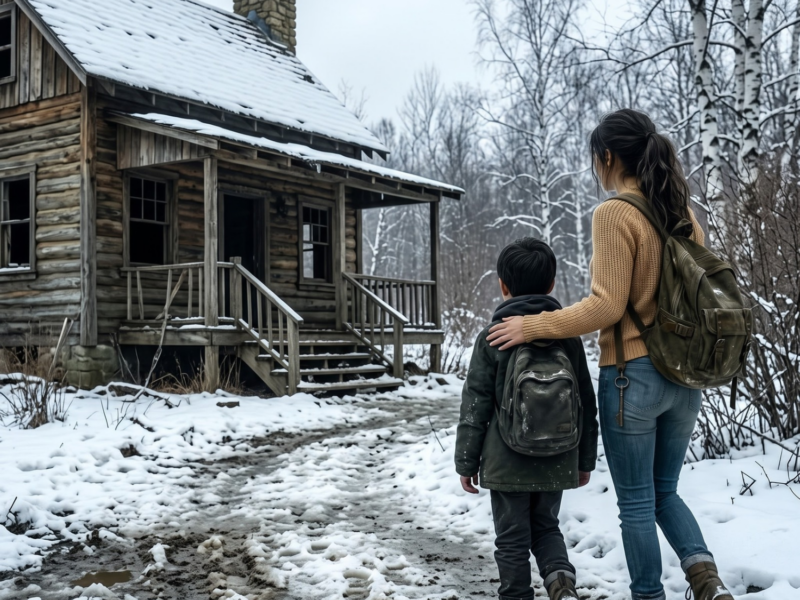
Kicked Out With Her Little Brother During Snowstorm, She Found a Forgotten Cabin Deep in the Pine
THE WEIGHING OF THE SCALES
The caseworker stepped inside, taking in the rustic architecture with a slow, professional sweep of her eyes. Marin watched her meticulously: the lit cast-iron stove, the canned provisions lining the pine walls, the made-up cot, and Toby sitting quietly at the workbench with his carving knife resting beside a half-finished wooden dog, looking warm, well-fed, and impeccably clean.
Whatever administrative nightmare the caseworker had braced herself to uncover on the long drive up this mountain, it clearly wasn’t this.
“You’ve been up here four days?” Sarah Lindstrom asked, turning back to Marin.
“Three nights and four days,” Marin corrected. “We got trapped in the whiteout the first night, and the county road has been impassable since. The food and firewood were already stocked by the man who owned this place. We didn’t steal a single thing that wasn’t offered.”
The caseworker crouched down slightly to level her eye line with the boy. “Tobias? Can I ask you a few quick questions, buddy? I promise you aren’t in any trouble whatsoever.”
Toby stared at her with wide, unblinking dark eyes and said nothing.
“Are you warm enough up here? Are you getting enough to eat?”
Still absolute silence.
Without breaking eye contact, Toby quietly set his carving knife down, slid off the wooden stool, crossed the room, and pressed his body firmly against Marin’s flank, clutching a tight fistful of her denim shirt exactly as he had done in the car four nights ago.
The caseworker watched the instinctive gesture, pulled a small notepad from her coat pocket, and scribbled a brief note. Marin’s heart plummeted—she couldn’t read the therapist-speak of social service shorthand, and every stroke of that pen felt like a death sentence.
“He doesn’t talk much,” Marin said defensively, her protective instincts flaring. “Not since our mom passed away. It’s not rudeness.”
“I can perceive that,” the caseworker’s voice softened perceptibly. “I can also perceive that he knows precisely where he feels safe.”
Standing up, she turned her attention toward the doorway.
Carla had finally made her way up the porch steps, hovering just inside the threshold, still shivering violently in her inadequate town coat.
“She took him in the middle of the night,” Carla’s voice wobbled, defensive and cracked. “I’ve been worried sick for four days! I am his legal guardian—I have the signed court papers right in my purse. And she just… she took him out into a deadly blizzard. Anything could have happened to him!”
Sarah Lindstrom turned slowly toward Carla, her expression hardening with the practiced patience of an investigator who has heard every variety of domestic fiction. “Ma’am, I’d prefer to hear the entire chronological sequence from the beginning. You filed the missing-persons report. Walk me through that night.”
And there it was—the opening door.
Marin had spent four consecutive days feeling too profoundly grateful simply to be alive to harbor active rage. But the anger was still banked deep inside her chest, glowing like the coals in the stove, and it rose up now clean, cold, and articulate.
“Tell her about the duffel bag,” Marin said, her voice cutting through the cabin air like a razor.
Carla’s eyes snapped up, wide with panic. “What?”
“Tell her about the duffel bag you packed and placed right by the front door before I even punched out of my double shift at the diner,” Marin demanded, stepping forward. “Tell her you sat me down with your boyfriend and ordered me to pack up an orphan and get out of your sight.”
She kept her voice level, knowing that a steady delivery carried far more evidentiary weight than screaming. “Tell her it was nine degrees below zero. Tell her the local motel was boarded up for the winter. Tell her what you explicitly said you were going to keep doing after we were gone.”
The cabin fell into a heavy, suffocating stillness. The caseworker’s pen froze completely above her notepad.
“Tell her about Toby’s monthly check,” Marin pressed relentlessly.
Carla’s face crumpled into a mask of pure anguish, fighting an internal war before hardening into defiance. “You don’t understand what my life has been like! My husband walked out on me in October, leaving me with his massive debts, his sister’s two kids, and a mortgage I can’t service alone. I am drowning! I have been drowning for an entire year!”
Tears spilled hot and fast down Carla’s cheeks, mixed with genuine fury. “Every single month that state support check arrived, and it was the only thing keeping our electricity from getting shut off. I’m not proud of it! But you were already twenty—you could work a register. He’s twelve! He brings state assistance with him. And you… you were just another mouth I couldn’t possibly—”
She choked on the final word, biting her lip so hard it turned white. But the confession had already escaped into the room, hanging in the air where everyone could hear its brutal calculus: One more mouth I couldn’t feed.
“So you kept the one the state pays for,” Marin finished for her, her voice trembling with restrained fury, “and you shoved the other one out into a freezing death.”
The young patrol deputy shifted uncomfortably, staring down at his patrol boots. The caseworker continued writing, her face utterly expressionless, while the terrifying realization settled over the room that the inquiry was no longer exclusively about Marin’s flight.
“He is not a check,” Marin whispered, no longer speaking to Carla at all. She was addressing the entire institutional apparatus that had treated her and her brother like inconvenient bureaucratic paperwork for twelve months. “He is my brother. He is the only family I didn’t lose when the cancer took our mother. I handed over thirty dollars of my weekly tips and every ounce of my sleep for a year so he could have a roof over his head. And the very first night things got financially tight, she set his packed bags by the door.”
She pointed a finger at Carla. “So you tell me which one of us exposed a twelve-year-old child to a blizzard.”
Nobody answered. Toby had lowered his head, pressing his face tightly against Marin’s ribs, his small fists clenched in her shirt.
“Maybe I can clarify a piece of this puzzle,” Hollis spoke up from the corner, breaking the agonizing tension.
He had remained quietly out of the way the entire time, but now he stepped forward into the lamplight, pulling the worn envelope out of his parka pocket.
“There’s a specific reason these kids ended up at this exact cabin,” Hollis said firmly, addressing the caseworker. “And it isn’t pure coincidence or blind luck. You all need to hear the actual history before anybody starts writing citations or filing emergency removal orders.”
He held up the envelope. “My name is Hollis Miller. I worked forty years for the U.S. Forest Service, and I knew the man who owned this timber claim—August Mercer—better than any living soul. Gus passed away two winters ago from stomach cancer. I sat vigil by his cot at the end.”
He turned the worn paper over in his weathered hands. “Gus didn’t leave any surviving blood kin of his own. His wife and little girl died in a devastating house fire when he was a young man, and the trauma broke his spirit. He spent a long stretch of his life as a drifting transient, sleeping rough, giving up on the world entirely.”
Hollis looked directly at Marin. “He told me once that he had reached the absolute edge and decided to be done. And then one winter night outside a late-night diner, a young woman working the counter came out the back door into the freezing dark and sat down beside a freezing, broken man. She didn’t just toss him a stale roll; she asked him his name and waited for the answer like he mattered.”
The old man’s voice grew rough and gravelly. “Gus always said that single moment was the night he walked back from the edge. Just a hot meal and a few minutes of human dignity. He spent the rest of his natural life trying to find that woman to express his gratitude. He built this cabin, proved up the acreage, and when he was dying and knew he’d never track her down, he drafted legal instructions and made me promise to safeguard them.”
He extended the envelope toward Sarah Lindstrom. “It’s addressed to Laney Kesler’s children. That’s these two right here. Gus didn’t know their specific names, but he knew they were coming.”









